Small businesses need useful automation without creating an expensive system nobody can maintain. The best choice depends on who owns the workflows, which apps matter, and how usage is billed.
Commercial disclosure: Product buttons are direct, non-tracked official links at publication, so ChoiceRidge does not currently earn a commission from them. Plans and pricing were checked August 15, 2026. No hands-on reliability or benchmark testing is claimed.
Quick picks for small businesses
Make is the strongest overall value for many SMBs; Zapier is easiest to adopt; n8n fits a technical owner; Power Automate fits Microsoft-first companies; Pipedream fits a developer-led business.
Five different ways to buy automation
Predictability depends on workflow shape. Count real actions, modules, complete runs, compute time, users, and bots—not only headline quotas.
| Platform | Entry pricing reference | Billing unit | Best reason to choose | Main trade-off |
|---|---|---|---|---|
| Make | Free: 1,000 credits/mo; Core: US$12/mo monthly or US$9/mo effective with annual prepayment for 10,000 credits | Credits: generally each module action consumes a credit | Visual multi-step scenarios, routers, filters, and strong value | Complex scenarios can be harder to debug and each module can affect usage |
| Zapier | Professional: $19.99/mo billed annually for 750 tasks | Tasks: successful action work; some actions use multiple tasks | Fast adoption, broad SaaS convenience, and built-in tools | Task economics can rise in multi-action or high-volume workflows |
| n8n | Cloud Starter: €20/mo billed annually for 2,500 executions | Executions: one complete workflow run, regardless of steps | Technical control, code, APIs, and Community Edition self-hosting | Self-hosting carries infrastructure, maintenance, security, and support work |
| Microsoft Power Automate | Premium: $15/user/mo paid yearly; Process: $150/bot/mo | Licensing by user or bot, subject to Microsoft licensing and capacity rules | Microsoft ecosystem, cloud flows, attended and unattended desktop RPA | Licensing and governance are more complex than a simple task quota |
| Pipedream | Free tier plus paid platform fee and usage; exact current quota in account/pricing | Credits: compute time per workflow segment and memory | Developer-first APIs, webhooks, code, and event workflows | Compute, memory, segments, and overage require cost monitoring |
The five platforms evaluated
Make
Why consider it: Best balance of visual power and entry economics for many multi-step workflows
Watch for: Complex scenarios can be harder to debug and each module can affect usage.
Check Make current termsZapier
Why consider it: Fastest route to common SaaS automations for many nontechnical teams
Watch for: Task economics can rise in multi-action or high-volume workflows.
Check Zapier current termsn8n
Why consider it: Strongest control and self-hosting path for technical operators
Watch for: Self-hosting carries infrastructure, maintenance, security, and support work.
Check n8n current termsMicrosoft Power Automate
Why consider it: Best fit for Microsoft 365, Power Platform, governance, and desktop RPA
Watch for: Licensing and governance are more complex than a simple task quota.
Check Microsoft Power Automate current termsPipedream
Why consider it: Best developer-first option for APIs, events, webhooks, and code
Watch for: Compute, memory, segments, and overage require cost monitoring.
Check Pipedream current termsBest choice by scenario
No-code operations team
Zapier. Choose for the shortest adoption path.
Cost-conscious multi-step workflows
Make. Model module credits carefully.
Technical founder
n8n. Use Cloud or own the self-hosted operating burden.
Microsoft 365 company
Power Automate. Licensing and governance can align with the existing stack.
API product or developer
Pipedream. Code and event handling are first-class.
Security, maintenance, and migration
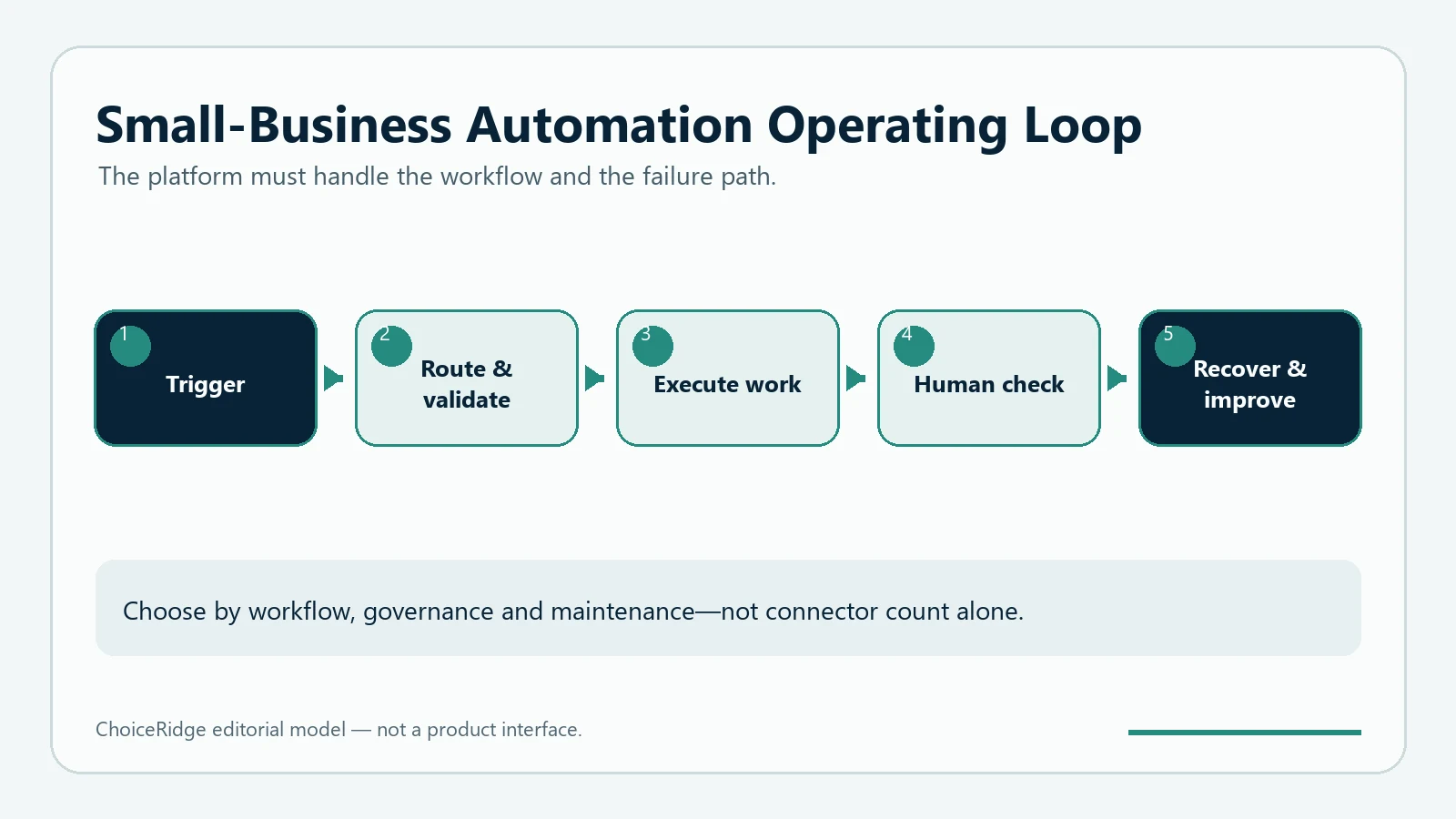
Start with low-risk, observable workflows such as notifications, enrichment, data routing, and internal updates. Avoid automating irreversible financial, fulfillment, access, or customer-data actions without validation, retries, ownership, and rollback.
Final verdict
Make is our general SMB starting point, but platform fit beats a universal winner. Zapier reduces adoption friction, n8n and Pipedream reward technical capability, and Power Automate is strongest when Microsoft and RPA requirements dominate.
Explore the complete automation library or use the Automation Tool Selector before building a shortlist.
Methodology and research limits
ChoiceRidge reviewed official pricing, product documentation, and feature descriptions available August 15, 2026. We considered billing architecture, workflow model, APIs and webhooks, code, self-hosting, desktop RPA, debugging, governance, maintenance, migration cost, and audience fit.
- No numerical scores or fabricated integration counts.
- No claim that self-hosting has zero total cost.
- No claim that provider features prove reliability or performance.
- Affiliate commission is not an inclusion or ranking criterion.
Read our Methodology, Editorial Policy, and How We Make Money.
Frequently asked questions
What should a small business automate first?
Repetitive, rules-based work with clear inputs, visible outputs, and a human recovery path.
Which platform is cheapest?
There is no defensible universal answer because billing units differ. Model your actual workflow volume and shape.
Is self-hosted n8n free?
The Community Edition has no SaaS subscription price, but infrastructure, updates, monitoring, backups, security, and staff time still cost money.