Shopify and BigCommerce solve different versions of the ecommerce problem. Shopify is a Hosted SaaS, while BigCommerce is a Hosted SaaS. The right choice depends on who owns hosting and maintenance, how payments are priced, how much commerce depth is built in, and whether design or operational control leads the decision. This comparison uses current official pricing and product documentation checked August 12, 2026. It does not claim controlled performance, conversion, SEO, uptime, or support testing.
Commercial disclosure: ChoiceRidge uses direct, non-tracked links in this comparison and currently earns no commission from them. Use-case fit, not affiliate status, determines the verdict.
Quick verdict: Shopify for ecosystem breadth; BigCommerce for native B2B and operational depth.
Choose Shopify when you need a broad merchant ecosystem, POS, and general-purpose managed commerce. Choose BigCommerce when you need B2B, multi-storefront, built-in operational features, and provider choice. Neither is universally better; the winner changes with the operating model.
Shopify vs BigCommerce at a glance
| Decision area | Shopify | BigCommerce |
|---|---|---|
| Model | Hosted SaaS | Hosted SaaS |
| Current cost signal | Localized annual prices checked: Basic €24, Grow €69, Advanced €289; Plus from €2,100 | Annual: Core $29, Growth $79, Scale $299; Performance from $1,499 |
| Payment/platform fees | Shopify Payments processing; third-party provider fee displayed at 2%, 1%, 0.6%, or 0.2% by plan | Embedded Provider fee $0; Open Provider fee 2%, 1%, or 0.6% on self-service plans |
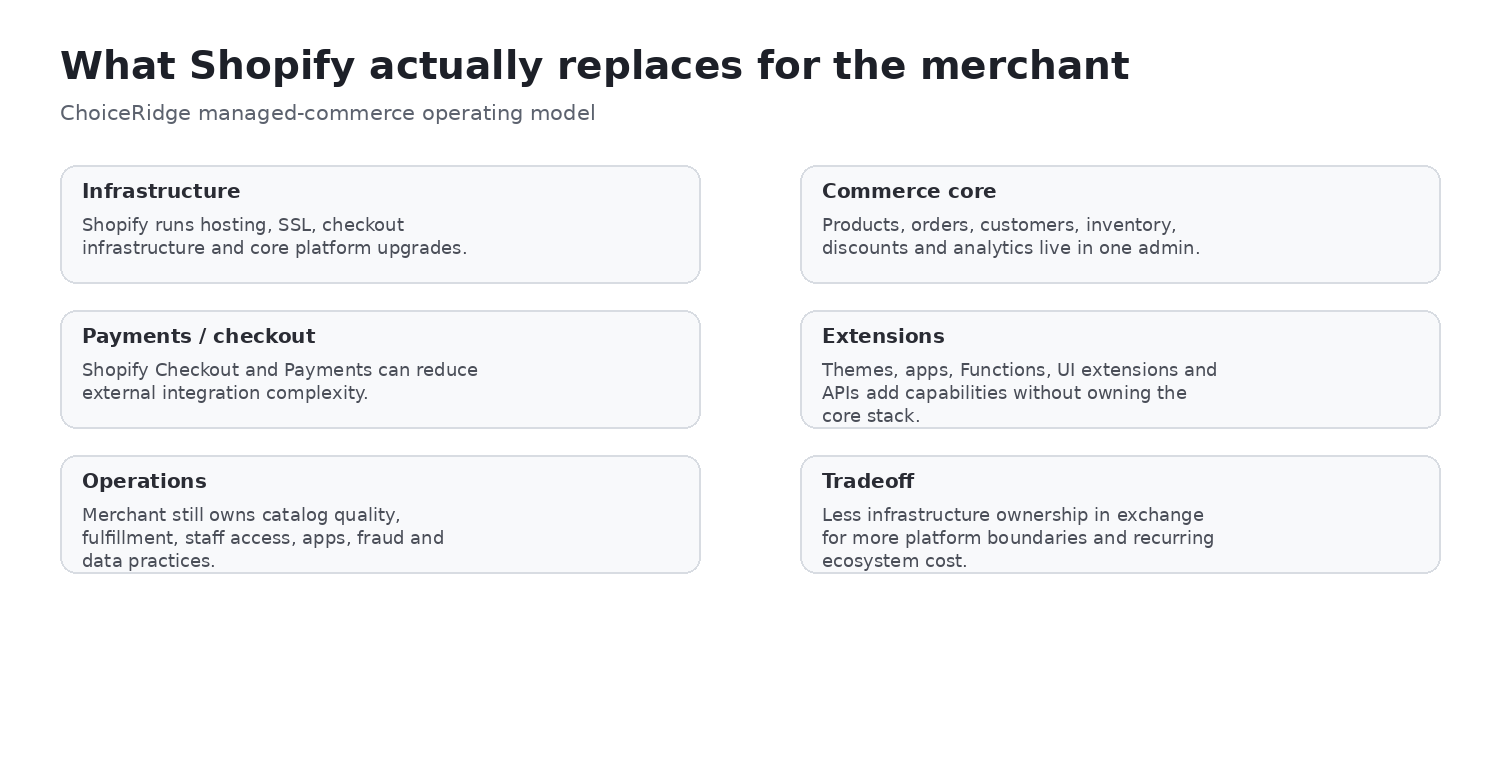
| Hosting responsibility | Managed by Shopify | Managed by BigCommerce |
| Capability emphasis | Broad app, theme, POS, channel, Markets, B2B, and API paths | Strong native B2B, multi-storefront, channels, checkout, and APIs |
| Best for | a broad merchant ecosystem, POS, and general-purpose managed commerce | B2B, multi-storefront, built-in operational features, and provider choice |
Pricing and real total cost
Shopify: Localized annual prices checked: Basic €24, Grow €69, Advanced €289; Plus from €2,100. Shopify Payments processing; third-party provider fee displayed at 2%, 1%, 0.6%, or 0.2% by plan. Add paid capabilities, implementation, design, integrations, migration, tax and shipping services, and staff time.
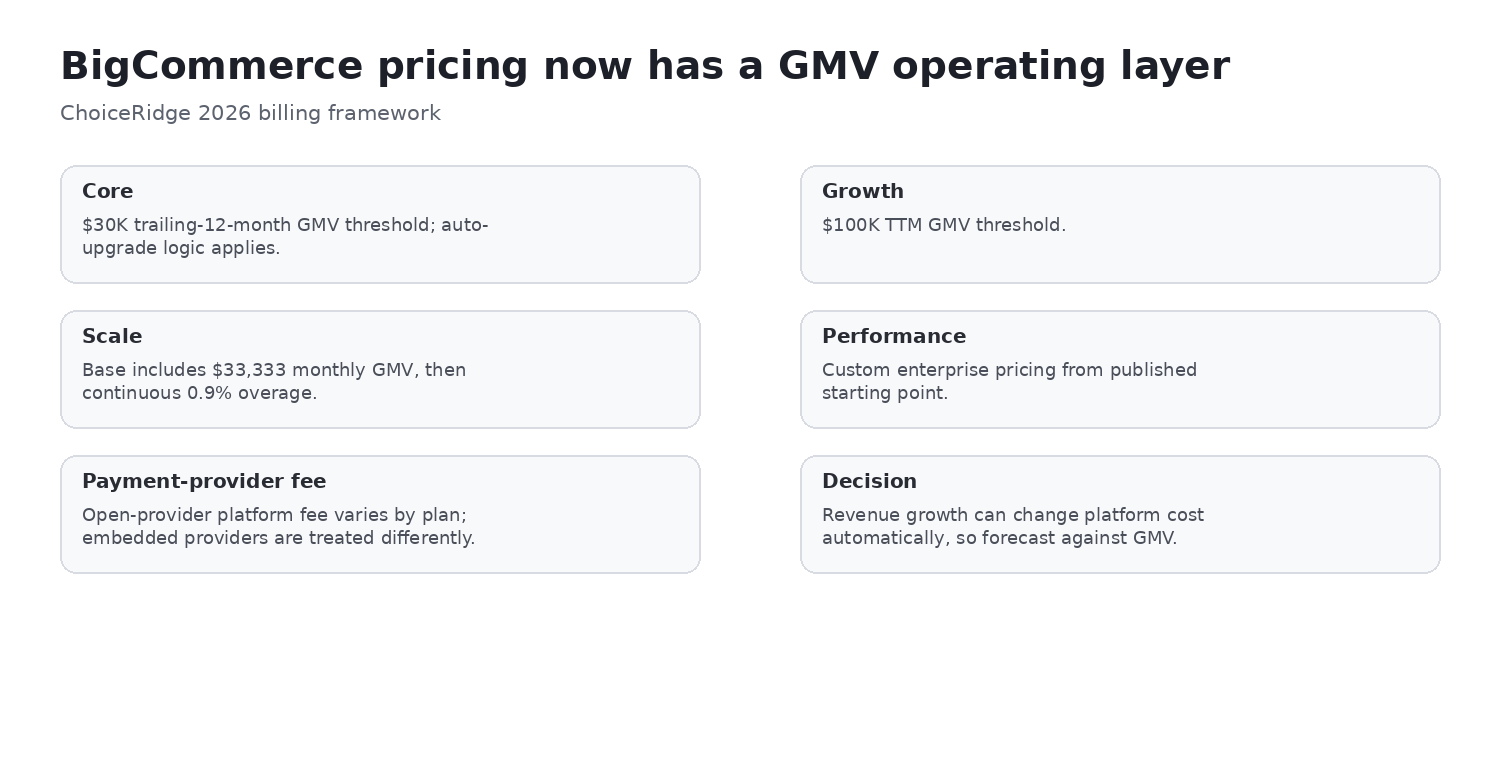
BigCommerce: Annual: Core $29, Growth $79, Scale $299; Performance from $1,499. Embedded Provider fee $0; Open Provider fee 2%, 1%, or 0.6% on self-service plans. Confirm country, currency, billing term, thresholds, renewal terms, processor availability, and every recurring add-on.
A useful three-year model includes launch and migration, subscriptions or hosting, payment mix, extensions or apps, developer and agency labor, maintenance, POS locations, international tools, and expected growth. Switching costs should include product, customer, order, URL, subscription, gift-card, review, analytics, and integration data.
Setup, design, checkout, and maintenance
Shopify emphasizes Broad app, theme, POS, channel, Markets, B2B, and API paths. BigCommerce emphasizes Strong native B2B, multi-storefront, channels, checkout, and APIs. Evaluate the daily workflow for catalog changes, inventory, promotions, refunds, fulfillment, customer service, content, and reporting—not only the storefront demo.
Payments, shipping, tax, and international selling
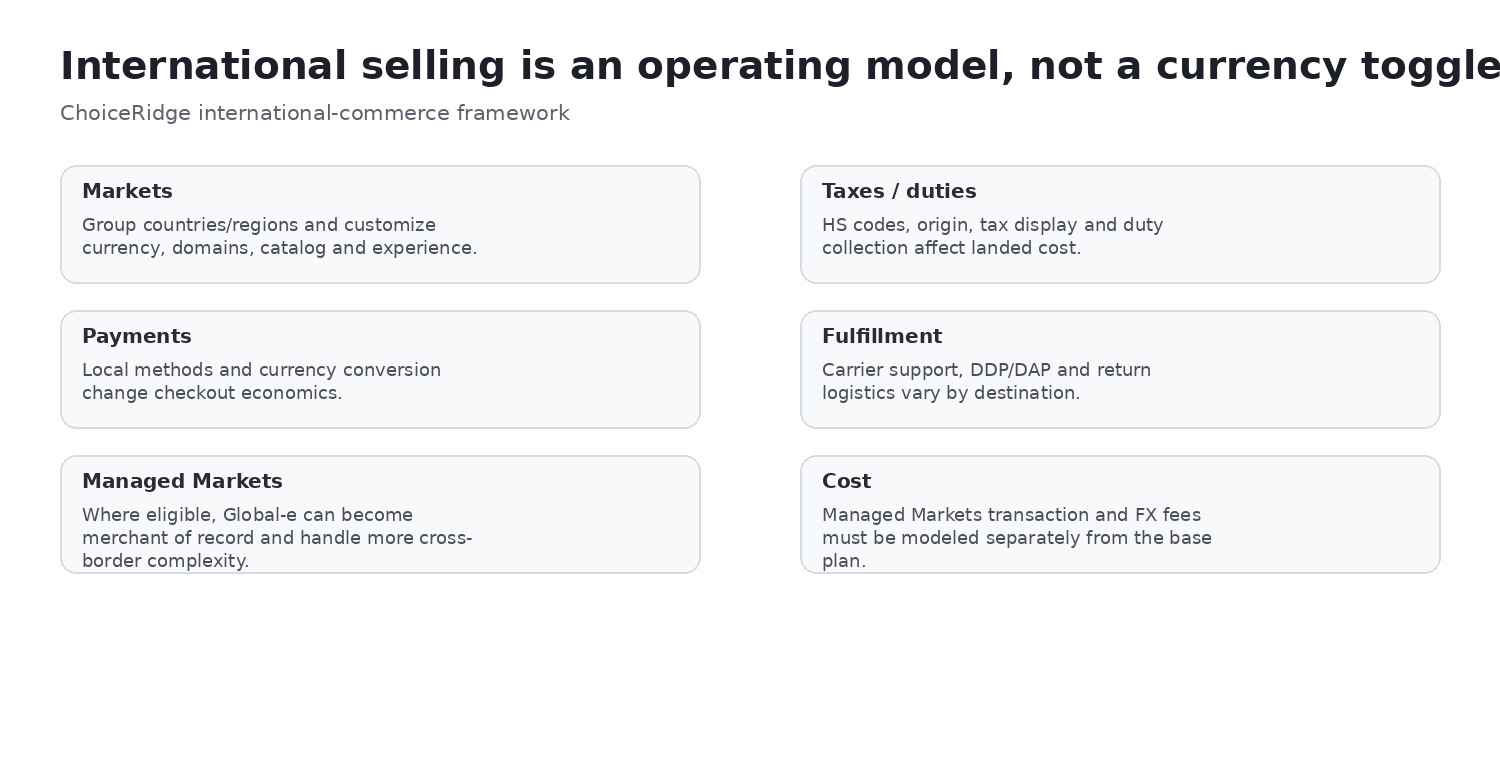
Processor fees are distinct from platform fees. Confirm cards, wallets, local methods, subscriptions, refunds, disputes, currency conversion, settlement country, tax automation, duties, shipping rates, and POS. International feature labels do not guarantee that every method or compliance workflow works in every country.
Apps, APIs, B2B, and scalability
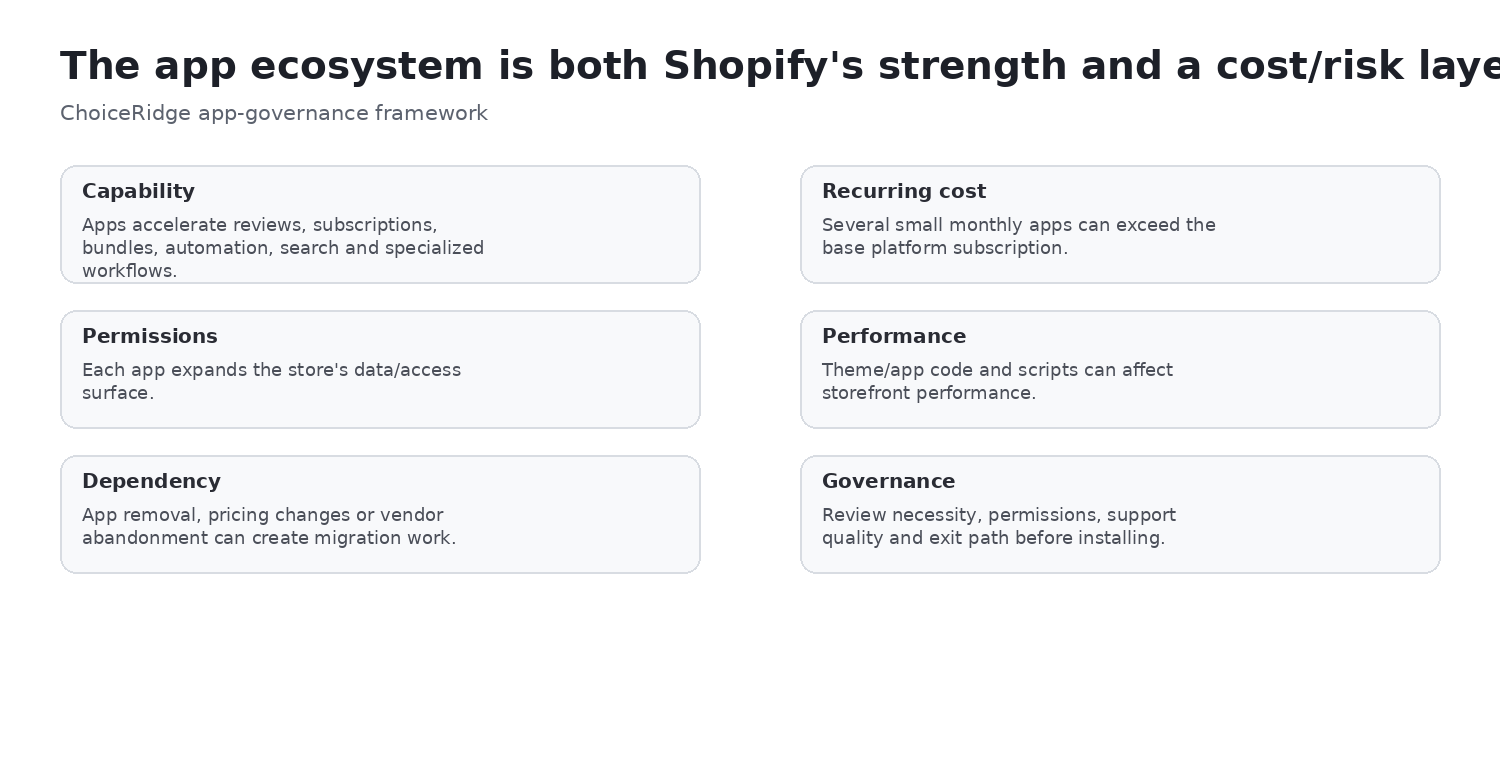
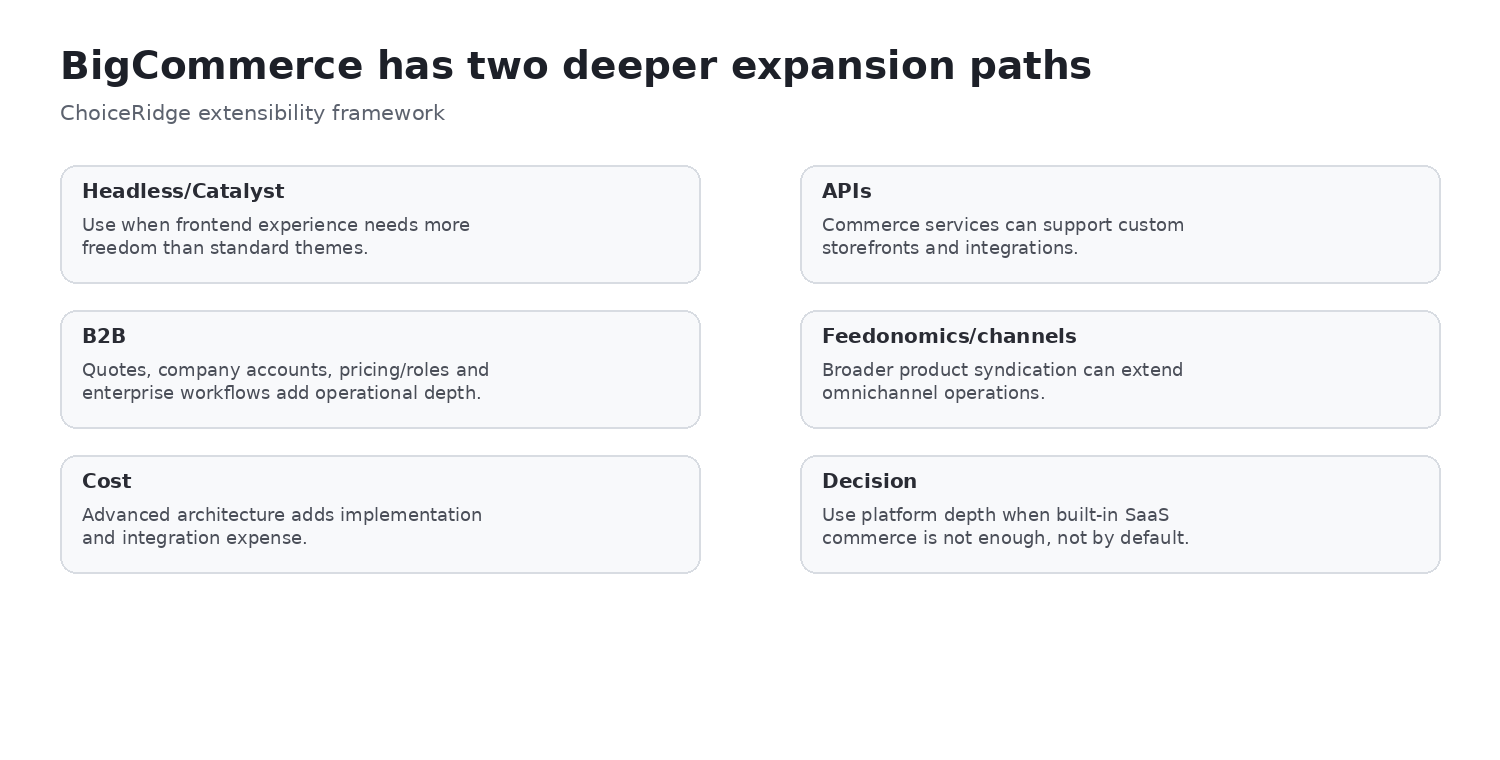
Review which requirements are native, which require an app or extension, and which require custom development. For B2B, verify company accounts, buyer roles, price lists, quotes, purchase orders, net terms, catalogs, and approval workflows. For scale, test representative catalog, checkout, integration, and administrative workloads; ChoiceRidge makes no unsupported speed claim.
Security, support, and ownership
Managed hosting reduces infrastructure work but does not remove responsibility for accounts, permissions, app access, fraud, customer data, exports, and incident plans. Self-managed software adds patching, compatibility, monitoring, backups, and recovery. Define which vendor or team owns each failure mode before selecting a platform.
Which platform should you choose?
Choose Shopify
a broad merchant ecosystem, POS, and general-purpose managed commerce.
Choose BigCommerce
B2B, multi-storefront, built-in operational features, and provider choice.
Run a proof of concept
When subscriptions, B2B, international tax, complex variants, custom checkout, multistore, or legacy integrations are critical.
Migration questions
Inventory every product type, variant, customer, historic order, URL, redirect, content page, subscription, gift card, tax rule, shipping rule, payment token, review, analytics event, and external integration. Confirm what can be exported, imported, recreated, or cannot legally or technically move.
Decision visuals
Additional decision questions
Which has more apps?
Shopify is generally ecosystem-led; app count alone does not prove fit.
Does BigCommerce charge transaction fees?
Processor costs always apply; current Open-provider fees depend on plan and configuration.
Which is better for B2B?
BigCommerce deserves strong consideration for native B2B paths; exact editions and contracts matter.
Which is better headless?
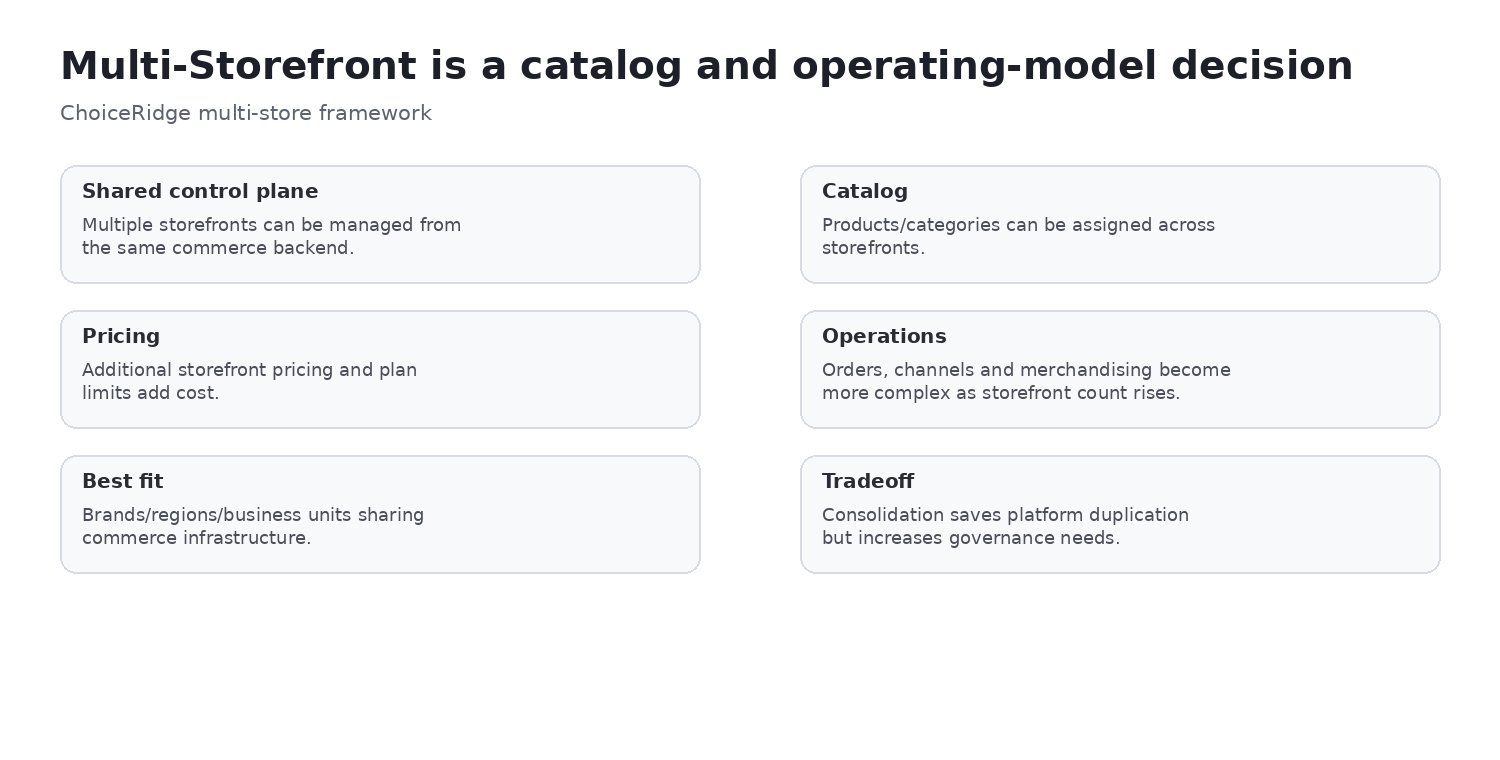
Both have headless paths; developer workflow and operational ownership should decide.
How does GMV affect the choice?
BigCommerce publishes GMV boundaries that can influence plan or overage economics.
Migration and proof-of-concept checklist
Test catalog, customer, order, promotion and URL mapping; rebuild apps and feeds; validate processor and settlement changes; rehearse webhooks and ERP integrations; define a rollback boundary.
Final verdict
Shopify for ecosystem breadth; BigCommerce for native B2B and operational depth. Select Shopify for a broad merchant ecosystem, POS, and general-purpose managed commerce; select BigCommerce for B2B, multi-storefront, built-in operational features, and provider choice. Price and test the whole operating model before committing.
Read the full Shopify review and BigCommerce review, explore the ecommerce platform library, or model add-ons with the Ecommerce App Cost Calculator.
Methodology and research limits
ChoiceRidge checked current official plan, pricing, payment, product, and support documentation for both platforms on August 12, 2026. This is document-based comparison, not a controlled benchmark or mystery-shopping test. No numerical rating is published.
Read our Methodology, Editorial Policy, and How We Make Money.
Frequently asked questions
Which is easier to operate?
The platform with fewer responsibilities for your team is easier in practice. Compare hosting, updates, integrations, and daily store workflows.
Which is cheaper?
It depends on revenue, payment mix, apps, hosting, labor, and required features. Subscription price alone cannot answer it.
Which is better for SEO?
Neither is automatically better. Implementation, content, crawlability, performance, links, and competition determine outcomes.
Should I migrate immediately?
No. Run a representative proof of concept and map data and integration constraints first.