Shopify is a managed commerce platform for teams that prefer a unified storefront, checkout, catalog, payments, channels and operational ecosystem over running their own commerce infrastructure. Its strongest advantage is reducing platform operations; its biggest purchasing risk is treating the subscription as the total cost. This research-based review checks official product documentation and public interface evidence, but does not claim hands-on store ownership, controlled performance testing or conversion testing.
Affiliate disclosure: Shopify operates an affiliate program for eligible referrals. The Shopify links in this review are direct, non-tracked official links, and ChoiceRidge does not currently earn a commission from them. Affiliate availability does not affect the verdict.
Quick verdict: the strongest general-purpose managed commerce operating system — if ecosystem cost fits your margins
Shopify’s biggest advantage is not any single theme, payment method or feature. It is the reduction in operational fragmentation. Hosting, checkout, products, orders, inventory, analytics, channels, apps and payments can live inside one managed platform. That makes Shopify a strong default for merchants who want to operate commerce rather than operate commerce infrastructure. The tradeoff is platform dependency and a total cost that can grow through payment economics, apps, POS, international tools and development.
- Best fit: merchants that want a hosted operating system for commerce rather than a server stack.
- Main strength: broad coverage across storefront, checkout, channels, POS, Markets, apps and partner services.
- Main caution: important costs and capabilities vary by plan, payment setup, country and contract.
- Rating: no numerical score is published because ChoiceRidge did not run a controlled live-store benchmark.
Pricing: the right plan is a sales-volume and operating-model decision
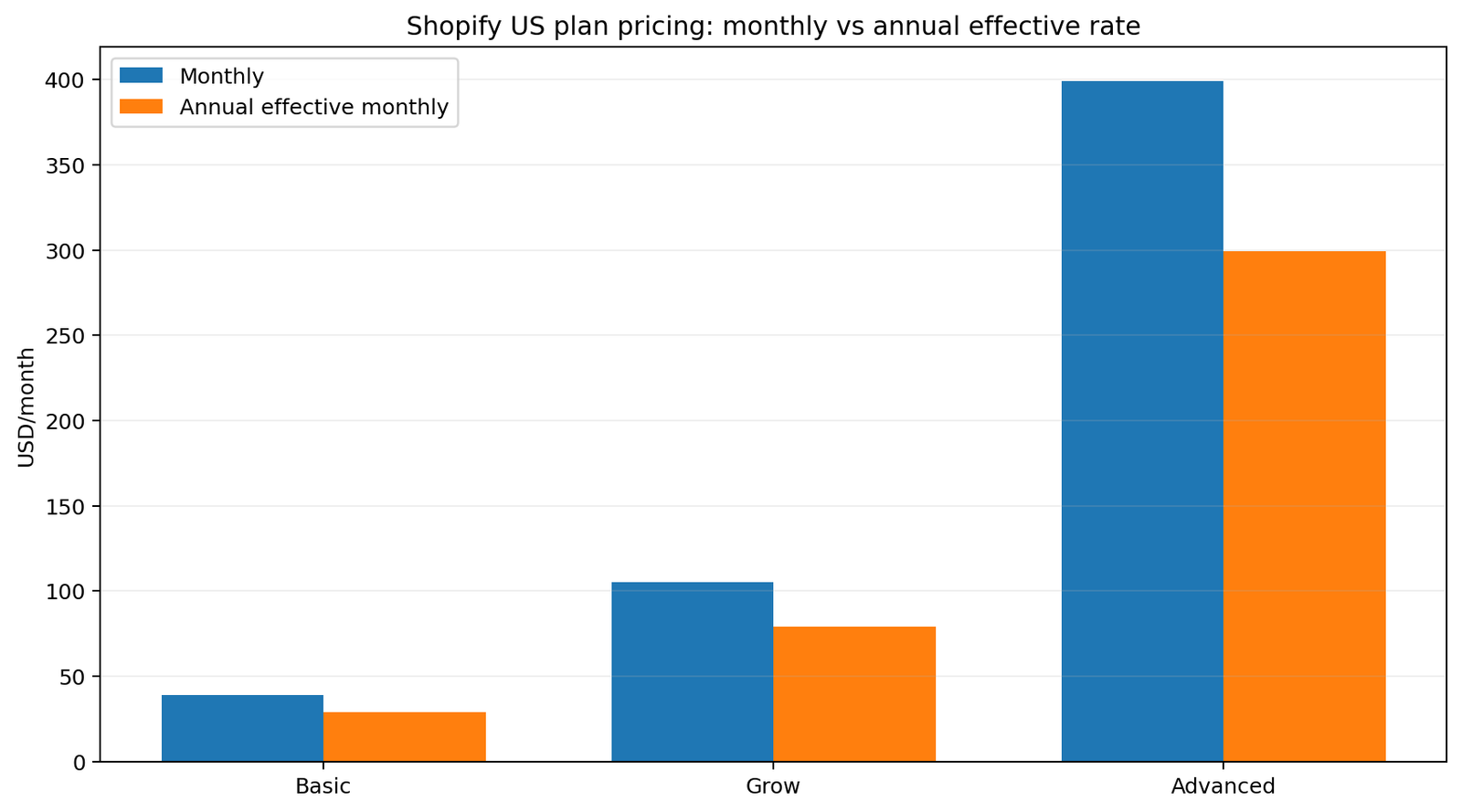
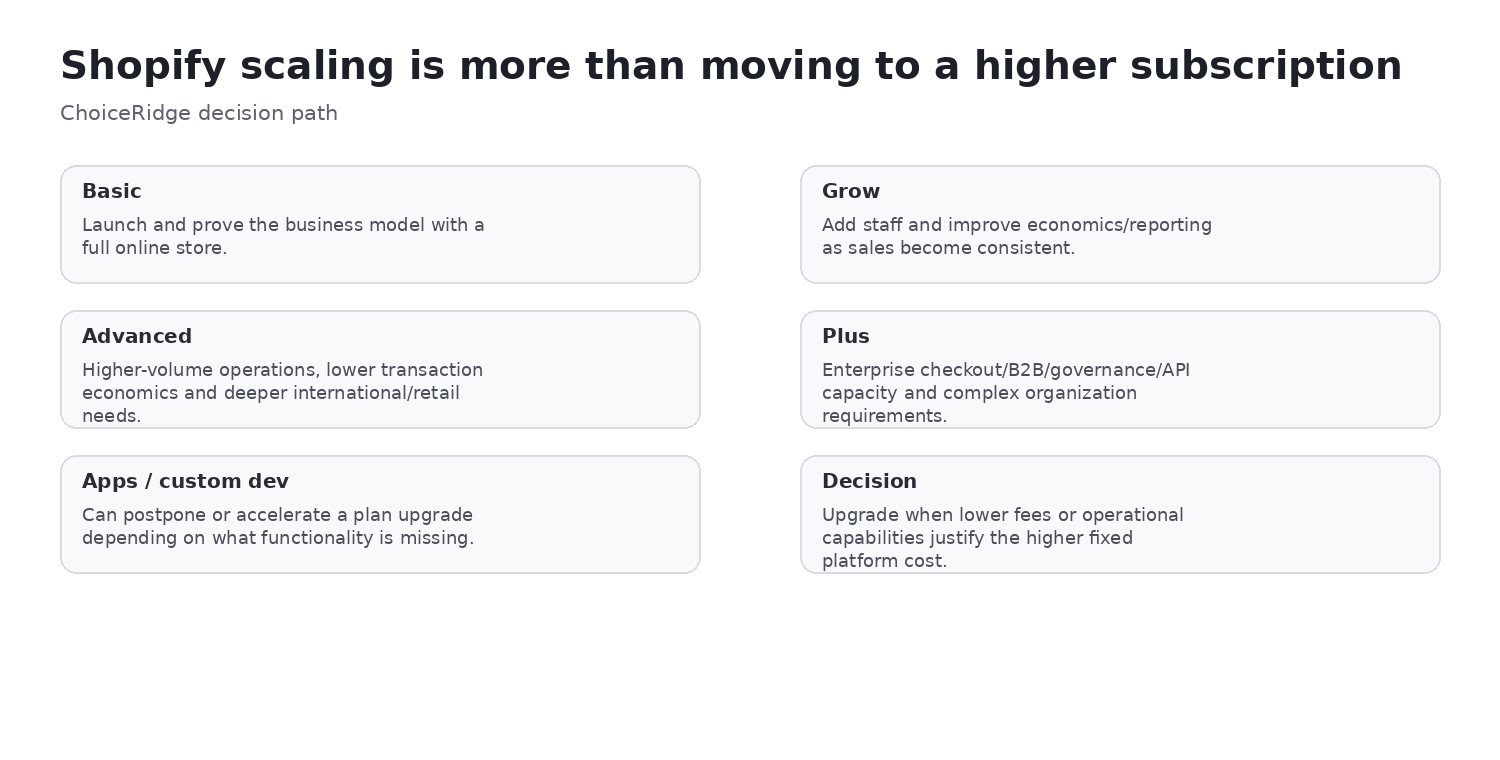
The current US reference supplied for this review is Basic at $39 monthly or $29 per month billed annually, Grow at $105 or $79, and Advanced at $399 or $299. Shopify localizes prices, currency, taxes, included features and payment rates. Always open the pricing page in the country where the store will contract and operate.
| Plan | US monthly | US annual equivalent | Team / operating fit | Important boundary |
|---|---|---|---|---|
| Basic | $39 | $29/month | Founder-led and early stores | No additional staff accounts; highest listed third-party transaction fee |
| Grow | $105 | $79/month | Small commerce teams | Five staff accounts and lower third-party transaction fee |
| Advanced | $399 | $299/month | Larger international operations | Fifteen staff accounts and up to 2x selected API capacity |
| Plus | $2,500 on one-year term; $2,300 on three-year term | Contract pricing | Complex organizations, B2B and checkout control | Variable platform fee may apply; verify contract and expansion stores |
A localized euro page observed by ChoiceRidge on August 12, 2026 displayed €24 for Basic, €69 for Grow and €289 for Advanced with annual billing. That observation is useful evidence of localization, not a universal rate and not a substitute for the live price in the buyer’s market.
Plan comparison: what changes
| Capability | Basic | Grow | Advanced | Plus |
|---|---|---|---|---|
| Additional staff accounts | 0 | 5 | 15 | Unlimited |
| Inventory locations | 10 | 10 | 10 | 200 |
| Listed third-party transaction fee | 2% | 1% | 0.6% | 0.2% when applicable |
| B2B catalogs | Up to 3 | Up to 3 | Up to 3 | Unlimited and broader B2B controls |
| Checkout customization | Standard limits | Standard limits | Standard limits | Full checkout extensibility subject to platform rules |
| Selected API capacity | Limited data access | Full standard access | Up to 2x | Up to 10x |
When does an upgrade pay for itself?
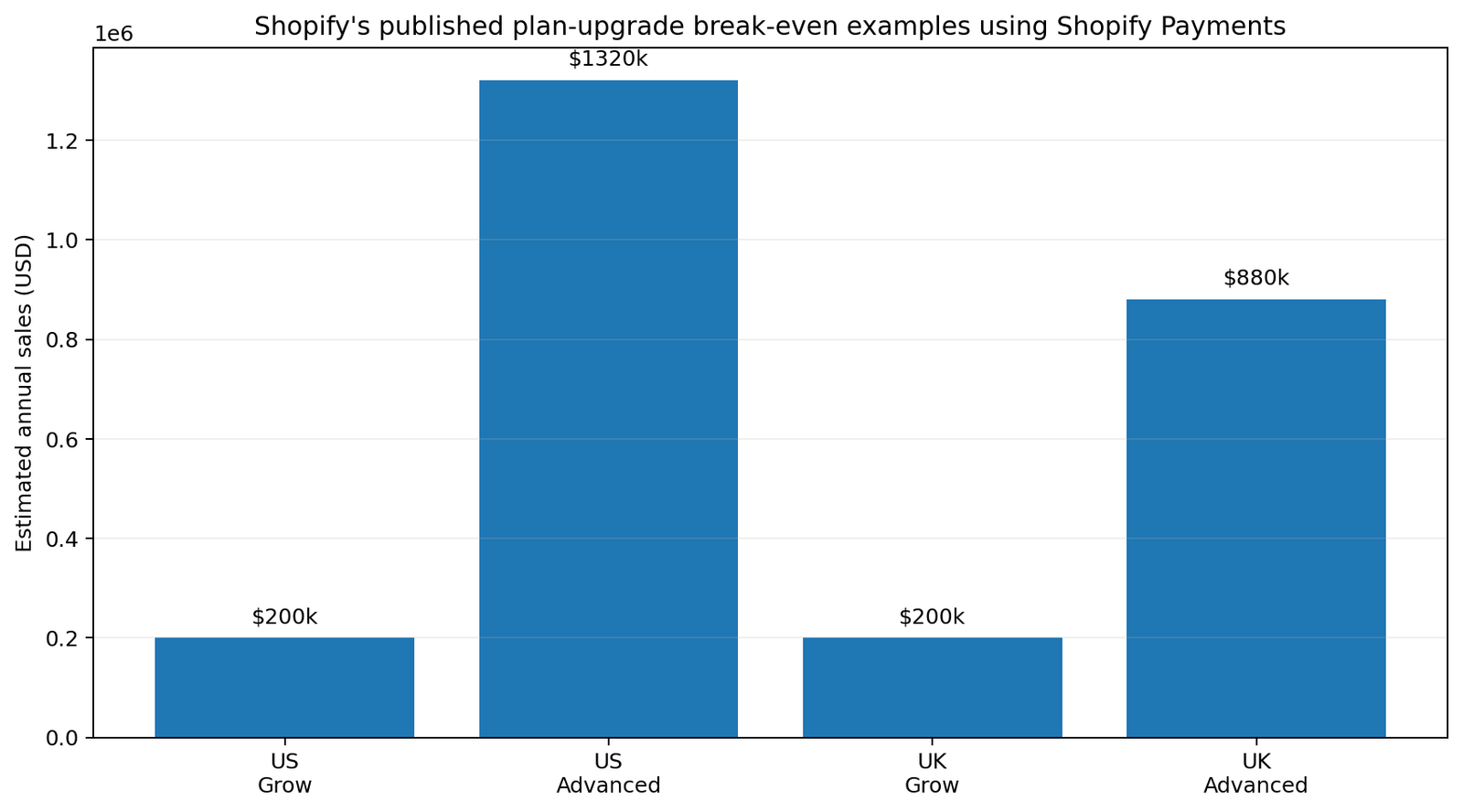
Do not upgrade because a plan label sounds more professional. Compare the incremental subscription against lower transaction or card rates, staff needs, reporting, shipping, Markets requirements and the cost of workarounds. Shopify publishes break-even examples, but they are illustrative—not guarantees for a store’s order mix.
Payments and transaction fees: subscription price is only the first layer
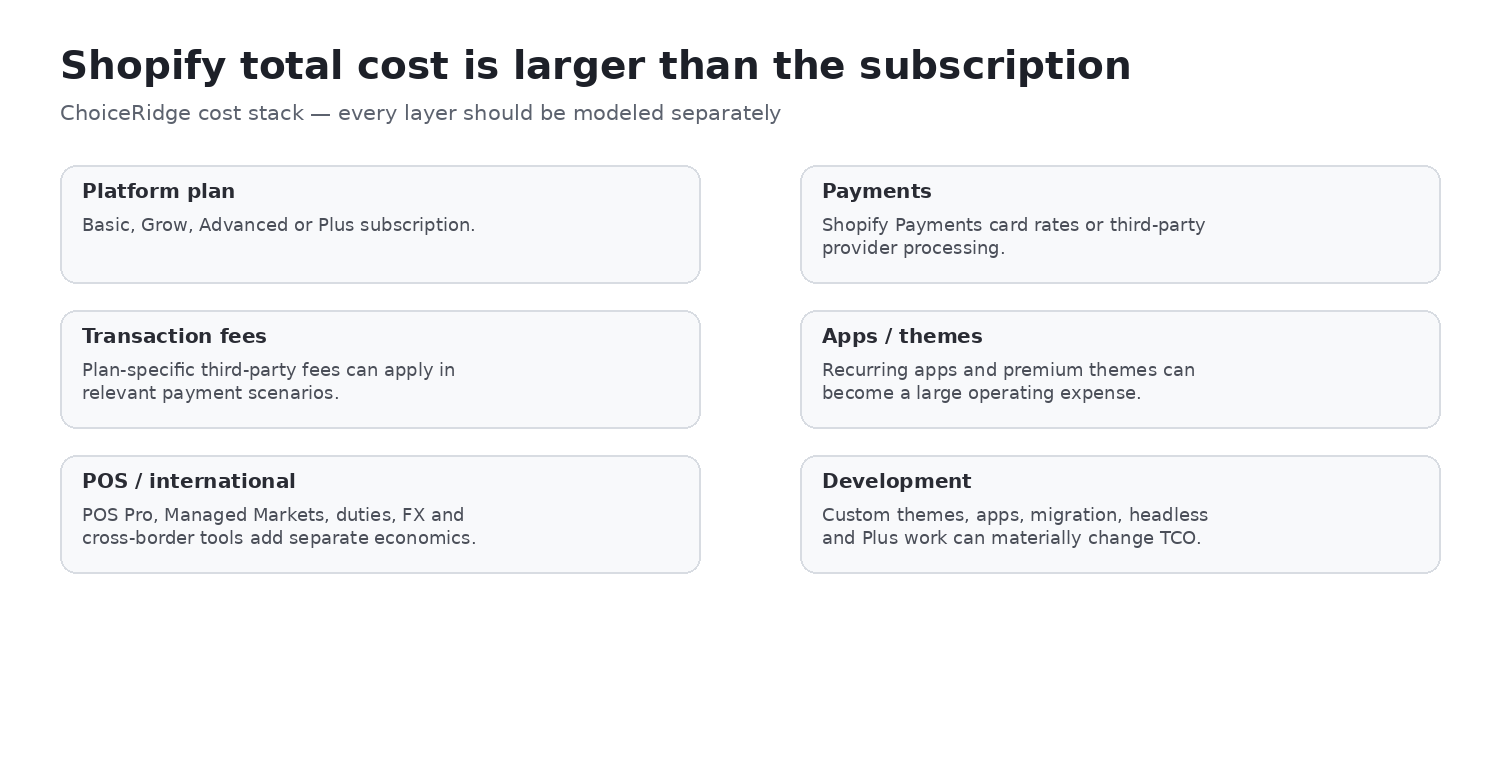
Shopify cost discussions often collapse different charges into one percentage. Keep these layers separate:
- Platform subscription: Basic, Grow, Advanced or Plus.
- Payment processing: Shopify Payments or an external processor; rate depends on country, method and plan.
- Third-party transaction fee: Shopify’s additional plan-specific fee when an external gateway is primary in applicable circumstances.
- International and currency costs: cross-border cards, conversion and settlement can add charges.
- Managed Markets: its transaction and FX fees are separate from payment processing.
- Operational additions: apps, themes, POS Pro, tax services, domains, development and agency support.
Shopify Payments is not universally available and is not mandatory in every supported configuration. When it is available and used as the primary provider, Shopify says the extra third-party transaction fee does not apply to eligible orders. Processor charges still apply. Refund, dispute and alternative-payment treatment should be checked for the merchant’s country.
Total cost of ownership
A realistic model is: platform + payment processing + extra transaction fees + apps/themes + POS/international services + development and operations. Include migration, integrations, translations, analytics, accessibility work, tax configuration, data retention and staff time. A cheap base plan with many recurring apps can cost more than a higher plan or a competing platform with more native functions.
The managed commerce operating model
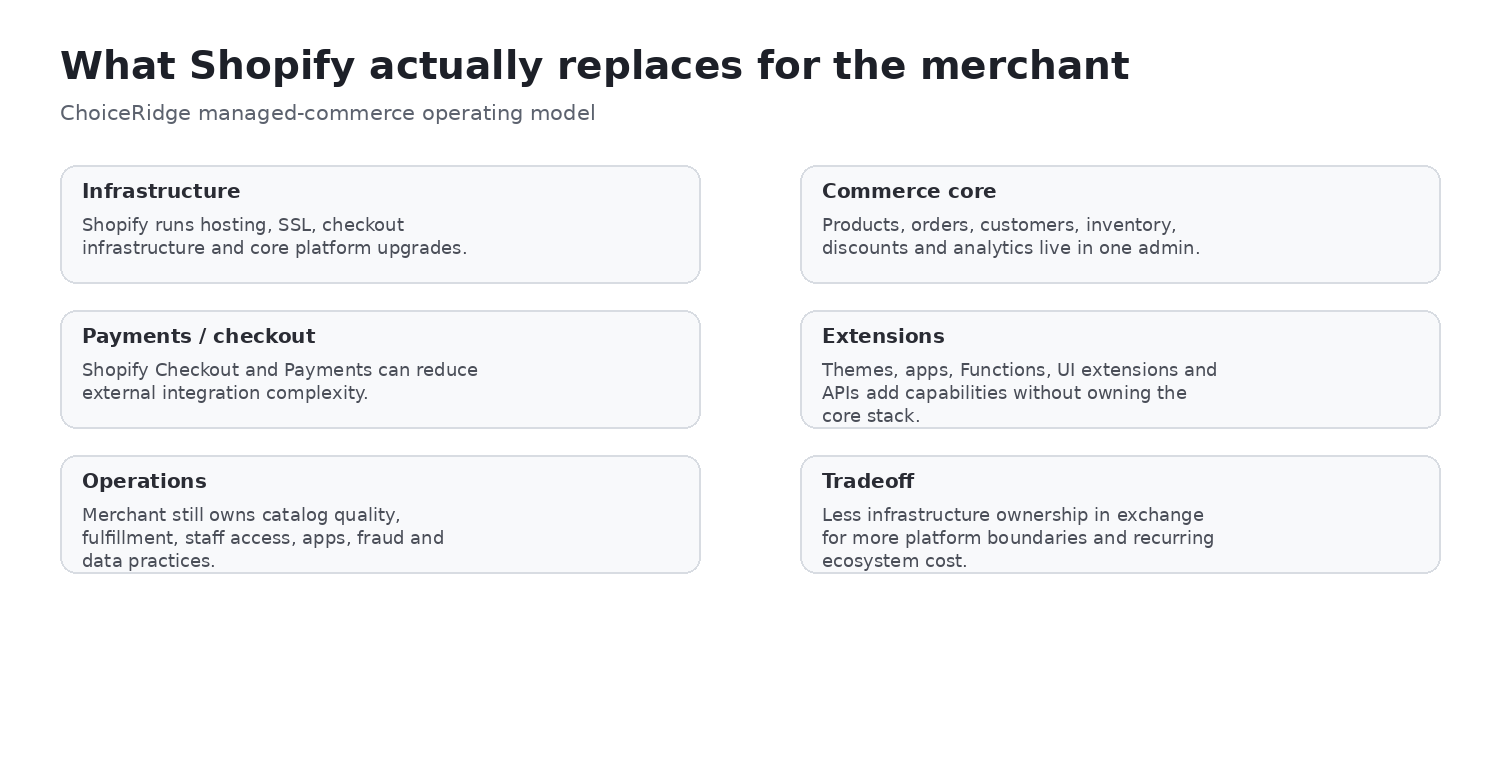
Shopify hosts the application, storefront delivery and core checkout platform. Merchants avoid patching a commerce server, but still own product data, merchandising, user permissions, app governance, domain and email configuration, fraud decisions, compliance inputs, exports and recovery planning. SaaS convenience transfers infrastructure work; it does not transfer business accountability.
Admin, products and inventory
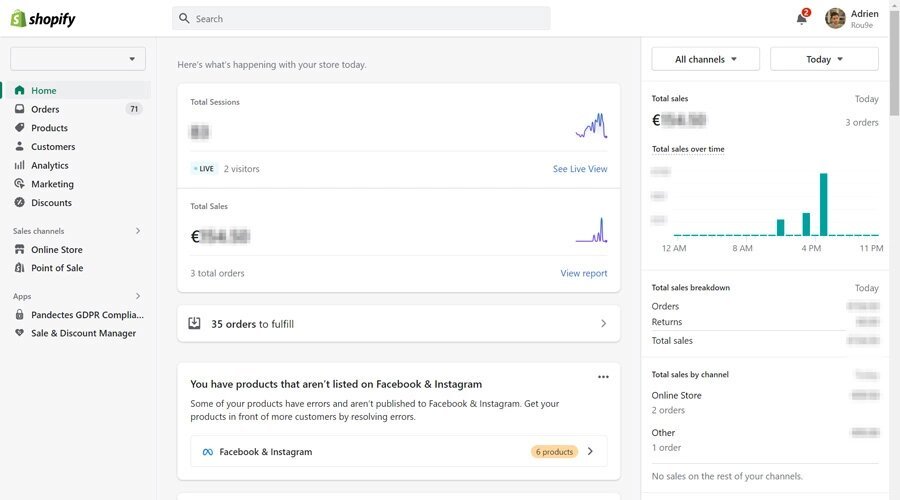
The admin organizes orders, products, customers, analytics, marketing, discounts, settings and sales channels. Its broad navigation is an advantage for teams standardizing daily work, but the real implementation burden sits in catalog structure, roles, app permissions and process design.
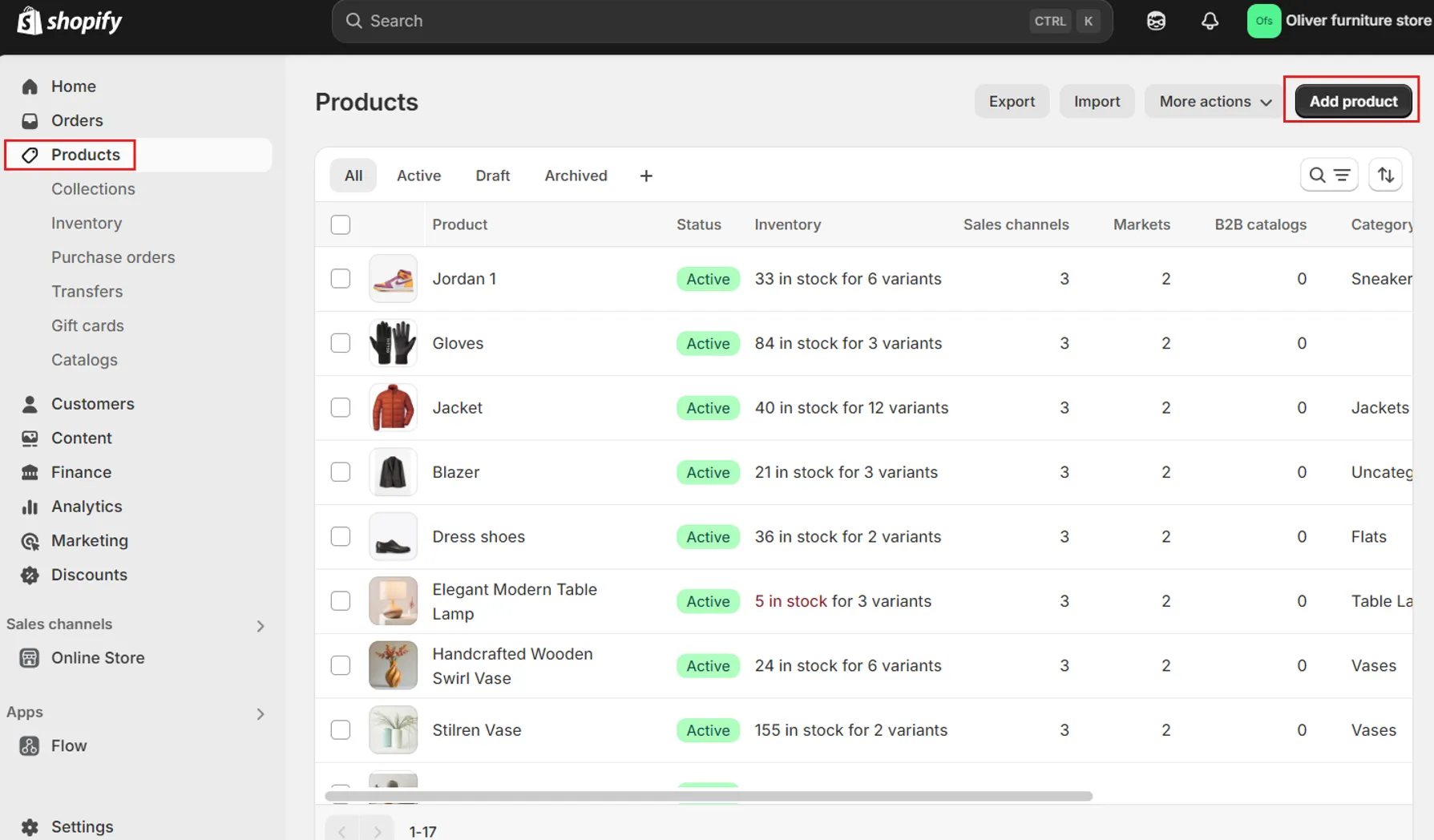
Products can carry variants, media, pricing, inventory, channel availability and market context. Before migration, test variant limits, bundles, subscriptions, metafields, multi-location stock, returns and ERP synchronization against the actual catalog—not only a demo product.
Themes and storefront design

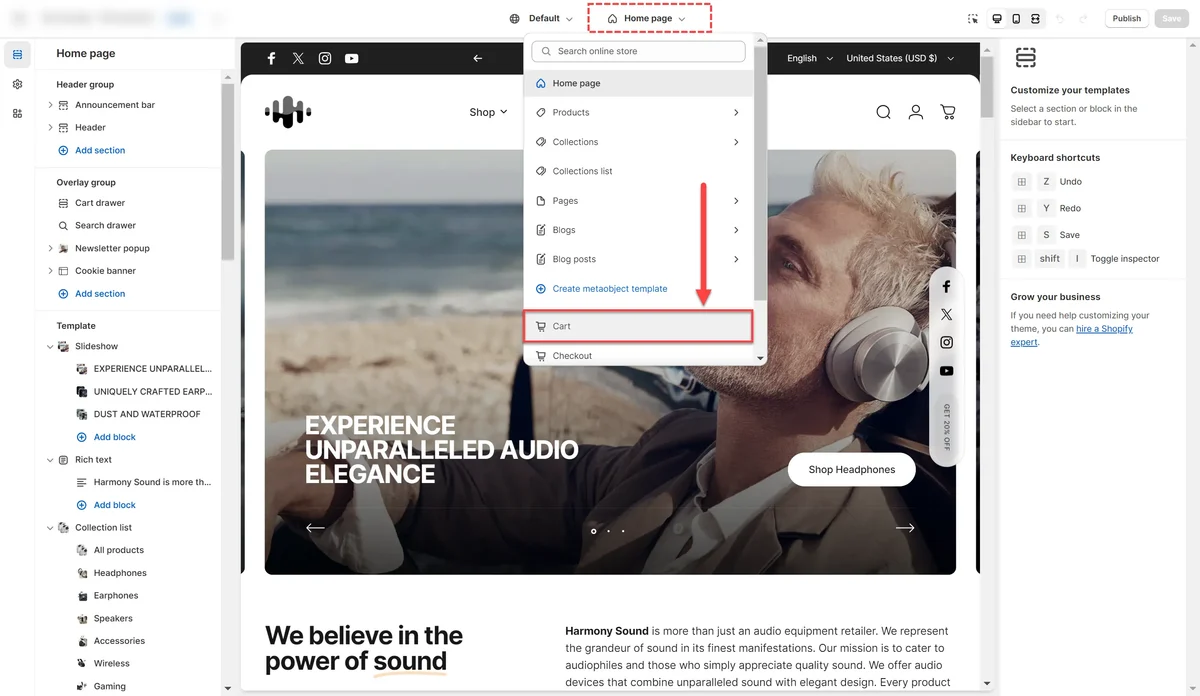
Online Store themes provide sections and blocks for merchant editing. Premium themes, custom Liquid work and app embeds can extend the design, but every addition increases maintenance and performance risk. Confirm accessibility, Core Web Vitals, structured data and upgrade compatibility in the real theme stack.
Checkout extensibility: upgrade-safe extension points with plan boundaries
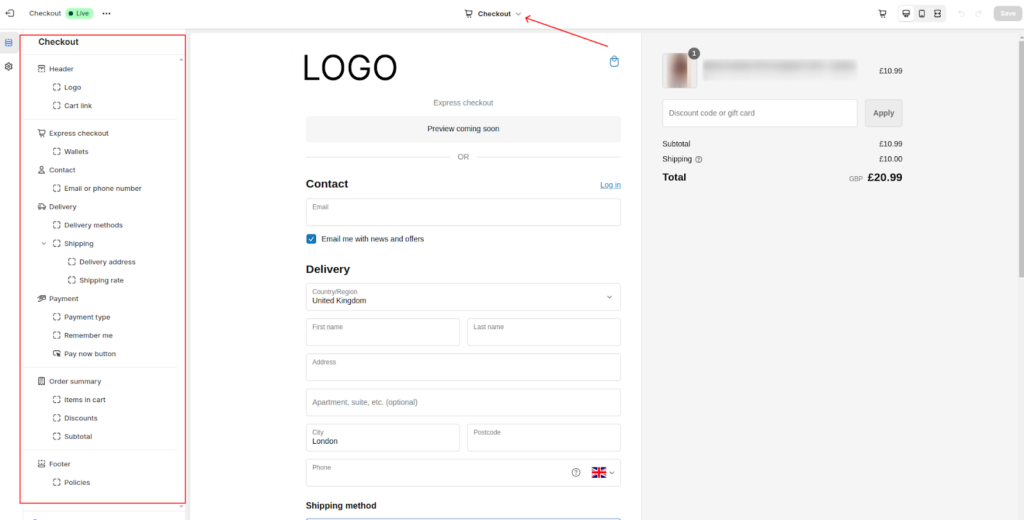
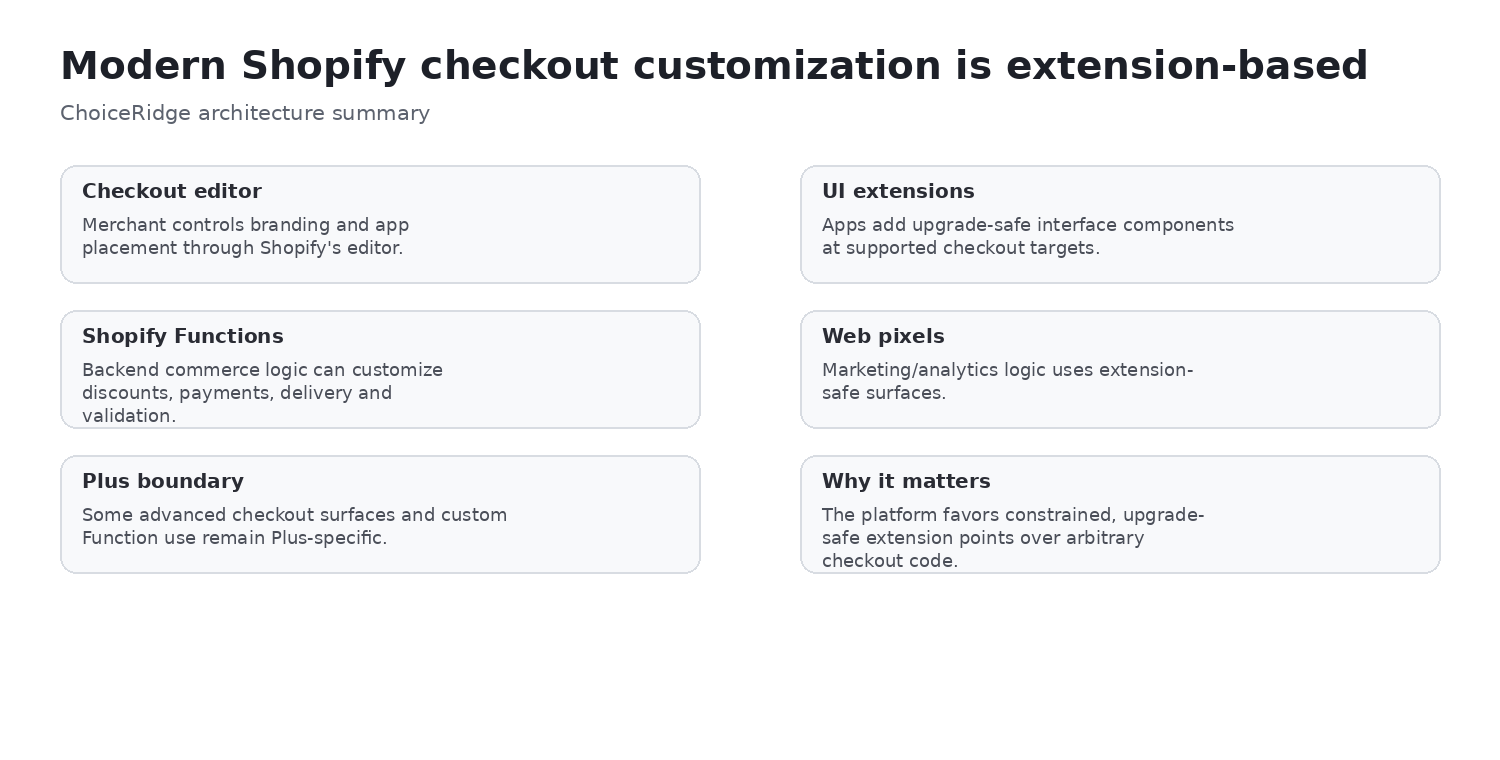
Standard plans can configure supported checkout settings and apps, but the deepest checkout customization is a Plus-level capability. Shopify’s current direction is extension-based: Checkout UI extensions and supported APIs replace unsupported direct template modification. Evaluate whether the required change is allowed on the target page, plan and surface.
Shopify Functions: powerful, but bounded
Shopify Functions can extend selected backend logic such as discounts, delivery or payment customization through supported APIs. They are not a general-purpose replacement for arbitrary server code. Confirm the Function API, plan requirement, execution constraints and deployment ownership for every proposed use case.
The app ecosystem is a competitive moat — and a dependency layer
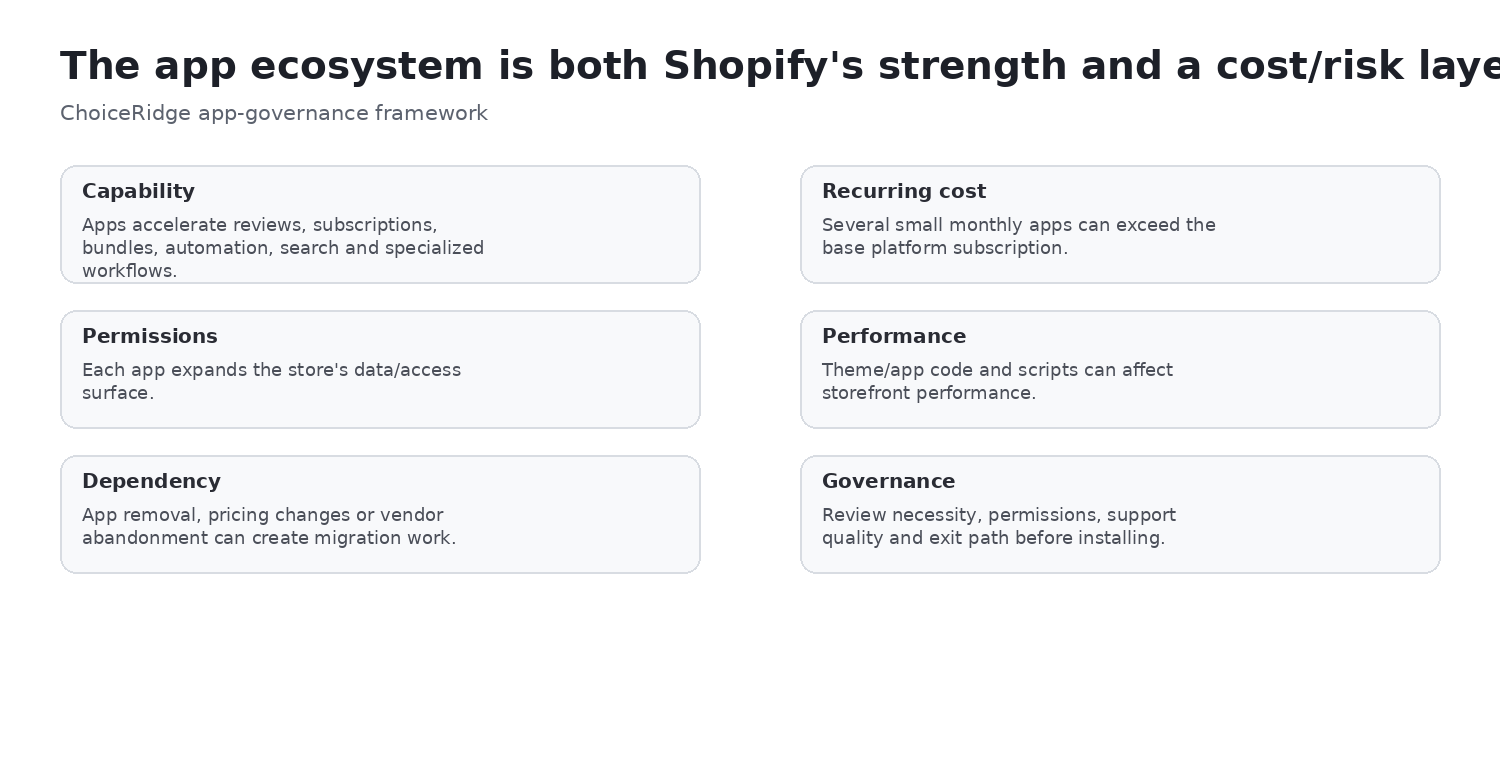
The App Store is one of Shopify’s largest advantages: reviews, subscriptions, loyalty, search, feeds, returns, B2B and operations can be added quickly. The same convenience creates recurring cost, permission, data, support, overlap and uninstall-risk concerns. Maintain an app register with owner, purpose, permissions, data processed, monthly cost, renewal, replacement path and removal test.
Markets: international commerce goes far beyond currency conversion
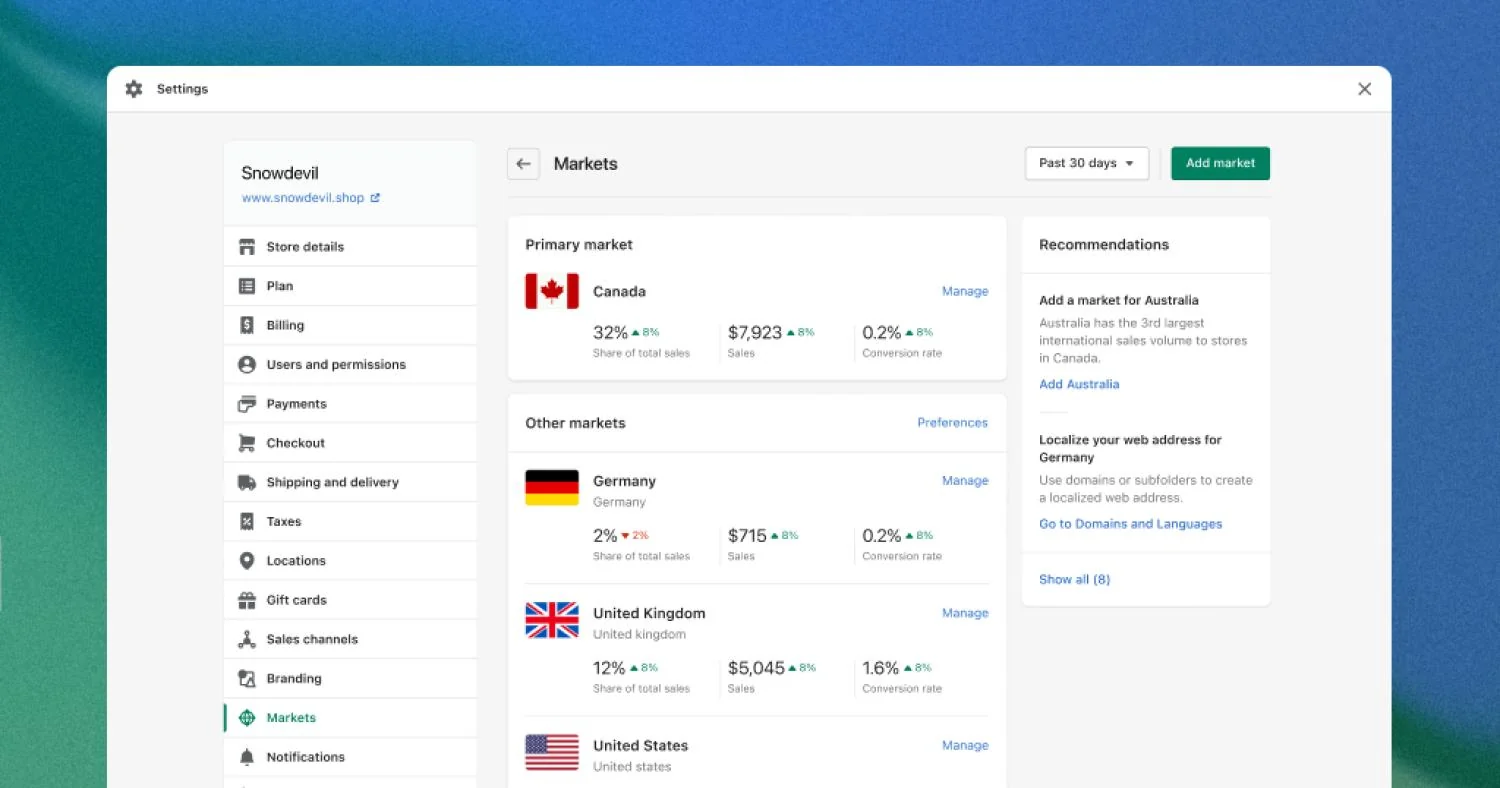
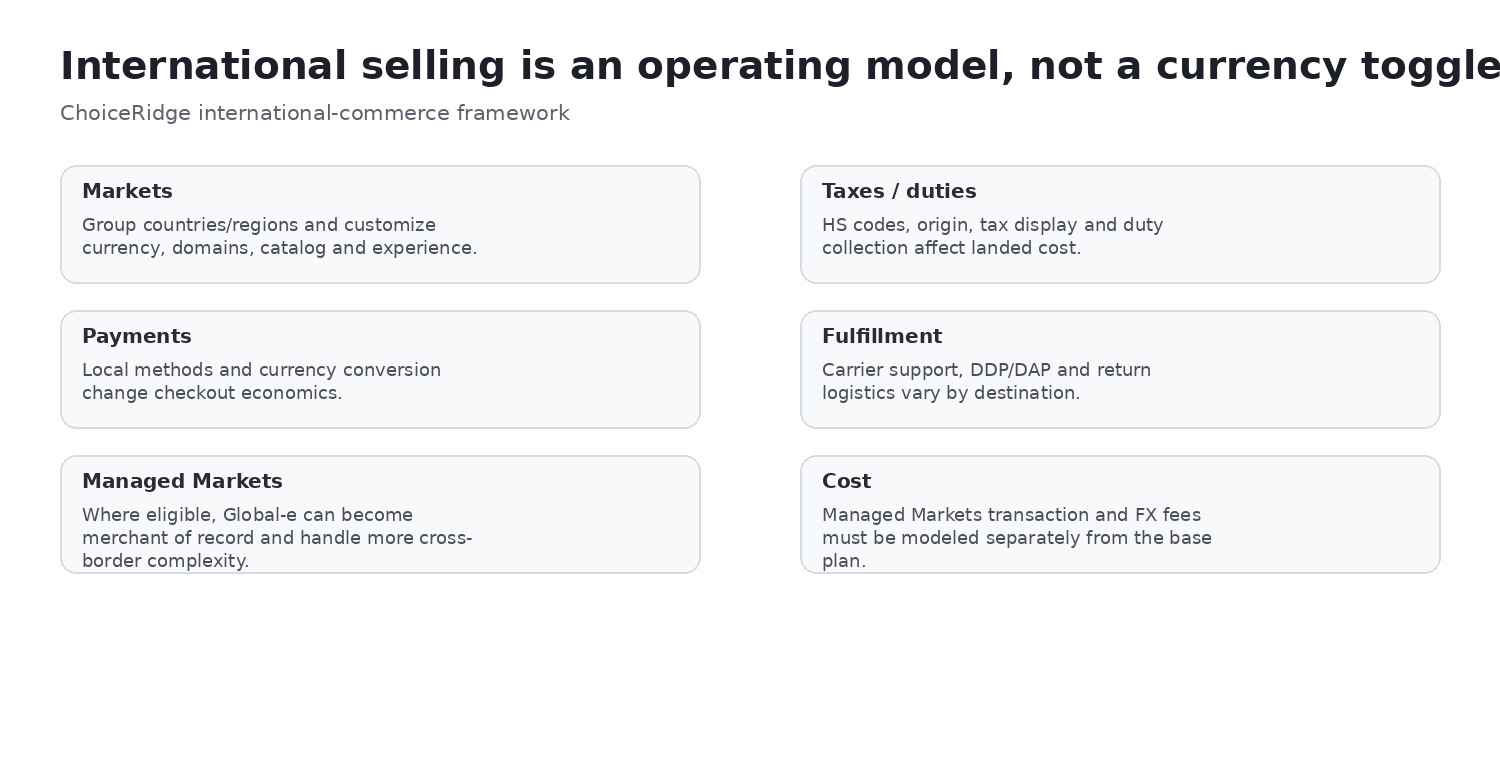
Markets helps group countries or regions and manage localized domains, languages, currencies, catalogs and market presentation. Availability differs by feature, country and plan. International readiness also depends on payments, tax registration, duties, product restrictions, privacy, customer service and fulfillment—configuration alone does not create compliance.
Managed Markets
Managed Markets uses Global-e as merchant of record for eligible cross-border orders. Shopify currently lists a 3.5% transaction fee for Basic, Grow and Advanced, 3.25% for Plus, and a 1.5% FX fee; Shopify Payments processing is separate. Eligibility, supported countries, excluded products, remittance and operational responsibilities must be reviewed before adoption.
Orders, inventory, fulfillment and POS: Shopify is strongest when commerce operations stay in one system
Order routing, returns, split fulfillment, inventory transfers, subscriptions, preorders and multi-location availability should be tested as end-to-end scenarios. Shopify lists ten inventory locations for Basic through Advanced and 200 for Plus. Those numbers do not prove that every warehouse or ERP workflow fits without apps or integration work.
Shopify POS connects retail and online commerce. POS Pro is priced per location and varies by market; current Plus terms include allowances that should be confirmed in the contract. Budget hardware, connectivity, payment rates, staff training, offline procedures, returns and reconciliation—not only the software add-on.
Analytics: built-in decision support is becoming deeper
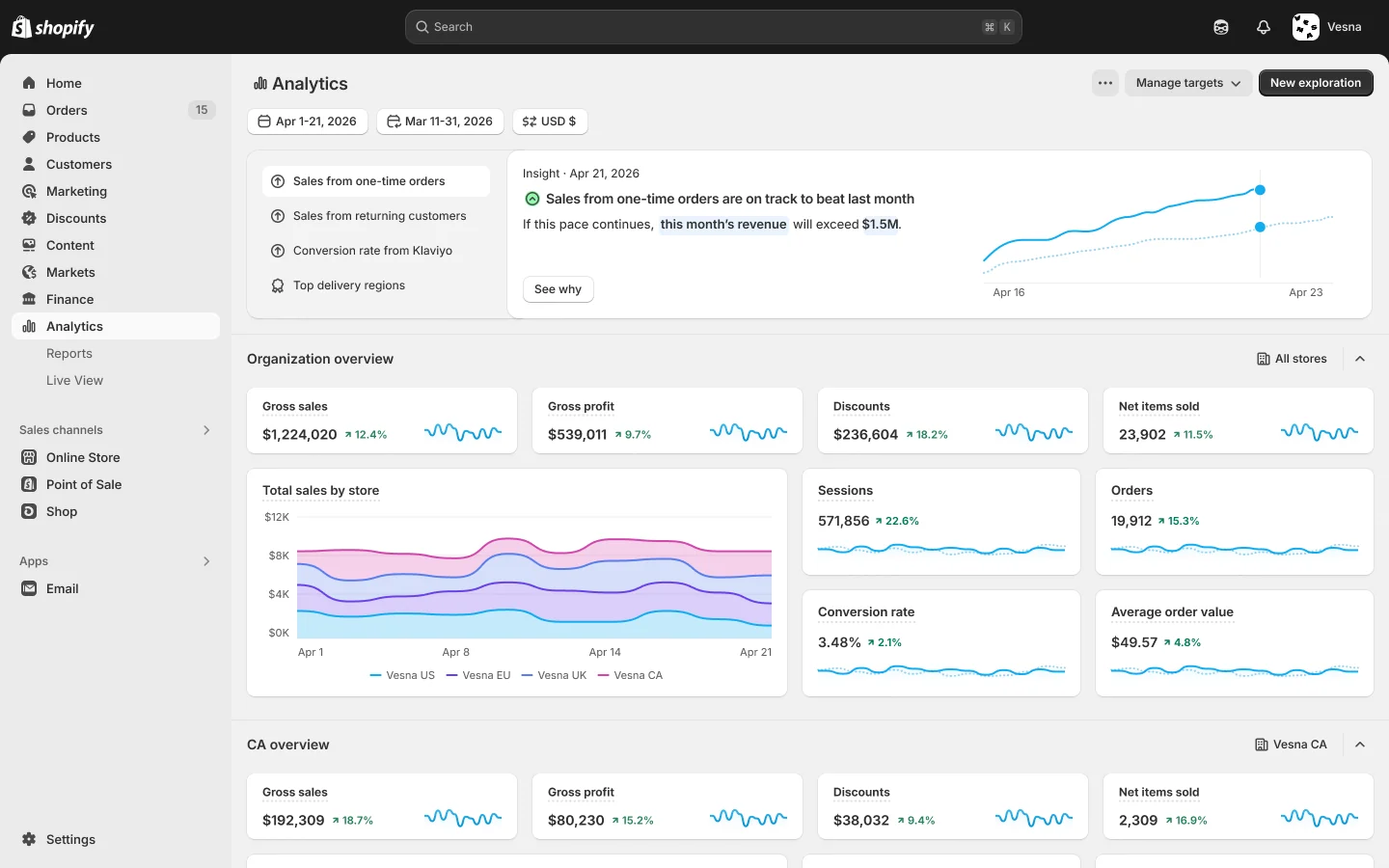
Shopify Analytics covers core commerce reporting and Shopify continues to evolve its reporting interface. Validate attribution, profit inputs, custom metrics, export/API needs, retention and reconciliation against the finance and analytics stack. A dashboard is useful evidence of interface capability; it is not proof that every metric is complete or decision-ready.
Shopify Plus, B2B and scaling: not simply “Advanced with more capacity”
Current pricing materials show up to three B2B catalogs on Basic, Grow and Advanced, while Plus provides broader native B2B controls and unlimited catalogs. Teams should still test company accounts, price lists, payment terms, approvals, tax exemptions, sales-rep workflow and ERP integration.
Shopify Plus currently starts at $2,500 per month on a one-year term or $2,300 per month on a three-year term, with variable fees possible. When Shopify Payments is primary, Plus waives third-party transaction fees; using an external processor as primary can add 0.20%. The primary store plus nine expansion stores are included, and additional expansion stores can cost $300 per month or use a revenue-share arrangement. Contract language controls.
AI, Sidekick and content tools
Shopify promotes Sidekick and generative tools for setup, content and analysis. These can shorten routine work, but outputs require review for price accuracy, claims, brand voice, copyright, accessibility and customer-data exposure. AI availability can vary by language, region and rollout; this review did not benchmark output quality.
Security, hosting and merchant responsibility
Shopify provides managed hosting and a PCI-compliant platform scope, reducing infrastructure work for merchants. Merchants remain responsible for accounts, MFA, permissions, app access, customer-data practices, lawful configuration, fraud review, domain security and incident response. Validate support channels, response expectations and escalation paths for the selected plan; ChoiceRidge did not run ticket-response testing.
Backups and business continuity
Managed availability is not the same as a merchant-controlled rollback. Define export frequency for products, customers, orders, themes, files, metafields and app data; document restoration steps; retain independent copies where appropriate; and test who can rebuild critical integrations. Many recovery tools are third-party apps, so their scope and retention need separate review.
APIs and headless commerce
Shopify supports custom apps, Admin APIs and headless storefronts, including Hydrogen and the Storefront API. Headless increases frontend control but adds hosting, deployment, caching, observability, preview, analytics and developer ownership. Check API limits and data access on the target plan; Advanced and Plus provide higher selected capacity than lower tiers.
Who should choose Shopify?
| Choose Shopify when… | Test carefully or choose another model when… |
|---|---|
| You want managed commerce infrastructure and a fast operational baseline. | You require open-source backend ownership or unrestricted server-level customization. |
| Themes, apps, channels, POS and partner availability reduce meaningful implementation time. | Recurring apps would dominate the budget or create unacceptable data and vendor risk. |
| The team accepts platform boundaries in exchange for simpler operations. | The required checkout, catalog, B2B or international workflow falls outside supported APIs. |
| There is a credible path from founder-led operations to Advanced or Plus. | A simpler site builder or a specialized enterprise platform better matches the operating model. |
Pros and cons
| Pros | Cons |
|---|---|
| Managed hosting, checkout and platform operations | Subscription is only one part of total cost |
| Broad ecosystem of themes, apps, partners, channels and POS | Apps add recurring cost, permissions and dependency risk |
| Clear plan path from small store to Plus | Third-party processor use can add a platform transaction fee |
| Markets, analytics, APIs and B2B cover many growth scenarios | Key limits, prices and services are country-, plan- or contract-specific |
| Reduced infrastructure maintenance | Core backend and checkout remain within Shopify’s product boundaries |
Alternatives worth comparing
- WooCommerce for WordPress ownership and extension flexibility when the team can manage hosting, security and maintenance.
- BigCommerce when built-in commerce depth and avoiding an added platform transaction fee are priorities.
- Wix Ecommerce for design-led small-business sites with simpler commerce operations.
- Squarespace Commerce for content-led, visually focused catalogs where deep operational tooling is secondary.
Continue with Shopify vs WooCommerce, Shopify vs BigCommerce or Shopify vs Wix.
Evidence behind the verdict
Evidence map
| Claim area | Evidence used | Limit |
|---|---|---|
| Plans, fees and limits | Shopify pricing and Help Center documentation checked August 15, 2026 | Localization and contracts can change |
| Admin, Markets and analytics | Official or clearly attributed public interface material | Not captured in a ChoiceRidge account |
| Themes, products and checkout | Attributed third-party interface screenshots plus official documentation | Screenshots do not establish current limits |
| Fit and total cost | ChoiceRidge decision models applied to documented capabilities | No merchant financial outcome is guaranteed |
What ChoiceRidge verified
- Published US Basic, Grow and Advanced reference prices and annual equivalents.
- Current plan limits for staff, inventory locations, selected API capacity and third-party transaction fees.
- Current Plus starting terms, expansion-store model and external-processor fee.
- Managed Markets published transaction and FX fees.
- Checkout, Functions, Markets and analytics documentation and the provenance of every supplied image.
What ChoiceRidge did not test
- No production store, payment account, POS deployment or Plus contract was purchased.
- No controlled speed, uptime, SEO, checkout-conversion or support-response benchmark was run.
- No app’s security, uninstall behavior or long-term support was independently audited.
- No legal, tax, PCI-scope or international-compliance conclusion is provided.
Why there is no numerical rating
A score would imply controlled evidence across performance, support, reliability and merchant outcomes that this research does not have. The verdict is therefore scenario-based: it identifies fit, cost layers and validation work instead of manufacturing precision.
Frequently asked questions
How much does Shopify cost?
In the US reference checked August 15, 2026, Basic was $39 monthly or $29 per month billed annually, Grow $105/$79, and Advanced $399/$299. Local pricing, tax and promotions can differ.
Does Shopify charge transaction fees?
Payment processing and Shopify’s extra third-party transaction fee are separate. The extra fee generally applies when an external gateway is primary, with plan-specific rates and market exceptions.
Is Shopify Payments required?
Not in every supported configuration, but availability varies by country. Using an external processor can add Shopify’s third-party transaction fee.
Is Shopify good for beginners?
It can be, because hosting and core commerce operations are managed. Beginners still need to learn catalog, payment, tax, shipping, permissions and app decisions.
Is Shopify good for international selling?
It offers Markets and international capabilities, but merchants must validate payments, currencies, tax, duties, restrictions, localization and fulfillment for every target market.
What is Shopify Markets?
Markets is Shopify’s framework for grouping and configuring countries or regions, including localization, currencies, domains and catalogs where supported.
What is Managed Markets?
It is an eligible cross-border service using Global-e as merchant of record. Published transaction and FX fees are separate from payment processing.
Can Shopify checkout be customized?
Yes within supported settings, apps and extension APIs. The deepest checkout controls are generally Plus capabilities and remain subject to platform boundaries.
Can Shopify be self-hosted?
No. Shopify’s core commerce platform is hosted SaaS. A headless frontend can be hosted separately, but the commerce backend remains Shopify.
Is Shopify Plus worth it?
Only when checkout, B2B, organizational controls, API capacity, POS allowances, fees or contract needs justify its cost. Model the whole contract.
When should I upgrade to Grow or Advanced?
Upgrade when staff, fees, reporting, shipping, international features or API needs produce a documented benefit greater than the incremental subscription.
Does Shopify require apps?
A basic store can use native features, but many specialized workflows rely on apps. Audit cost, permissions, performance, data and exit risk for each one.
Is Shopify good for B2B?
It now exposes some catalog capability on standard plans, while Plus provides the broader native B2B model. Test real company, pricing, terms and integration workflows.
How does Shopify compare with WooCommerce?
Shopify reduces infrastructure work within a hosted platform; WooCommerce provides more WordPress and backend control while making the owner responsible for hosting, updates, security and extension compatibility.
Continue comparing
Browse the ecommerce platform library, estimate extension spend with the Ecommerce App Cost Calculator, and read the Methodology, Editorial Policy and How We Make Money.