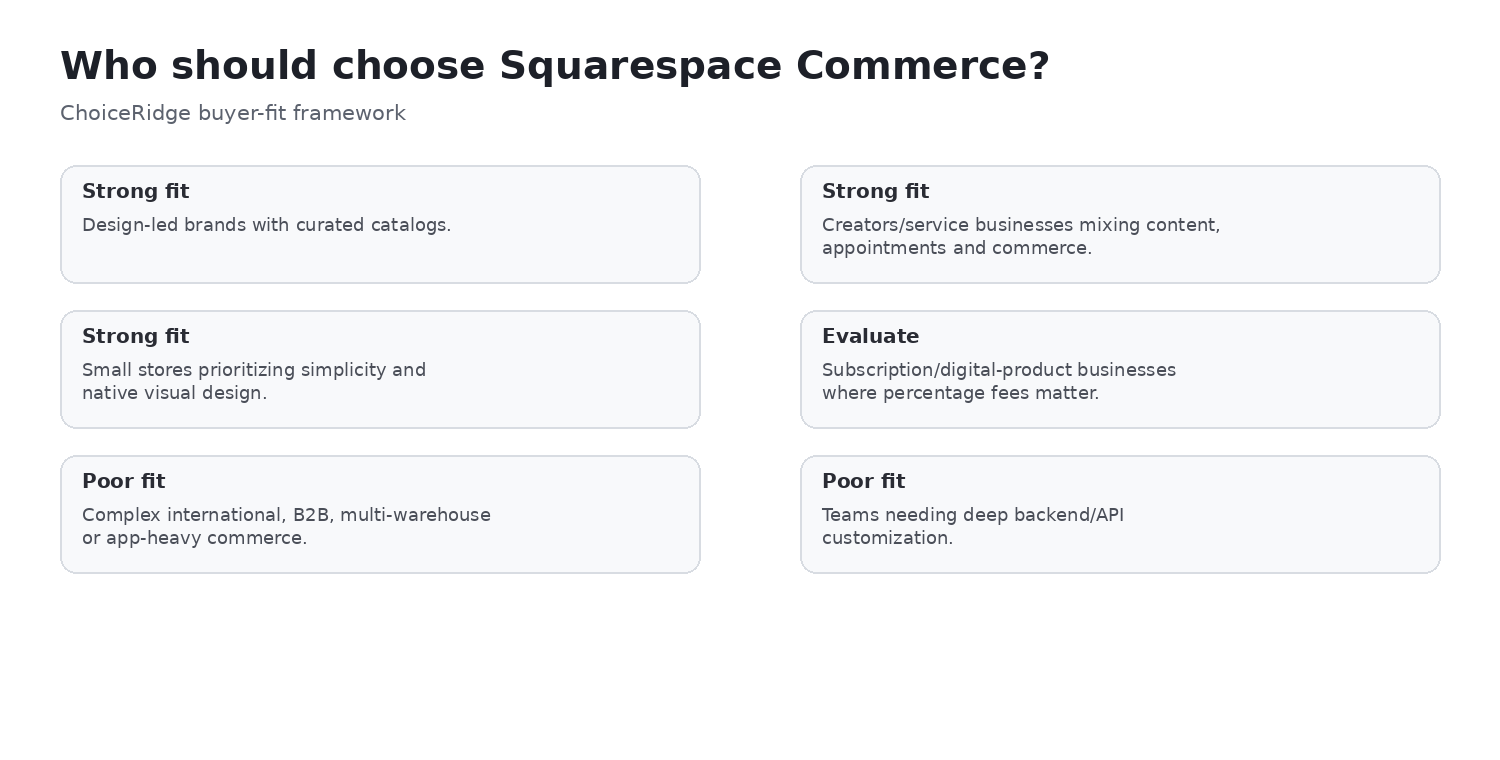
Choose an ecommerce platform by the work your team must do after launch. Start with payment eligibility, catalog and order complexity, who owns maintenance, and a realistic first-year budget. Shopify, WooCommerce, BigCommerce, Wix and Squarespace belong on different shortlists; a feature count cannot choose between them. This guide is for a business owner or operations lead defining that shortlist before a technical pilot.
Affiliate disclosure: some companies operate affiliate programs, but every link on this page is a direct, non-tracked official or internal link. ChoiceRidge currently earns no commission from these links. Commercial availability does not determine placement.
Start with a disqualifying requirement
Write down the condition that would make a platform unusable even if its storefront looked excellent. Examples include an unsupported payment method in your country, a subscription model your chosen integration cannot renew, customer-specific pricing that cannot reach checkout, or inventory rules your warehouse cannot reconcile. Treat these as pass/fail gates before awarding points for convenience.
| Situation | Starting shortlist | What could rule it out? |
|---|---|---|
| Managed retail operations with an app ecosystem | Investigate Shopify and BigCommerce | Required payment, channel or checkout workflow is unavailable for the proposed plan or market |
| WordPress investment and a team that can own software operations | Investigate WooCommerce | No named owner for hosting, updates, backups and extension compatibility |
| A website-led business with a limited commerce workflow | Investigate Wix and Squarespace alongside hosted commerce options | A representative catalog, subscription or fulfillment workflow needs unsupported workarounds |
| Complex accounts, pricing or multiple storefronts | Start with written requirements and plan-specific demonstrations | A feature exists in marketing material but is excluded from your quote or integration path |
The shortlist is a research starting point. Read the Shopify review, BigCommerce review and WooCommerce review for vendor-specific limits and the date of the underlying pricing research.
Compare a first-year operating budget
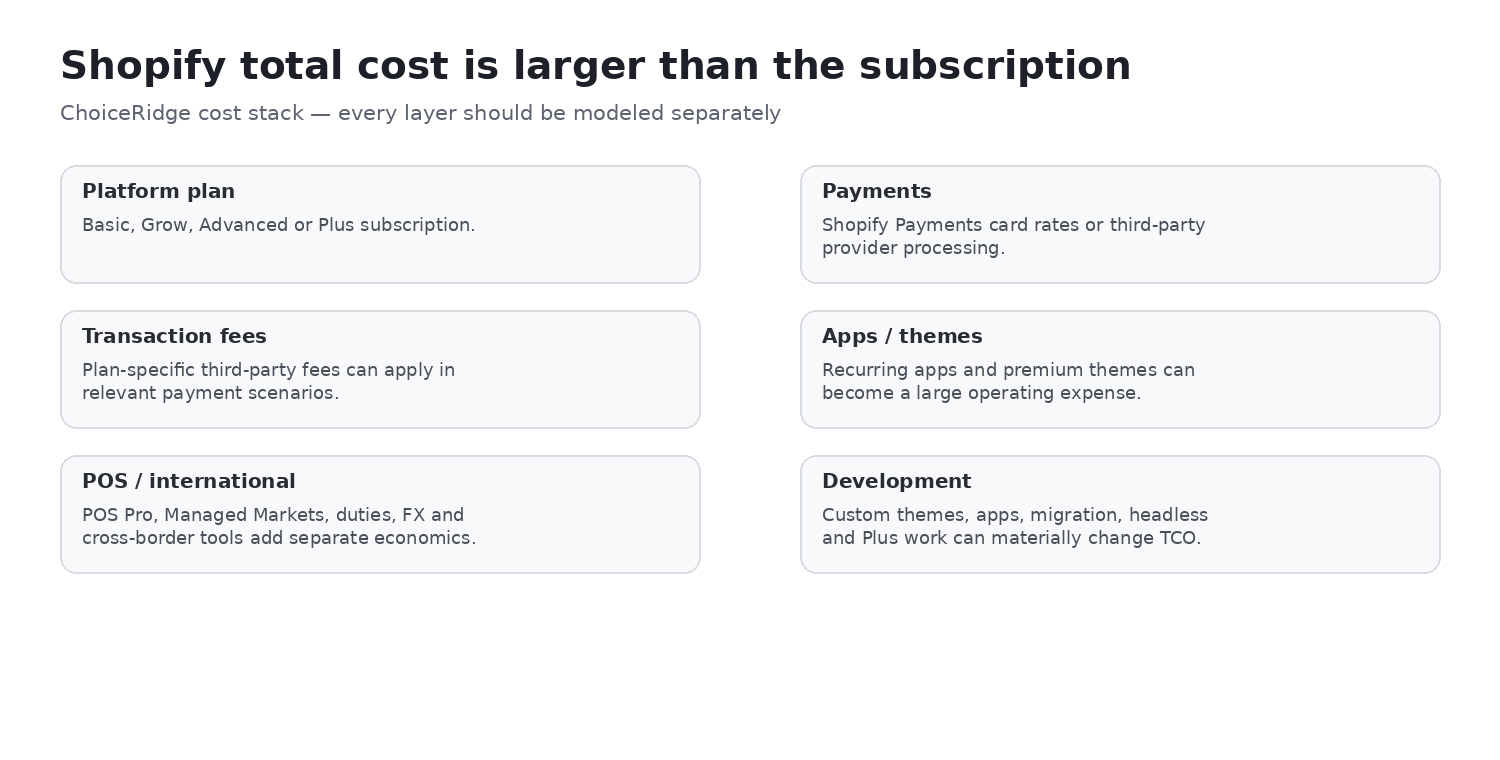
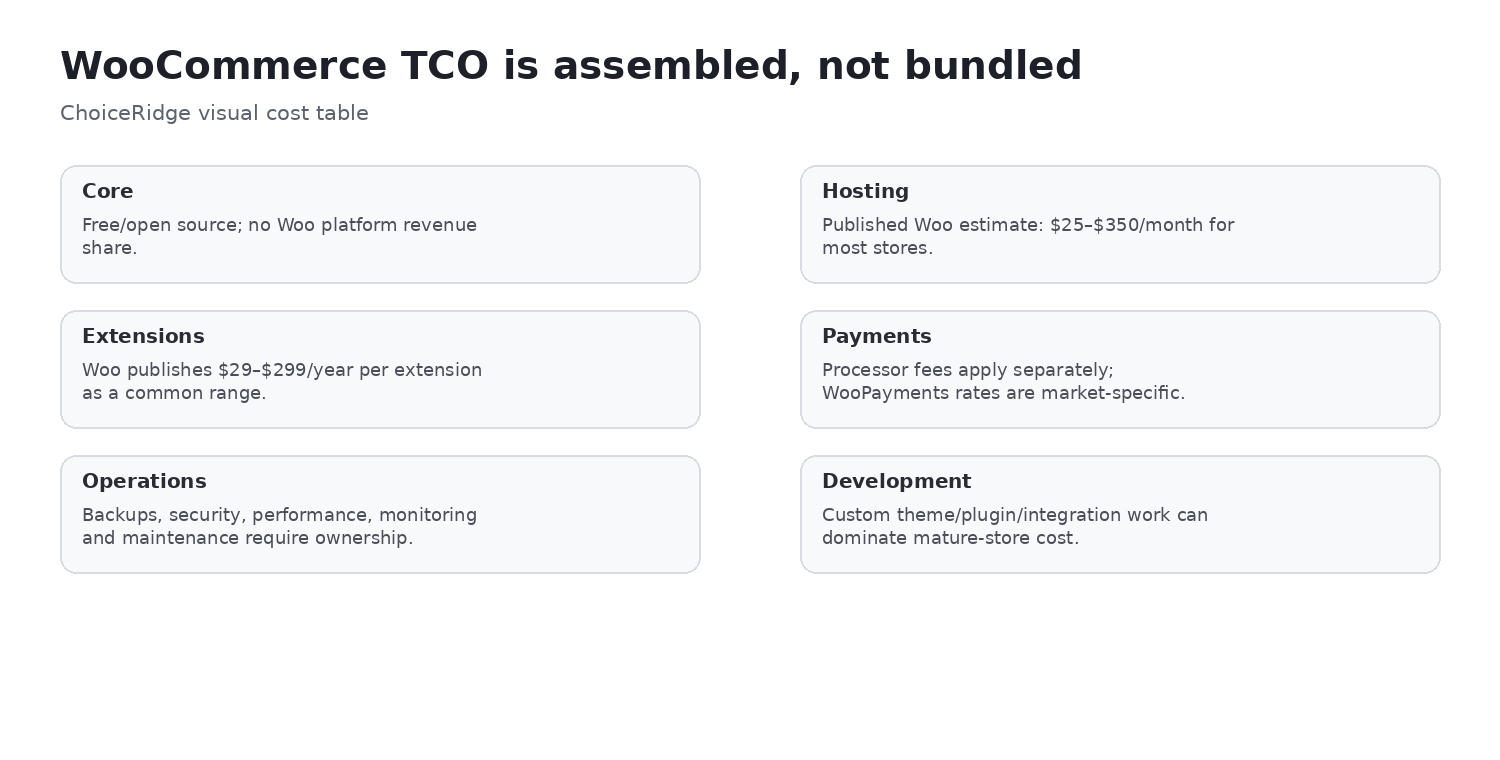
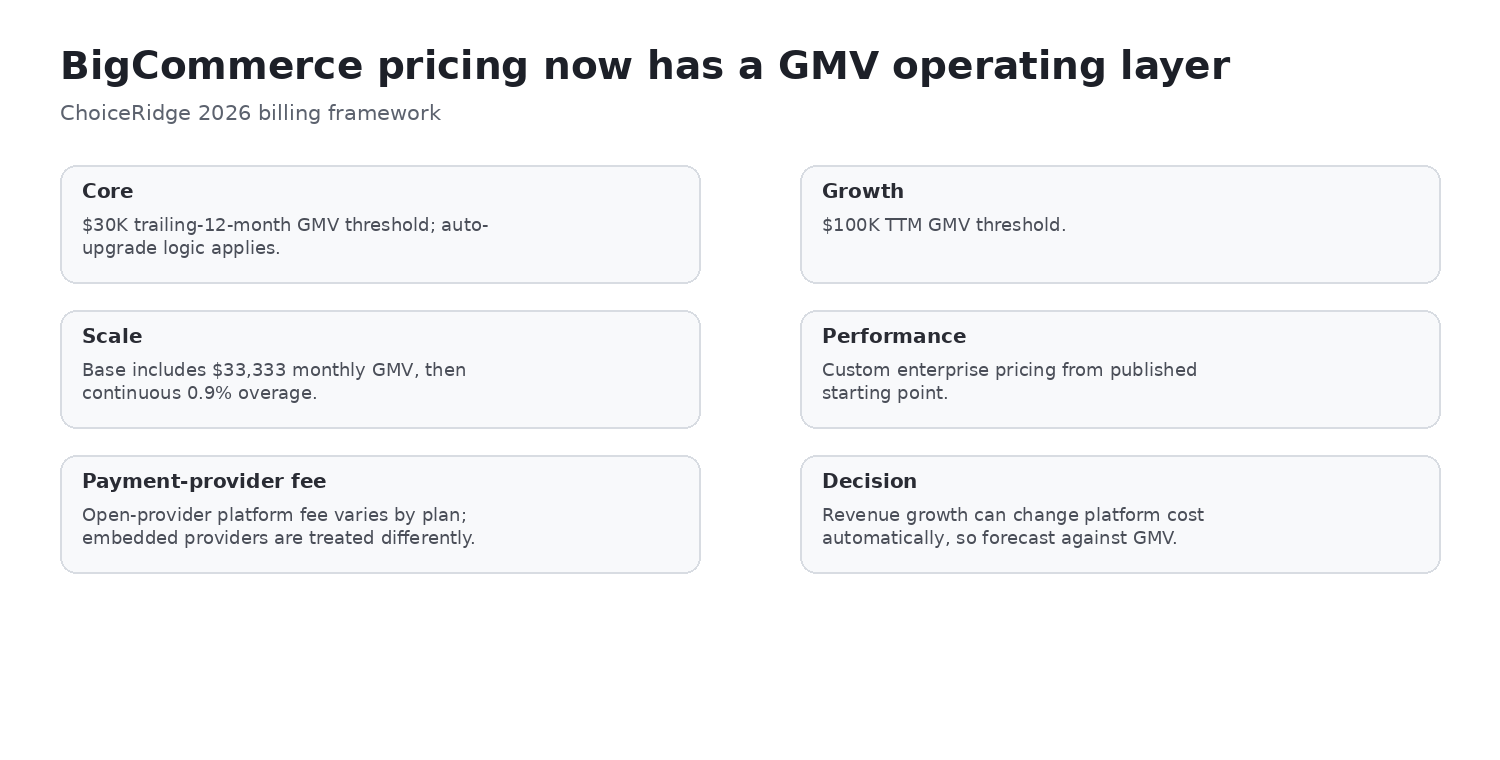
Use one market, currency and payment mix. Separate platform fees from processor fees, third-party transaction fees, apps, hosting, implementation, support and internal maintenance. An annual effective monthly subscription is not the same cash commitment as a cancellable monthly subscription. Record tax treatment, renewal prices and whether a quoted capability is an add-on.
Hypothetical example, not a provider quote: an option with a US$80 monthly platform fee, US$70 in apps and 6 maintenance hours a month at US$50 per hour costs US$5,400 a year before payments and implementation: 12 × (80 + 70 + 6 × 50). Add a hypothetical US$2,000 implementation project and the first-year subtotal is US$7,400. Replace every input with your own assumptions; this example estimates neither market prices nor savings.
At hypothetical annual processed sales of US$120,000, an additional 0.5 percentage-point fee would add US$600, assuming the same sales base and no exemptions. Fixed per-payment charges need a transaction count as well. Refunds, currency conversion, chargebacks and platform-specific definitions can change the result. Use our ecommerce cost calculator as a planning aid and reconcile the final numbers to written terms.
Assign the work before choosing the platform
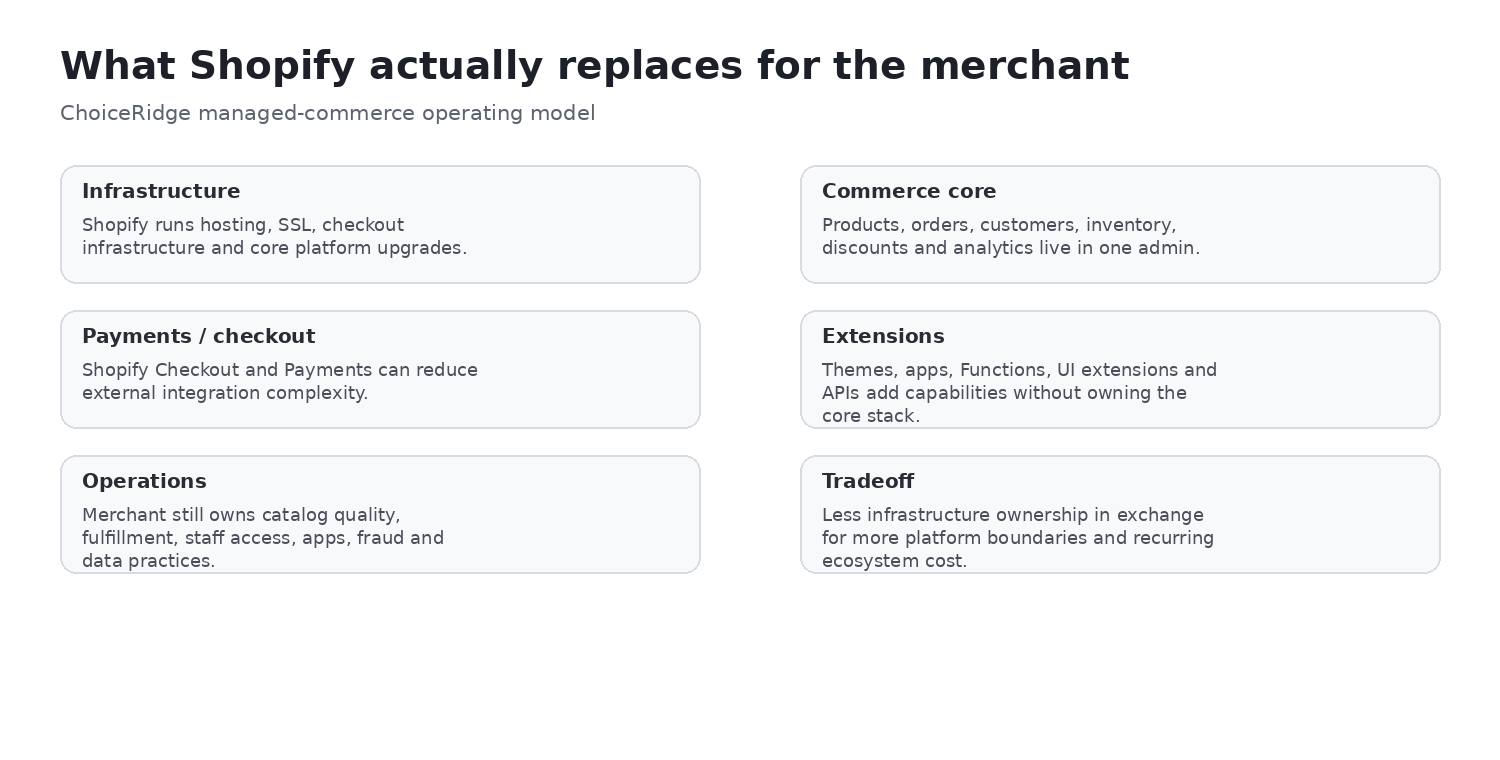
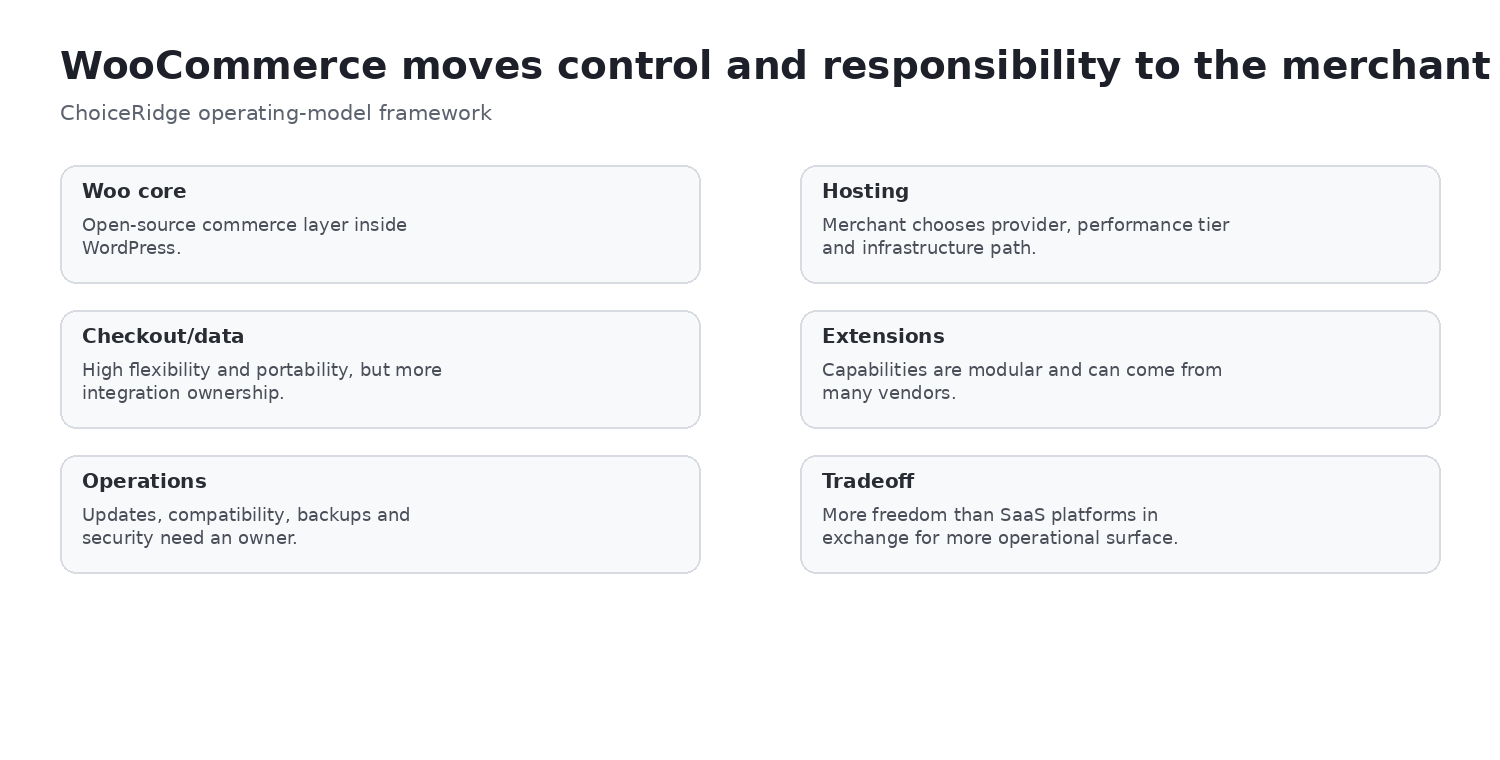
Ask who publishes products, corrects stock, resolves a failed order export, updates integrations, reconciles refunds and handles an outage. A hosted platform can reduce infrastructure work while leaving the merchant responsible for its data, permissions, apps and operating procedures. With a self-managed store, include the server and software lifecycle in that responsibility map.
For a small team, a manual exception queue with a clear owner can be more valuable than an ambitious integration nobody maintains. For a growing operation, show how staff access, fulfillment and accounting change when order volume doubles. Test an ordinary day and a failure day; a platform should fit both.
A small pilot with a clear exit decision
- Catalog: create representative variants, tax classes, stock rules and one difficult product. Record which work needs an app or custom code.
- Purchase: complete a permitted test transaction using the intended market and payment configuration. Verify discounts, tax, shipping and customer messages.
- Exception: cancel or partially refund an order and reconcile the result in fulfillment and accounting.
- Operations: let the person who will run the store perform the task without the implementer prompting every click.
- Exit: inspect product/customer/order exports, URL mapping and the limits on moving payment or subscription data. Do not assume portability.
Record expected result, observed result, workaround, owner and recurring cost for each step. Stop the selection if a mandatory requirement fails. A visually impressive demo is insufficient evidence of an operating fit.
When to use a different guide
If the business requirements already pass and your question is extension ownership, use the developer evaluation guide. For a custom frontend, use the headless architecture guide. For ERP or warehouse synchronization, use the API operations guide. Those decisions need different evidence from a general business shortlist.
Recommendation: choose the operating model that passes your gates
Choose the lowest-complexity option that satisfies the mandatory workflow and has a funded owner. Reconsider a cheaper subscription if extensions, support or maintenance erase the difference. Choose a more customizable architecture only when its extra control solves a specific requirement worth maintaining. There is no universal winner or platform-level guarantee of conversion, performance or search visibility.
Research basis and limits
Editorial revision and the documentation below were reviewed on October 16, 2026. These are documented product boundaries and proposed evaluation exercises, not hands-on test results or performance benchmarks. No fresh provider prices were checked for this guide. Verify current plans, market eligibility and API versions before purchase or implementation.
Read our methodology and commercial transparency. ChoiceRidge and Vantevion have common ownership; no Vantevion product is evaluated in this guide.
Existing editorial illustrations
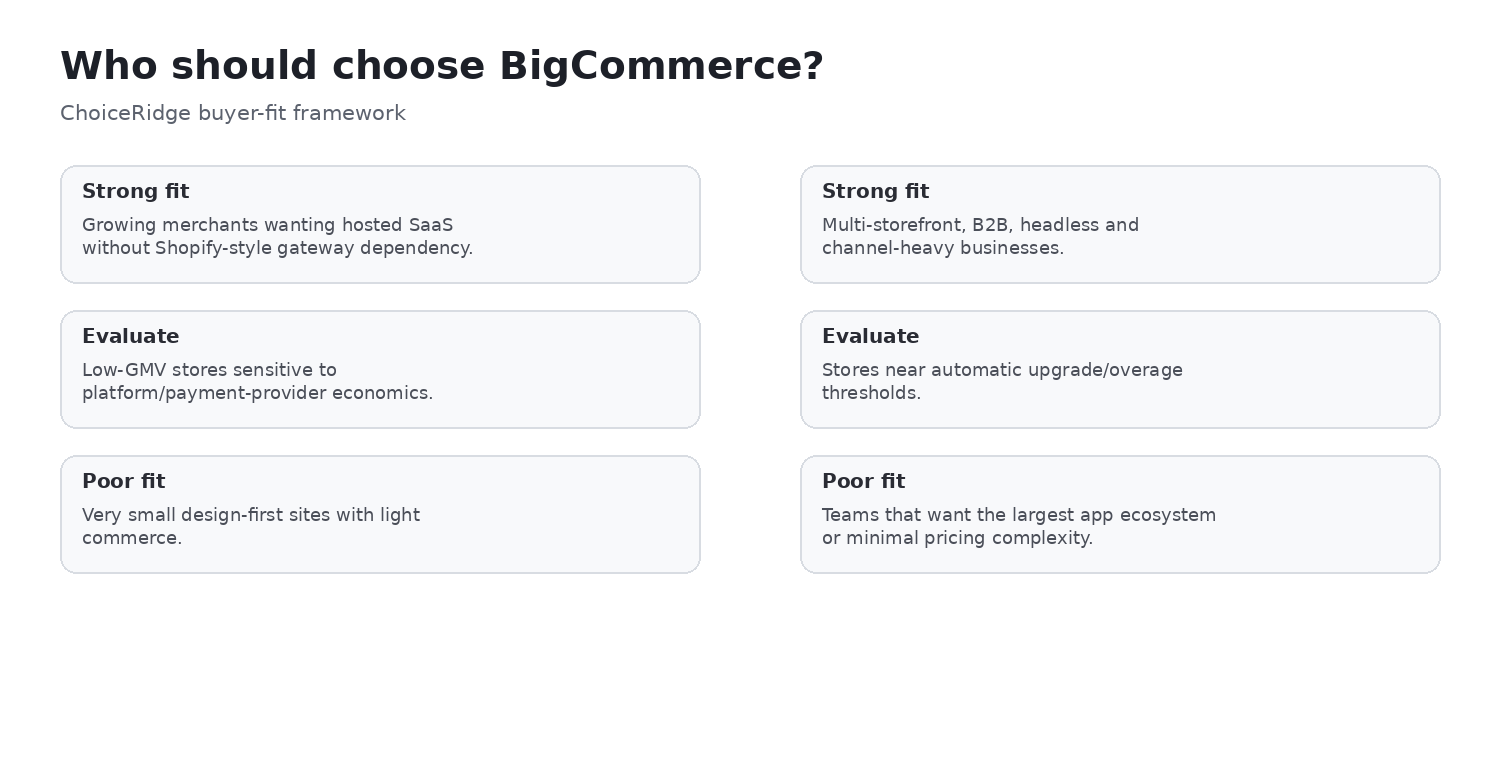
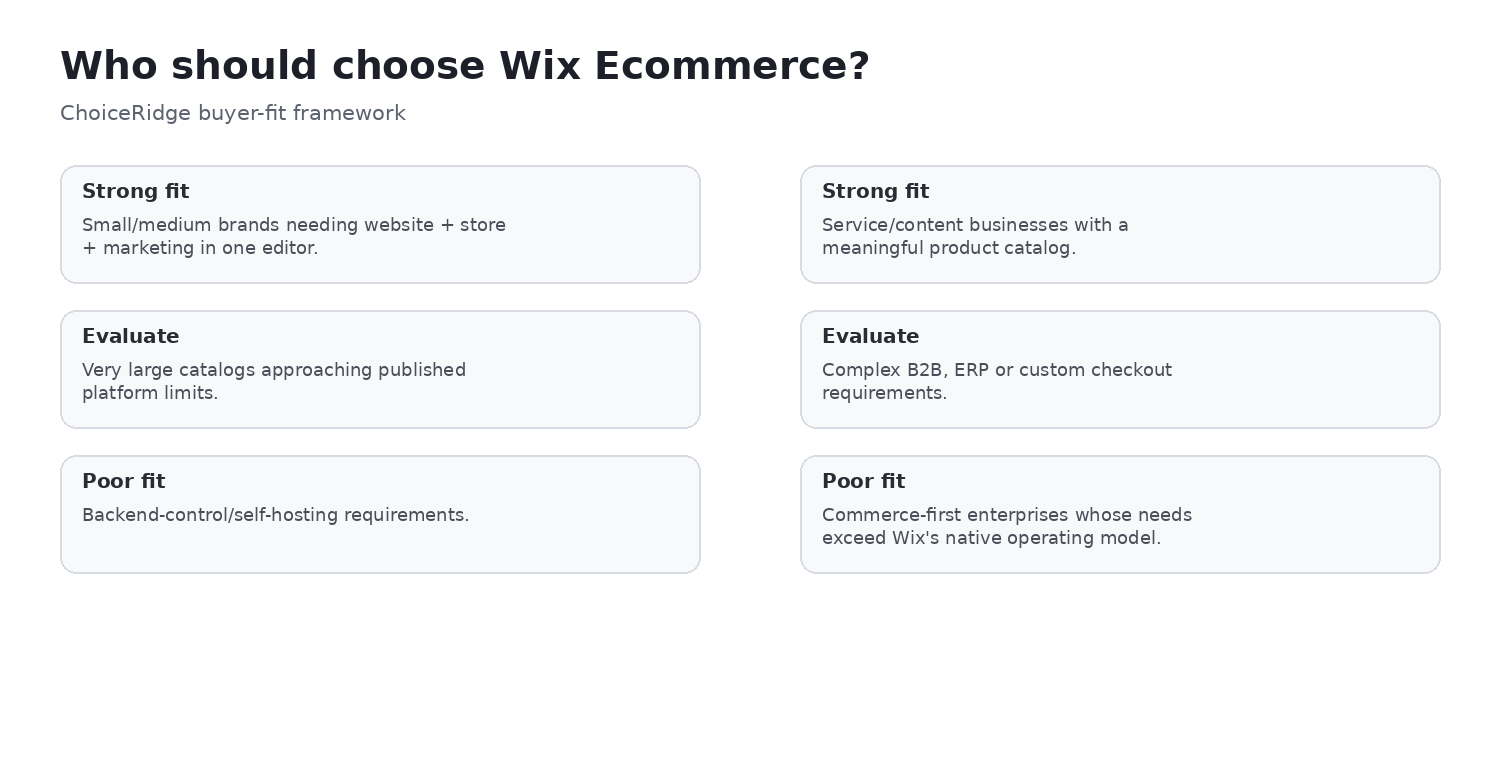
These previously published visuals are illustrative context. They are not evidence of a new provider test or a current platform ranking. The decision criteria above govern this revision.