Choosing among ecommerce platforms is an operating-model decision, not a feature-count contest. For developer control, APIs, deployment and extensibility, the right answer depends on total cost, payment rules, hosting responsibility, daily workflows, technical ownership, and the capabilities the business actually needs. ChoiceRidge ranks platforms by scenario rather than declaring one universal winner. This guide uses current official pricing and product documentation checked August 12, 2026, plus the five detailed reviews already published in this cluster. No controlled performance, conversion, SEO, uptime, security, or support testing is claimed.
Affiliate disclosure: some companies operate affiliate programs, but every link on this page is a direct, non-tracked official or internal link. ChoiceRidge currently earns no commission from these links. Commercial availability does not determine placement.
Quick picks
WooCommerce for open-source control; Shopify for ecosystem and APIs; BigCommerce for API-led hosted commerce; Wix for Velo and SMB extensions; Squarespace for more curated customization. Treat this as a shortlist, then verify the platform against a representative store workflow.
Best ecommerce platforms compared
| Platform | Current cost signal | Hosting model | Payment/platform fees | Maintenance | Key trade-off |
|---|---|---|---|---|---|
| 1. WooCommerce | Core $0; Woo guidance: hosting $25–$350/month, extensions $29–$299/year each | Self-hosted open source | No Woo platform transaction fee; processor charges apply | High unless managed | Hosting, compatibility, security and support ownership |
| 2. Shopify | Basic €24/month annually on the localized page checked | Hosted SaaS | Shopify Payments processing; outside-provider fee varies by plan | Low infrastructure burden | Third-party costs and platform boundaries |
| 3. BigCommerce | Core $29, Growth $79, Scale $299 annually; Performance from $1,499 | Hosted SaaS | Embedded Provider fee $0; Open Provider 2%, 1% or 0.6% | Low infrastructure burden | GMV rules, overage and provider classification |
| 4. Wix Ecommerce | Localized ecommerce-capable plans; verify market | Hosted site builder | Processor fees vary; US standard Wix Payments cards 2.9% + $0.30 | Low infrastructure burden | Regional packaging and less complex-commerce depth |
| 5. Squarespace Commerce | Localized Basic/Core/Plus/Advanced rollout | Hosted site builder | New Basic commerce fee 2%; other new plans 0%; processor separate | Low infrastructure burden | Plan transition and advanced-operation limits |
Platform-by-platform analysis
WooCommerce
Why it fits: WordPress ownership, content, plugins, code and payment choice.
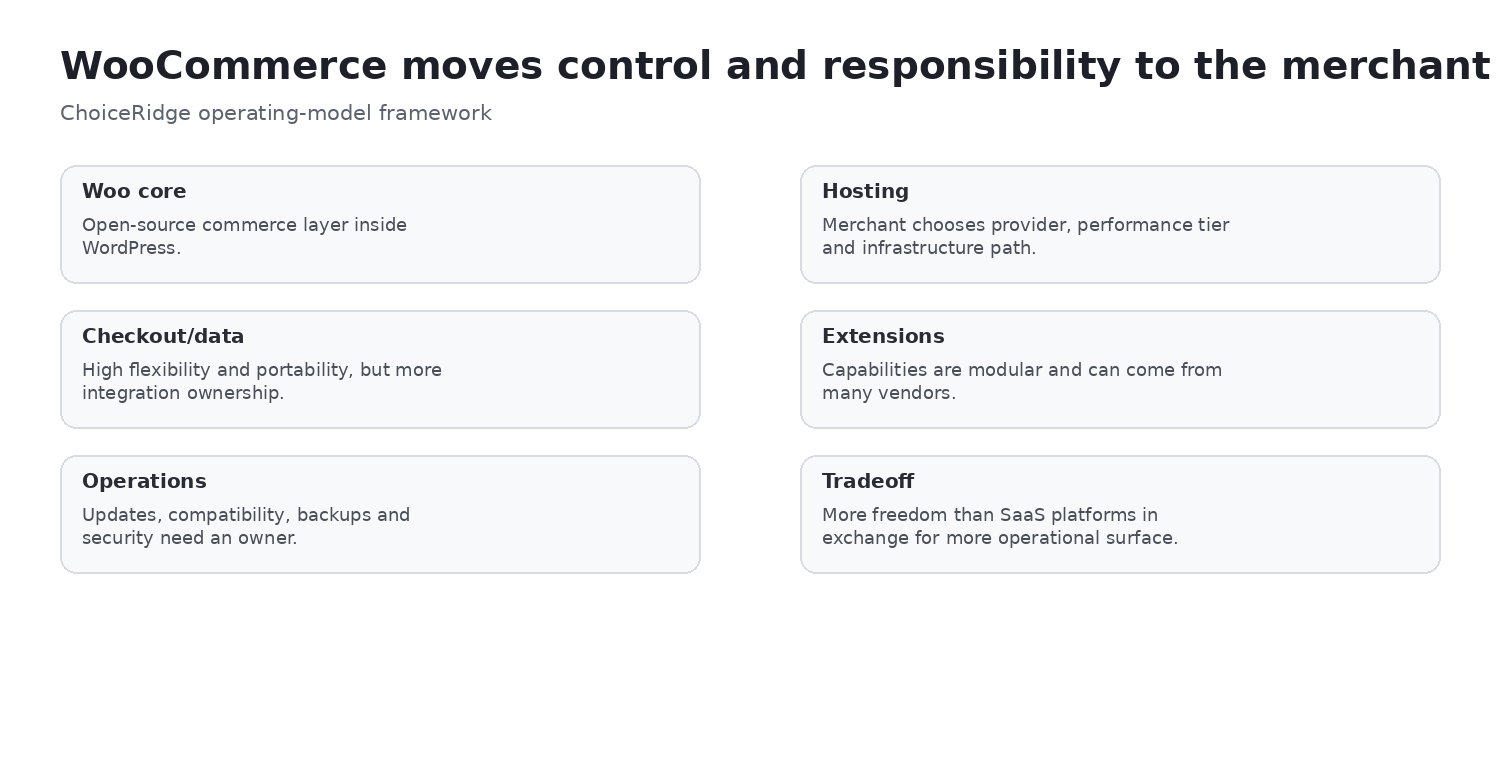
Trade-off: Hosting, compatibility, security and support ownership.
Shopify
Why it fits: Broad managed commerce, apps, POS, channels and enterprise path.
Trade-off: Third-party costs and platform boundaries.
BigCommerce
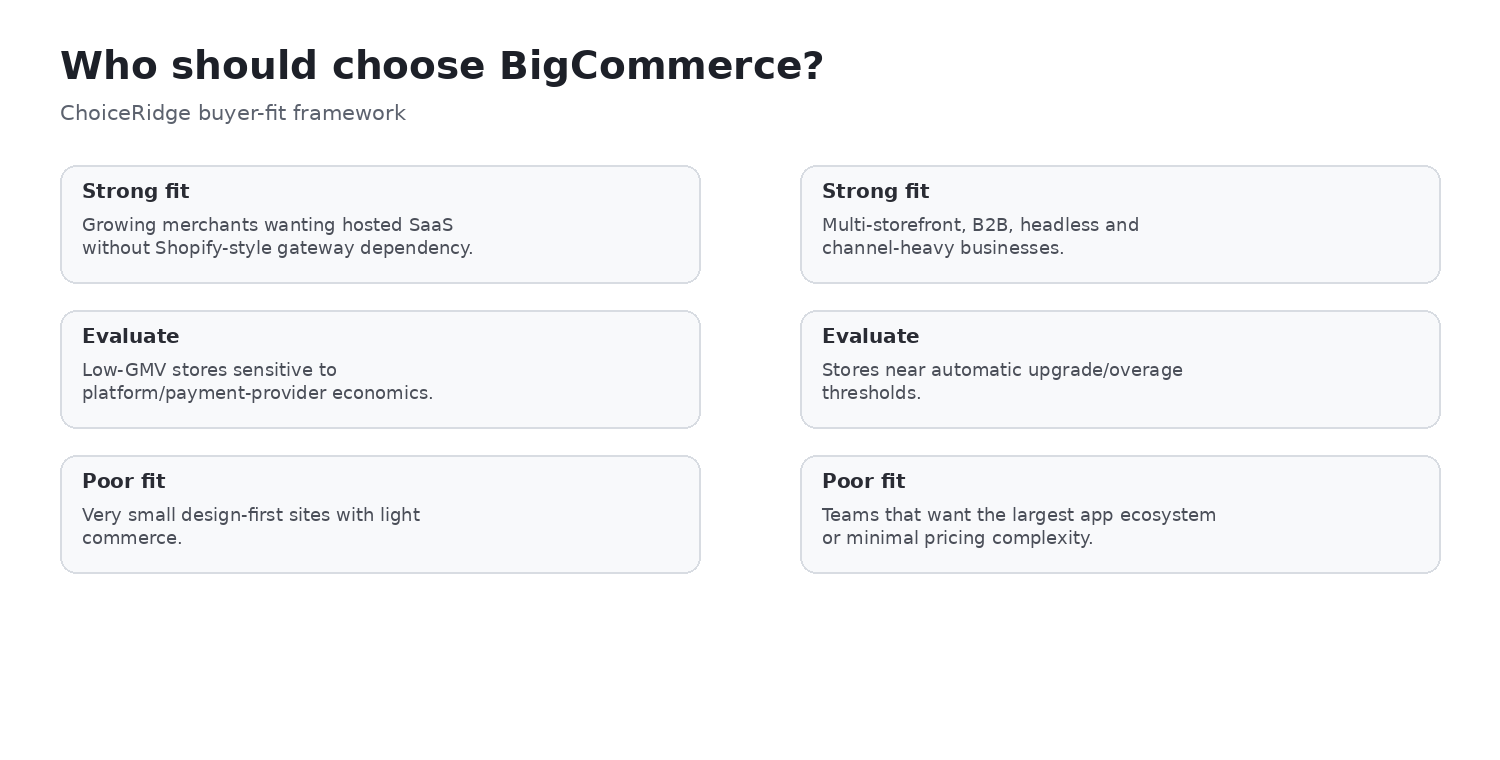
Why it fits: Native B2B, multi-storefront, multichannel and APIs.
Trade-off: GMV rules, overage and provider classification.
Wix Ecommerce
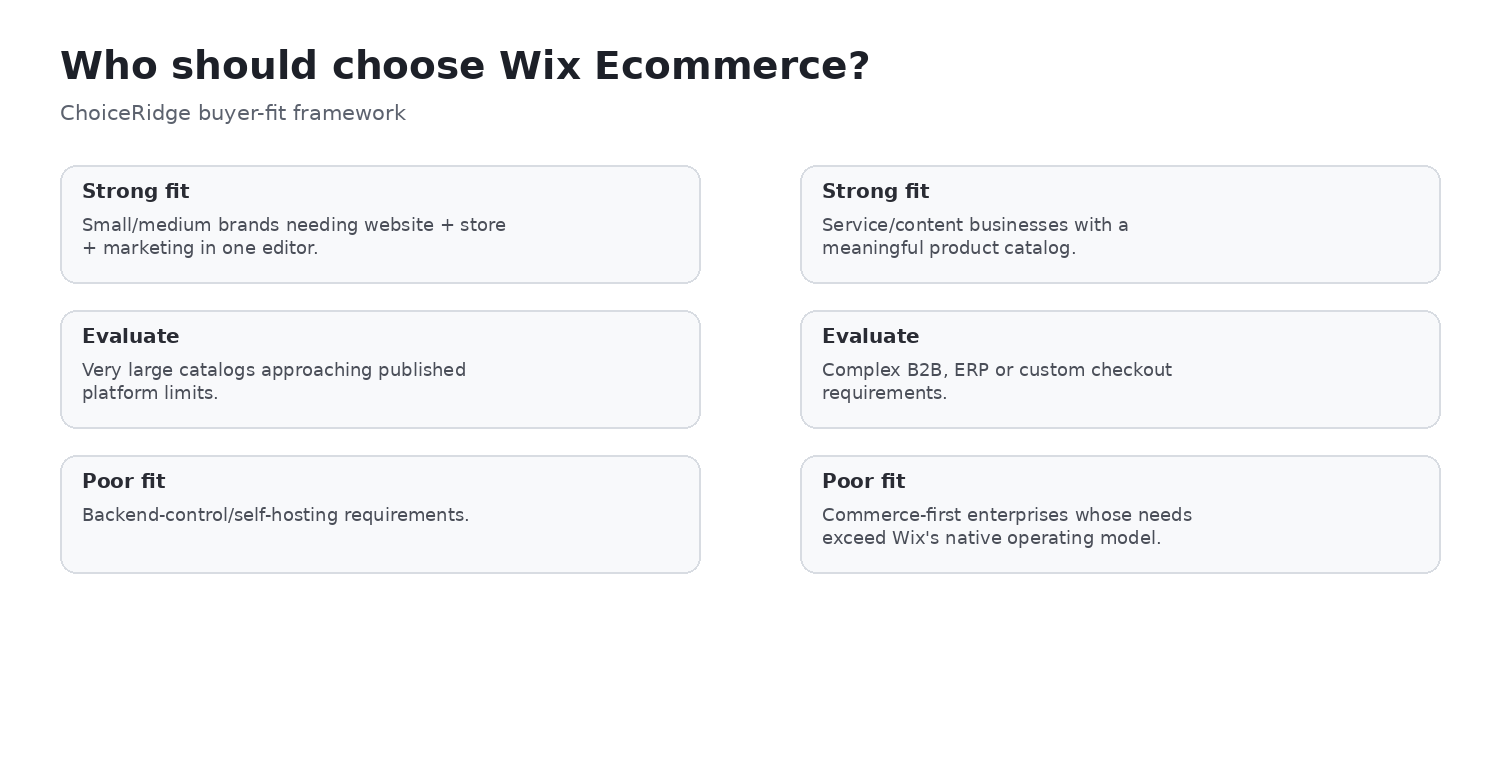
Why it fits: Visual building, services, content and SMB commerce.
Trade-off: Regional packaging and less complex-commerce depth.
Squarespace Commerce
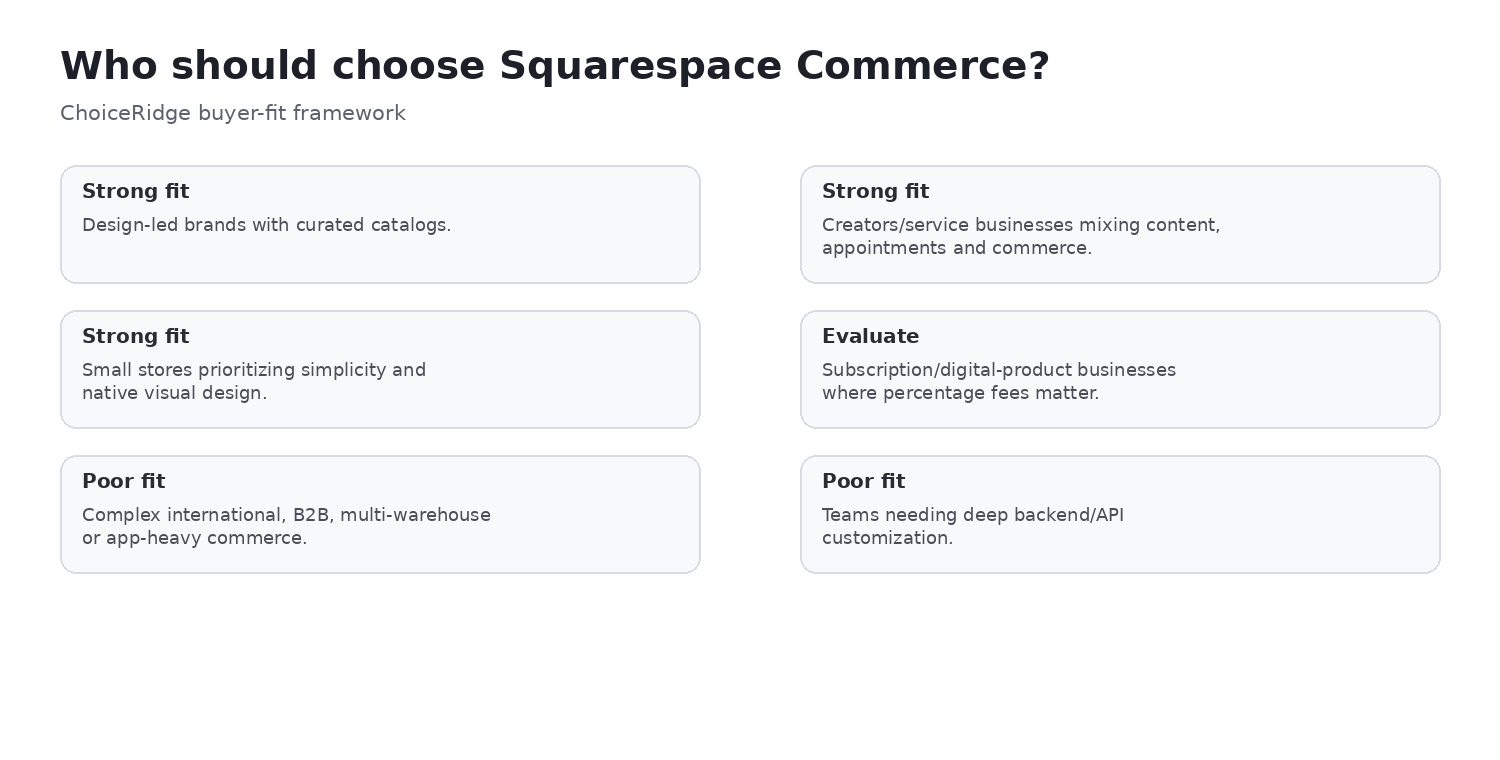
Why it fits: Design, content, services, downloads and subscriptions.
Trade-off: Plan transition and advanced-operation limits.
What matters most for developer control, APIs, deployment and extensibility
Document the required product types, variants, payment methods, countries, currencies, tax and shipping rules, inventory locations, channels, subscriptions, B2B workflows, content, roles, reporting, integrations, APIs, recovery objectives, and support expectations. Separate must-haves from optional capabilities and test the highest-risk workflows.
Hosted SaaS versus self-hosted software
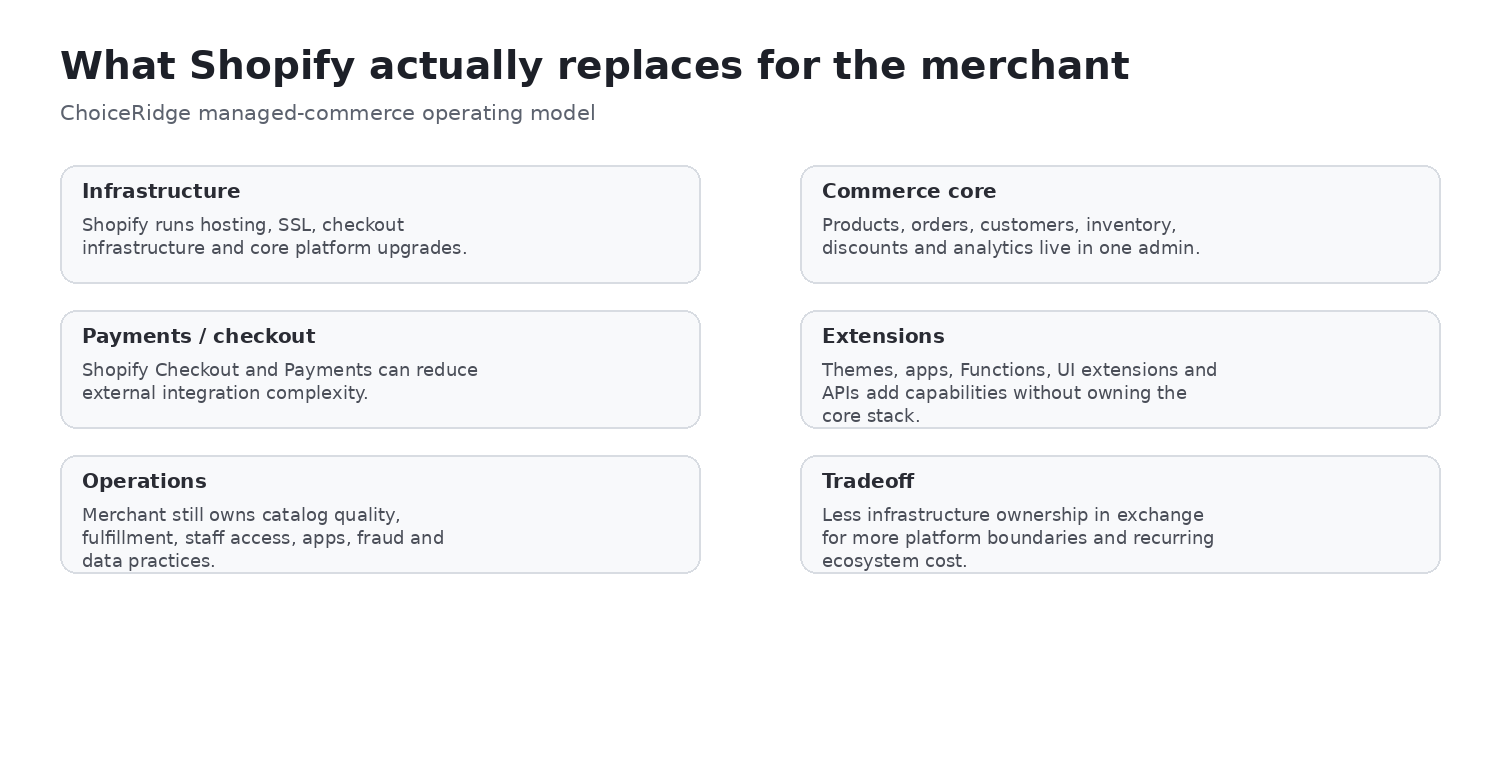
Hosted platforms reduce server and update work but retain platform boundaries and plan economics. WooCommerce provides deeper hosting, code, and data control while making the merchant or managed provider responsible for updates, compatibility, monitoring, security, backups, and performance. These models should not be compared by subscription price alone.
Choose by scenario
Choose WooCommerce
When its primary strength aligns with the business and its trade-off is acceptable.
Choose Shopify
When the second scenario is more important than the default recommendation.
Run a proof of concept
For complex checkout, subscriptions, international tax, B2B, large catalogs, headless, high volume, or legacy integrations.
Limitations that can change the ranking
Country availability, payment provider, GMV, catalog shape, staff roles, app dependence, contract terms, developer capacity, support ownership, and migration constraints can reverse the order. A vendor demo is not a substitute for testing your own products, checkout, orders, refunds, integrations, and administrative workload.
Migration and switching considerations
Inventory products, variants, collections, customers, orders, subscriptions, payment tokens, gift cards, discounts, reviews, content, URLs, redirects, tax rules, shipping rules, analytics events, feeds, and integrations. Verify what can be exported, imported, reconstructed, or cannot move. Plan parallel validation, redirects, reconciliation, rollback, and post-launch monitoring.
Decision visuals
Additional decision questions
Which platform gives developers the most control?
WooCommerce provides source and infrastructure control, with corresponding maintenance ownership.
Which has the best managed ecosystem?
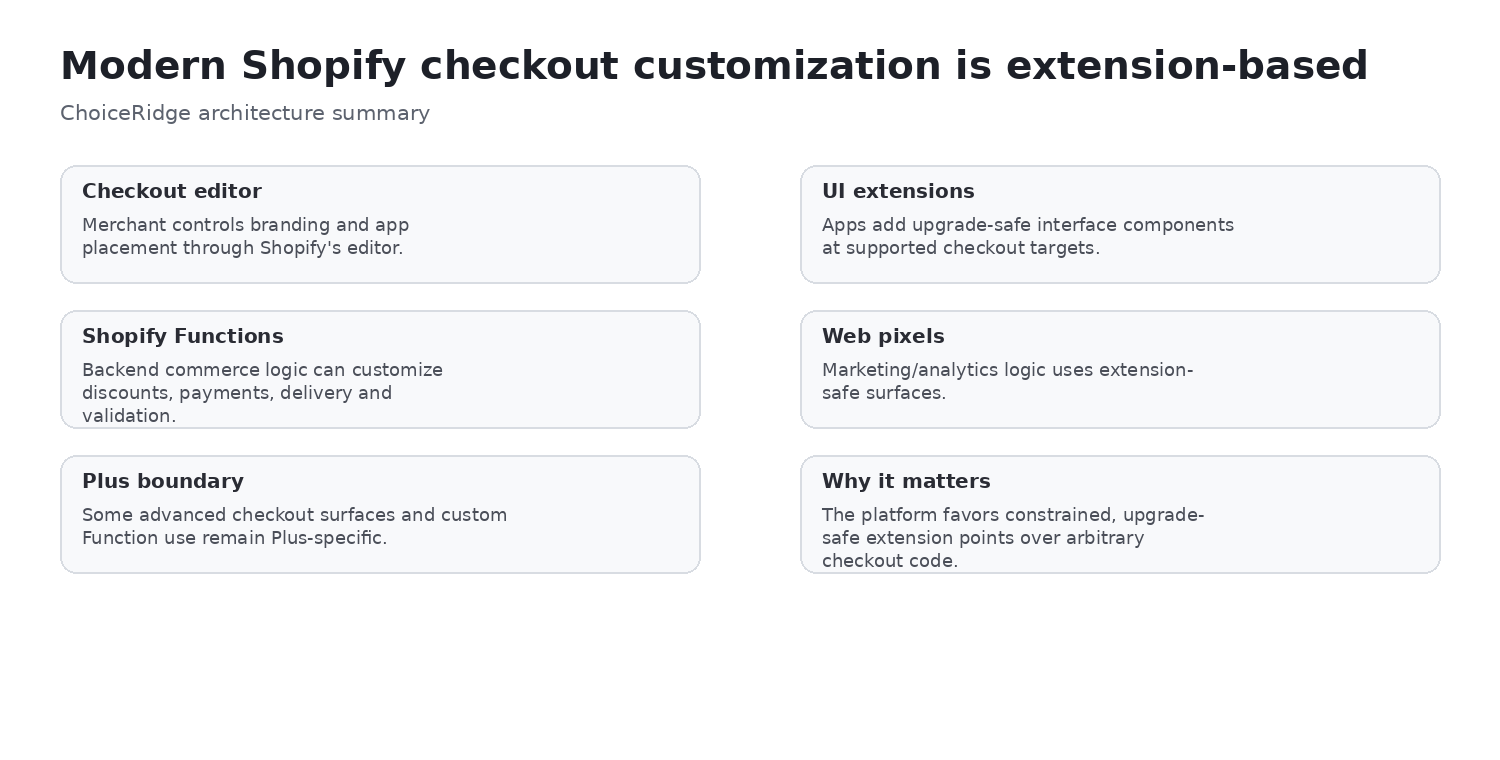
Shopify has a broad app, theme and partner ecosystem, subject to platform boundaries.
Is BigCommerce good for headless?
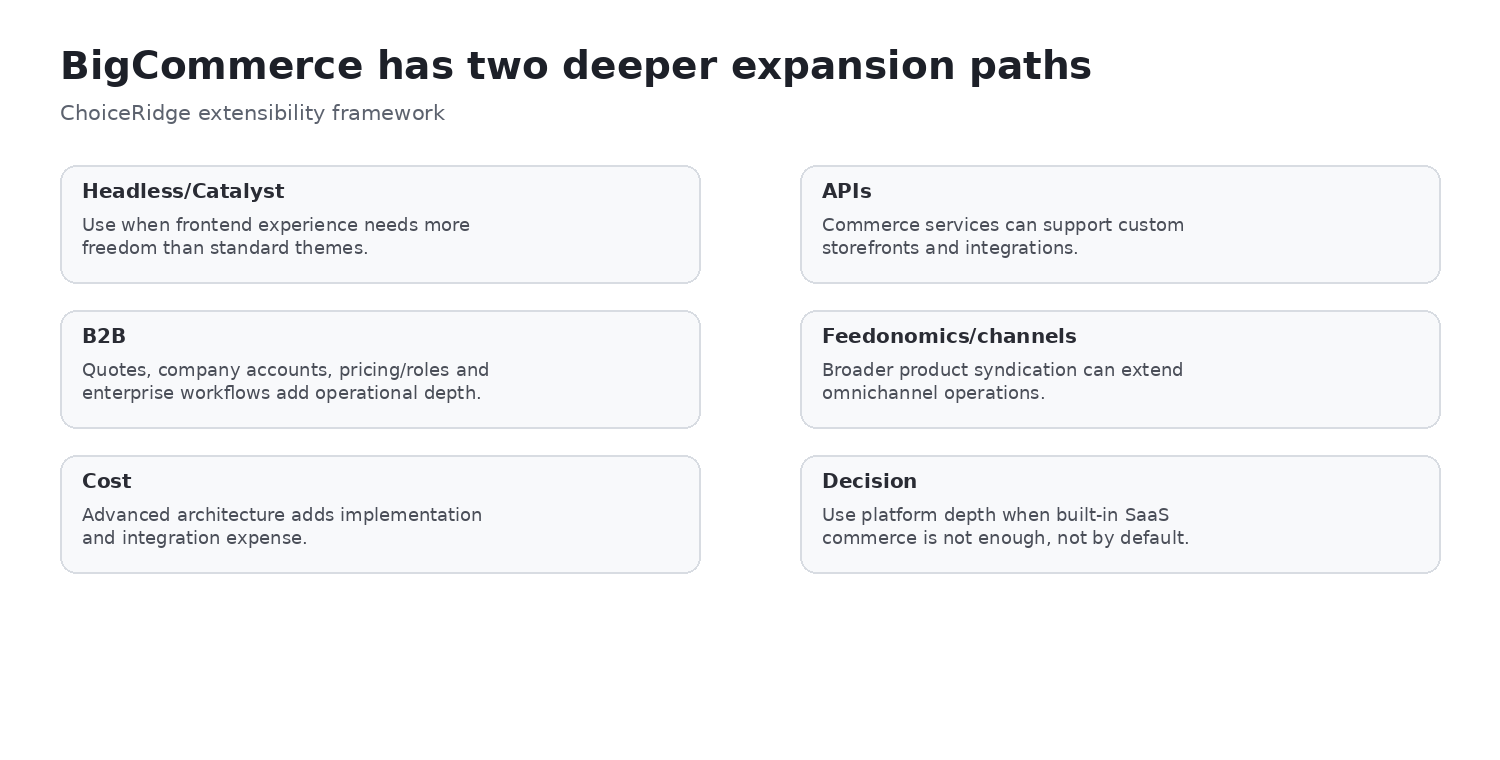
It provides API-led and Catalyst paths that merit evaluation for complex hosted commerce.
Are API limits the only developer constraint?
No. Versioning, checkout boundaries, webhooks, observability, deployment and data access also matter.
Did ChoiceRidge run developer benchmarks?
No. This guide documents official capabilities and operating implications without claiming hands-on performance tests.
Migration and proof-of-concept checklist
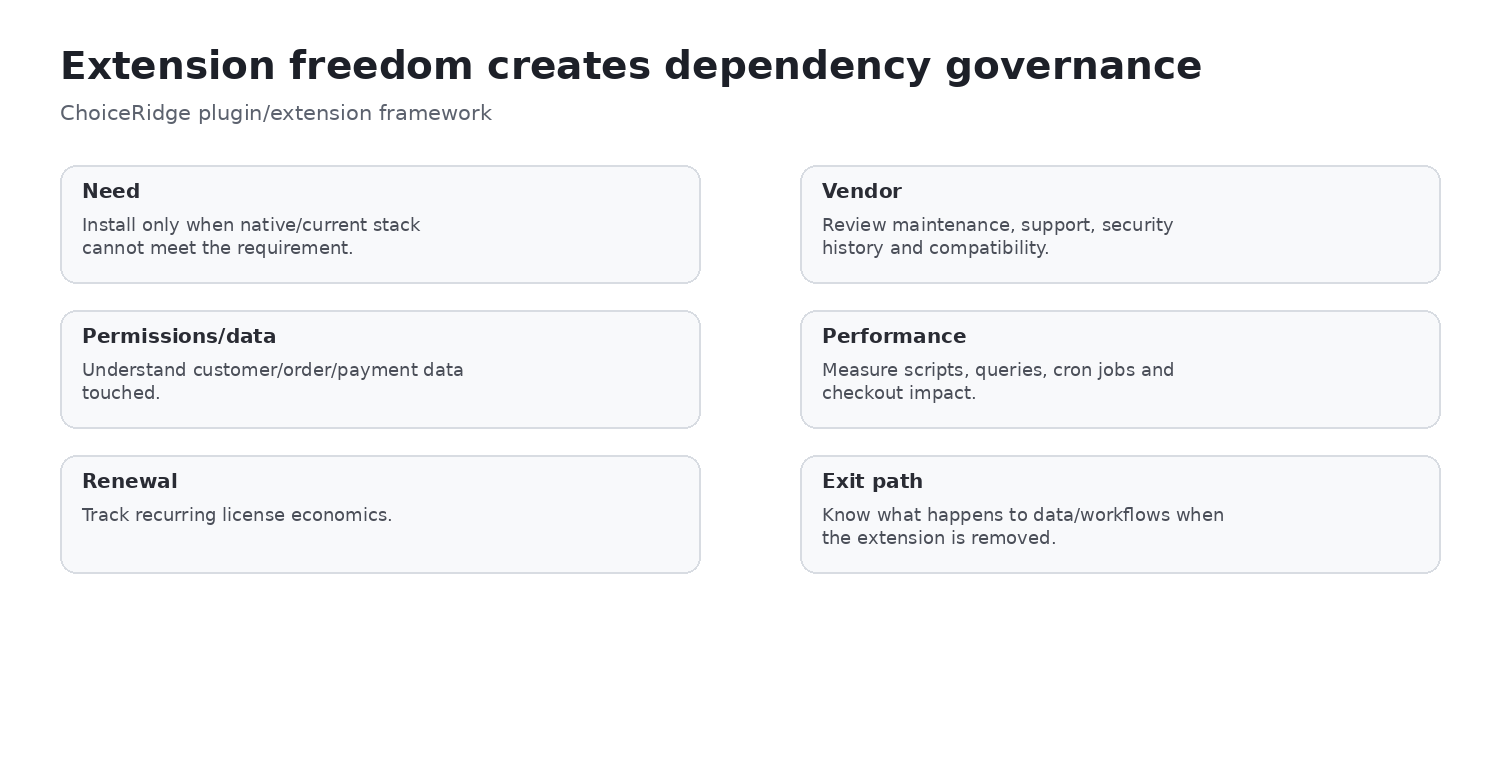
Build one representative extension or integration; process webhook retries; test API limits, preview, deployment, logs and rollback; export core data; document platform-owned versus team-owned failure domains.
Additional primary sources
Final recommendation
WooCommerce for open-source control; Shopify for ecosystem and APIs; BigCommerce for API-led hosted commerce; Wix for Velo and SMB extensions; Squarespace for more curated customization. Make the final choice from a three-year cost model and a representative proof of concept, not a promotional starting price.
Explore all ecommerce reviews and comparisons or use the Ecommerce App Cost Calculator.
How ChoiceRidge evaluates ecommerce platforms
We compare official plan and fee documentation, hosting responsibility, commerce capabilities, extensibility, operational burden, and use-case fit. Rankings are editorial judgments supported by documented evidence. We do not publish a numerical score or claim hands-on tests that were not performed.
Read our Methodology, Editorial Policy, and How We Make Money.
Frequently asked questions
What is the best ecommerce platform?
There is no universal winner. The best platform matches the business model, team, payment needs, operating burden, and growth path.
Which platform is cheapest?
Compare total cost, not the starting subscription. Hosting, processing, apps, development, maintenance, and migration can dominate.
Should I choose hosted or self-hosted ecommerce?
Choose hosted SaaS for lower infrastructure responsibility; choose self-hosted software when control justifies the operational work.
Which platform is best for SEO?
No platform guarantees rankings. Implementation, content, crawlability, performance, links, and competition matter.
Can I switch platforms later?
Yes, but subscriptions, payment tokens, URLs, order history, apps, and custom workflows may not transfer cleanly.
How should I test a shortlist?
Build representative products, checkout, payments, fulfillment, refunds, reporting, and integrations before committing.