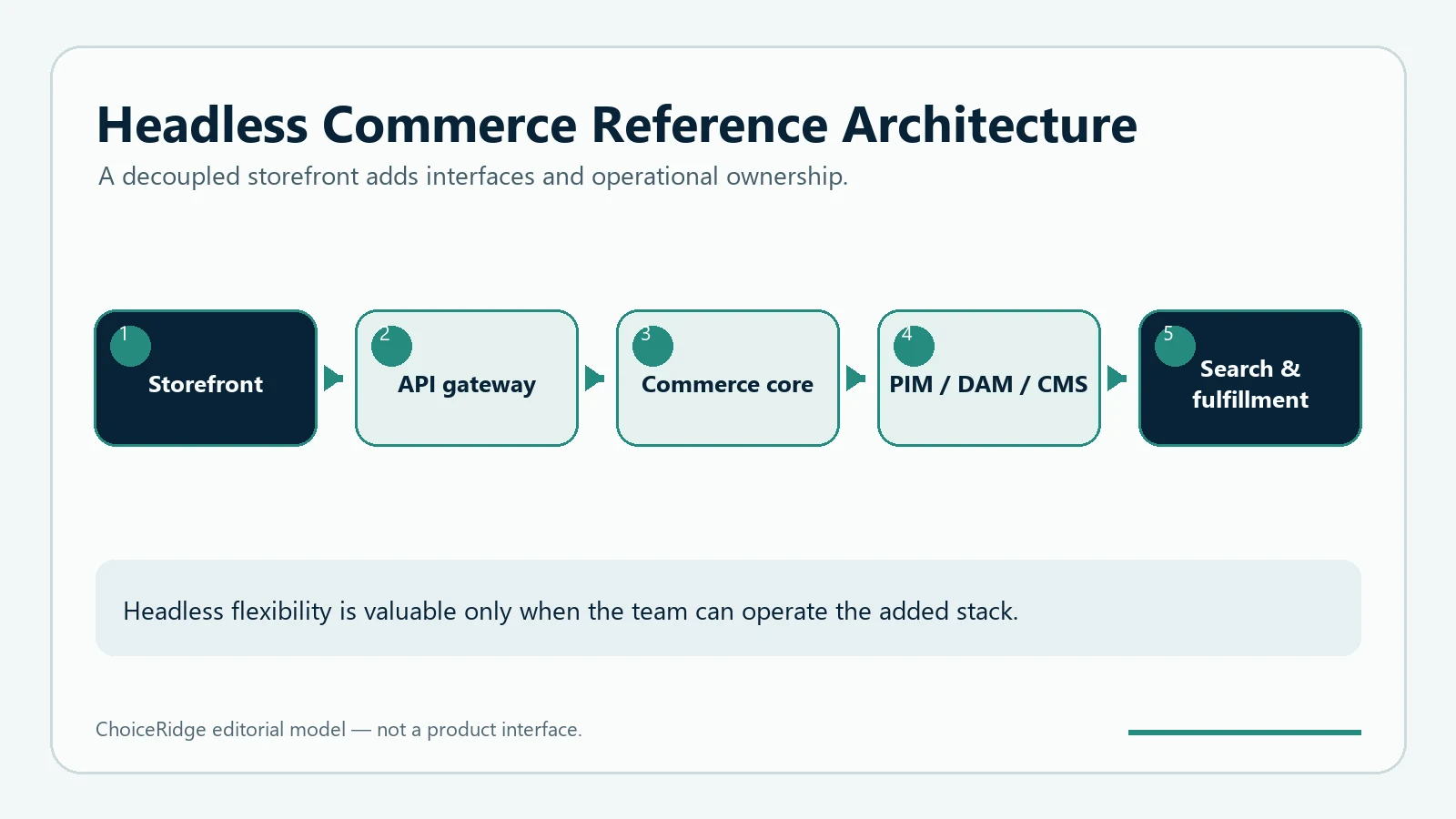
Headless ecommerce separates the buyer-facing frontend from the commerce backend. Consider it when a specific experience, content model or delivery channel cannot be served well by the supported storefront. It also gives your team more systems to deploy, observe and recover. This guide is for an architect deciding whether that ownership is justified, then comparing the architecture boundaries.
Affiliate disclosure: some companies operate affiliate programs, but every link on this page is a direct, non-tracked official or internal link. ChoiceRidge currently earns no commission from these links. Commercial availability does not determine placement.
A reference architecture with named responsibilities
Think in four paths: the browser reads a rendered storefront; the frontend server retrieves commerce and editorial data; the buyer’s cart reaches the supported checkout; backend events update search, integrations and caches. Assign an owner and an outage behavior to each path before selecting services.
| Layer | System of record | Failure question |
|---|---|---|
| Catalog, stock and order state | Commerce backend or an explicitly designated ERP/PIM integration | Can the storefront show stale stock, and where is the final availability check? |
| Editorial copy and reusable content | CMS, if one is needed | Can a content outage leave product and checkout paths available? |
| Product enrichment | PIM when the catalog workflow warrants it | Which system wins when two feeds update the same field? |
| Rendering and delivery | Frontend repository, hosting and cache configuration | Who rolls back a broken release, and what invalidates cached pages? |
A CMS, PIM, search service and separate frontend are not mandatory just because the store is headless. Add a component for a requirement and name its source of truth. For content boundaries, see PIM versus DAM versus CMS.
Choose a checkout boundary before a frontend framework
Shopify documents Storefront API and Hydrogen paths for custom storefronts. BigCommerce documents headless storefront architectures. WooCommerce’s Store API supports customer-facing product, cart and checkout operations. These facts establish available surfaces; they do not establish parity across extensions, markets, accounts or payment methods.
Determine whether the project uses a provider-hosted checkout transition, an embedded supported experience, or a custom checkout implementation permitted by the platform. Prototype the exact cart-to-payment handoff. Test customer identity, discounts, delivery selection, tax, returns and the confirmation event. A working product page does not prove a complete transaction.
Do not assume a theme app automatically works in a custom frontend. List every existing app that injects UI or depends on storefront scripts. Ask for a documented headless integration or budget for replacement. Confirm accessibility, payment eligibility and consent behavior with the responsible specialists for the actual design; this article supplies no certification.
Design cache invalidation around data sensitivity
Cache public editorial and catalog data according to a stated freshness policy. Treat personalized prices, customer details, cart contents and authentication responses separately. Shared caching of buyer-specific responses can expose data or show the wrong price. Record which keys depend on locale, currency, channel and customer context.
For a hypothetical price update, follow the event from the source system to the commerce backend, search index and page cache. Decide what happens if one invalidation fails. Keep a bounded expiry and a reconciliation procedure so a missed notification does not leave a stale product indefinitely. This is a proposed design exercise, not a measured provider guarantee.
Observe each boundary: storefront errors, upstream API failures, cache age, cart failures, checkout handoff and order confirmation. Use correlation identifiers without logging secrets or unnecessary customer data. Alert on a business outcome, such as accepted orders not reaching fulfillment, as well as infrastructure errors.
What the platform shortlist actually decides
- Shopify: investigate the documented headless toolkit when you want a Shopify commerce backend and can own the custom buyer experience. Confirm required extensions and checkout constraints.
- BigCommerce: investigate its headless path when the catalog, channel and commerce requirements fit its APIs. Prove session, channel and checkout context in the pilot.
- WooCommerce: investigate Store API and WordPress extension paths when self-managed control is a deliberate requirement. Test the payment/plugin combination and fund upgrades.
This is an architecture shortlist, not a ranking by speed or conversion. No platform was load-tested by ChoiceRidge for this comparison. For limits and integration load, use the API operations guide.
Release and operating-cost gates
Include frontend hosting, build pipelines, previews, secrets, monitoring, cache purge, content previews, integration workers and on-call time in the budget. Version configuration with code and rehearse a rollback in an isolated environment. A frontend rollback cannot reverse orders or external writes already performed; define how you reconcile those separately.
Before launch, require a full transaction, a failed upstream request, a missed invalidation, a frontend rollback and a named support route. Keep a conventional storefront as a serious alternative if the added components solve no measurable business constraint.
Recommendation: prove the reason to separate the frontend
Choose headless after the custom experience and an affordable operating model both pass review. Otherwise, retain a supported storefront and invest in the catalog and workflow. Headless architecture alone offers no automatic SEO or performance improvement. The general ecommerce guide covers the business decision that should come first.
Research basis and limits
Editorial revision and the documentation below were reviewed on October 16, 2026. These are documented product boundaries and proposed evaluation exercises, not hands-on test results or performance benchmarks. No fresh provider prices were checked for this guide. Verify current plans, market eligibility and API versions before purchase or implementation.
Read our methodology and commercial transparency. ChoiceRidge and Vantevion have common ownership; no Vantevion product is evaluated in this guide.
Existing editorial illustrations
These previously published visuals are illustrative context. They are not evidence of a new provider test or a current platform ranking. The decision criteria above govern this revision.