A product information management system, digital asset management system, and content management system solve related but different problems. Confusion begins when teams ask one platform to become the master for every attribute, image, campaign page, and channel transformation. Clear ownership reduces duplicate edits, stale product facts, broken assets, and integration loops.
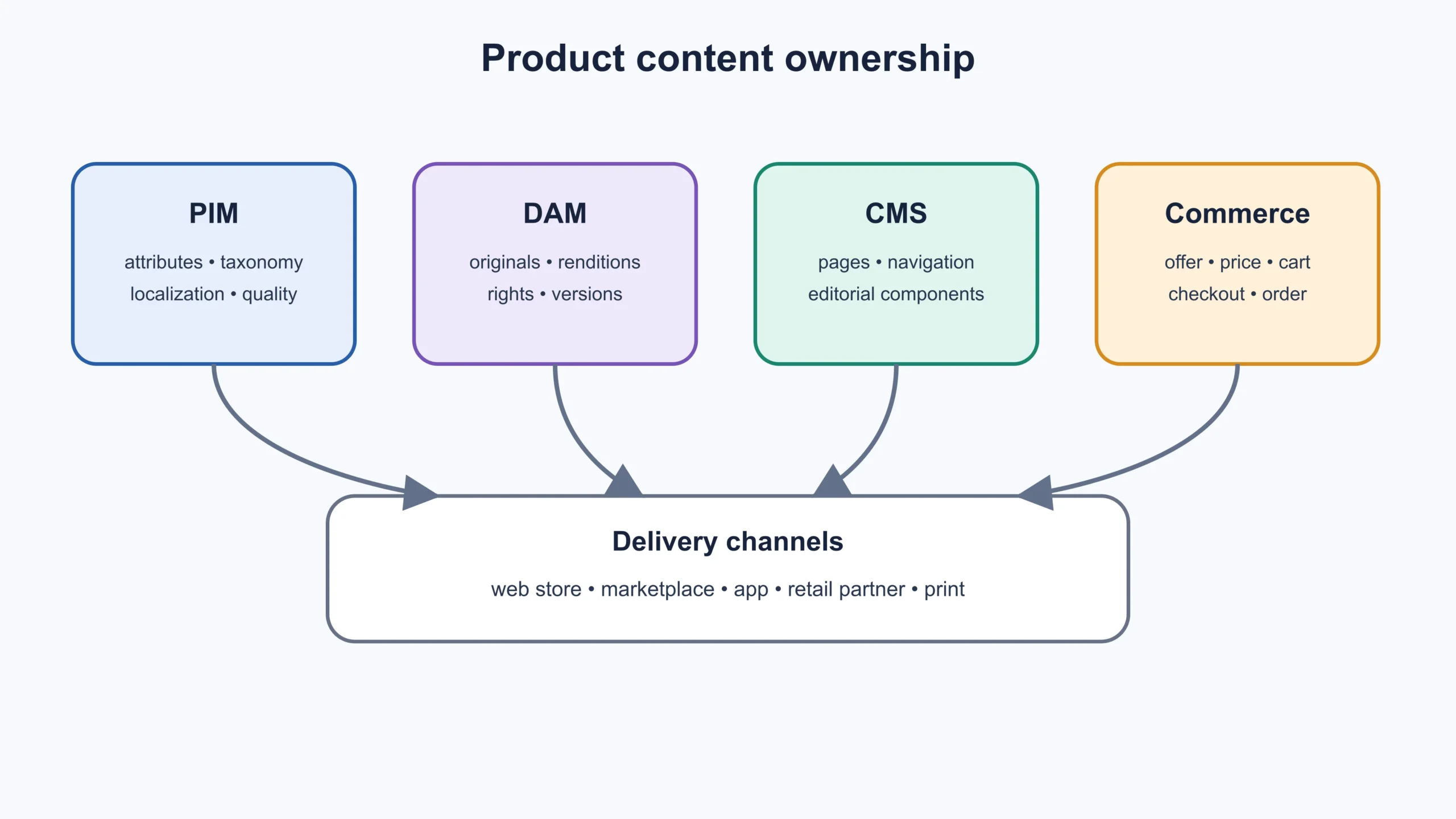
Image disclosure: The hero is an AI-generated editorial illustration and does not depict a real software implementation. The architecture diagram is an original ChoiceRidge schematic.

Short answer
Use PIM to govern structured sellable product information, DAM to govern reusable digital assets and rights, and CMS to compose and publish web experiences. The ecommerce platform still owns commerce behavior such as price presentation, cart, checkout, and orders. A small catalog may not need separate systems; complexity in products, channels, languages, assets, workflow, and governance creates the case.
The responsibility boundary
| System | Primary object | Typical responsibilities | Should not automatically own |
|---|---|---|---|
| PIM | Product and variant information | Attributes, taxonomy, completeness, localization, channel data | Original asset binaries, page layouts, orders |
| DAM | Digital asset and rendition | Images, video, rights, metadata, versions, crops | Product truth, price, checkout |
| CMS | Page and content component | Editorial layout, navigation, landing pages, publishing | Inventory, order state, full product master |
| Commerce platform | Sellable offer and transaction | Catalog delivery, price, promotion, cart, checkout, order | Enterprise source data by default |
Vendors often combine capabilities, so evaluate the actual data model and workflow rather than the label.
Product data needs governance
GS1's Global Data Model defines a consistent set of foundational product attributes used to list, order, store, move, and sell products. Its data-quality framework emphasizes checking repository information against the physical product. That illustrates why a PIM project is not only a database migration: teams need ownership, definitions, validation, workflow, and audit.
Map each attribute to a source and steward. Examples include GTIN, SKU, dimensions, weight, materials, ingredients, compatibility, regulatory statements, localized description, and channel-specific classification. Decide which changes create a new product identity, which require approval, and which channels receive each value.
DAM is more than an image folder
A DAM should manage original files, renditions, metadata, rights, expiry, approvals, relationships, and distribution. Test whether a product can reference assets without copying uncontrolled versions into every downstream system. Model market and channel restrictions, model releases, photographer or agency rights, alt-text workflow, and replacement of recalled or expired media.
Do not assume the newest upload is approved. Publishing systems should receive a stable asset identifier and appropriate rendition, with cache and invalidation behavior understood.
CMS composes the experience
The CMS combines editorial components, navigation, campaign material, buying guides, and product references into a web experience. It may store presentation-specific copy, but canonical product facts should not diverge silently from the governed source. Preview must reflect real commerce data and availability closely enough for editors to catch broken combinations.
In a headless architecture, APIs and frontend code increase flexibility while also increasing responsibility for preview, cache, routing, accessibility, analytics, and failure handling. Use the existing ChoiceRidge headless ecommerce guide for the platform decision.
When separate systems are justified
Signals include thousands of products or attributes, multiple brands and markets, many languages, marketplaces and retail partners, rich media with rights constraints, frequent supplier updates, long approval chains, or repeated data-quality incidents. A separate PIM or DAM may be excessive for a small single-channel catalog with one team and simple assets.
Calculate total operating cost: implementation, connectors, data cleanup, taxonomy design, migration, workflow configuration, training, API usage, storage, renditions, monitoring, and ongoing stewardship. The software does not resolve unclear ownership.
Integration design
Choose a source of truth per field and prohibit circular updates. Use stable identifiers, versioned schemas, validation, idempotent events, and a dead-letter or exception queue. Document full and delta synchronization, deletion, asset replacement, localization fallback, and channel rejection.
Test a product introduction, attribute correction, image-rights expiry, regional launch, product withdrawal, taxonomy change, and recovery after a downstream outage. Verify what a customer sees, not only that an API returned success.
Selection checklist
- Product, asset, page, offer, and order ownership defined
- Attribute dictionary, taxonomy, identifiers, and stewardship approved
- DAM rights, renditions, expiry, and accessibility workflow tested
- CMS preview and publishing use governed product and asset references
- No circular write paths between systems
- Localization and channel validation produce actionable exceptions
- Deletion, withdrawal, recall, and asset replacement propagate
- Total cost includes data cleanup and ongoing governance
- Export format and exit strategy preserve relationships and versions
This guide fills the product-data architecture gap between Ecommerce Platforms and Commerce Operations. It does not rank PIM, DAM, or CMS vendors; those require a separately dated market review.
Method and limitations
This product-neutral guide uses GS1 standards as the product-data foundation. Exact system boundaries vary by vendor and organization. Regulated product information requires sector-specific governance and qualified review.