Ecommerce automation should protect order accuracy and customer data while reducing repetitive work across storefronts, fulfillment, inventory, CRM, support, email, accounting, and internal alerts.
Commercial disclosure: Product buttons are direct, non-tracked official links at publication, so ChoiceRidge does not currently earn a commission from them. Plans and pricing were checked August 15, 2026. No hands-on reliability or benchmark testing is claimed.
Best ecommerce automation by operating model
Make is the best visual/value fit; Zapier the broad SaaS convenience choice; n8n the technical and self-hosted choice; Power Automate the Microsoft back-office and RPA choice; Pipedream the custom API and event choice.
Compare by ecommerce workflow—not integration count
Validate the exact Shopify, WooCommerce, marketplace, ERP, CRM, support, accounting, and fulfillment triggers and actions needed. A connector name alone does not guarantee every event or field.
| Platform | Entry pricing reference | Billing unit | Best reason to choose | Main trade-off |
|---|---|---|---|---|
| Make | Free: 1,000 credits/mo; Core: US$12/mo monthly or US$9/mo effective with annual prepayment for 10,000 credits | Credits: generally each module action consumes a credit | Visual multi-step scenarios, routers, filters, and strong value | Complex scenarios can be harder to debug and each module can affect usage |
| Zapier | Professional: $19.99/mo billed annually for 750 tasks | Tasks: successful action work; some actions use multiple tasks | Fast adoption, broad SaaS convenience, and built-in tools | Task economics can rise in multi-action or high-volume workflows |
| n8n | Cloud Starter: €20/mo billed annually for 2,500 executions | Executions: one complete workflow run, regardless of steps | Technical control, code, APIs, and Community Edition self-hosting | Self-hosting carries infrastructure, maintenance, security, and support work |
| Microsoft Power Automate | Premium: $15/user/mo paid yearly; Process: $150/bot/mo | Licensing by user or bot, subject to Microsoft licensing and capacity rules | Microsoft ecosystem, cloud flows, attended and unattended desktop RPA | Licensing and governance are more complex than a simple task quota |
| Pipedream | Free tier plus paid platform fee and usage; exact current quota in account/pricing | Credits: compute time per workflow segment and memory | Developer-first APIs, webhooks, code, and event workflows | Compute, memory, segments, and overage require cost monitoring |
How each platform fits ecommerce
Make
Why consider it: Best balance of visual power and entry economics for many multi-step workflows
Watch for: Complex scenarios can be harder to debug and each module can affect usage.
Check Make current termsZapier
Why consider it: Fastest route to common SaaS automations for many nontechnical teams
Watch for: Task economics can rise in multi-action or high-volume workflows.
Check Zapier current termsn8n
Why consider it: Strongest control and self-hosting path for technical operators
Watch for: Self-hosting carries infrastructure, maintenance, security, and support work.
Check n8n current termsMicrosoft Power Automate
Why consider it: Best fit for Microsoft 365, Power Platform, governance, and desktop RPA
Watch for: Licensing and governance are more complex than a simple task quota.
Check Microsoft Power Automate current termsPipedream
Why consider it: Best developer-first option for APIs, events, webhooks, and code
Watch for: Compute, memory, segments, and overage require cost monitoring.
Check Pipedream current termsBest choice by scenario
Small Shopify merchant
Zapier. Fast common app connections can outweigh unit cost.
Multi-step operations
Make. Visual routing and transformation are strong.
Custom WooCommerce stack
n8n. Technical control and APIs matter.
Microsoft ERP/back office
Power Automate. RPA and Microsoft governance are differentiators.
Custom storefront/API
Pipedream. Developer event processing is the natural fit.
Security, maintenance, and migration
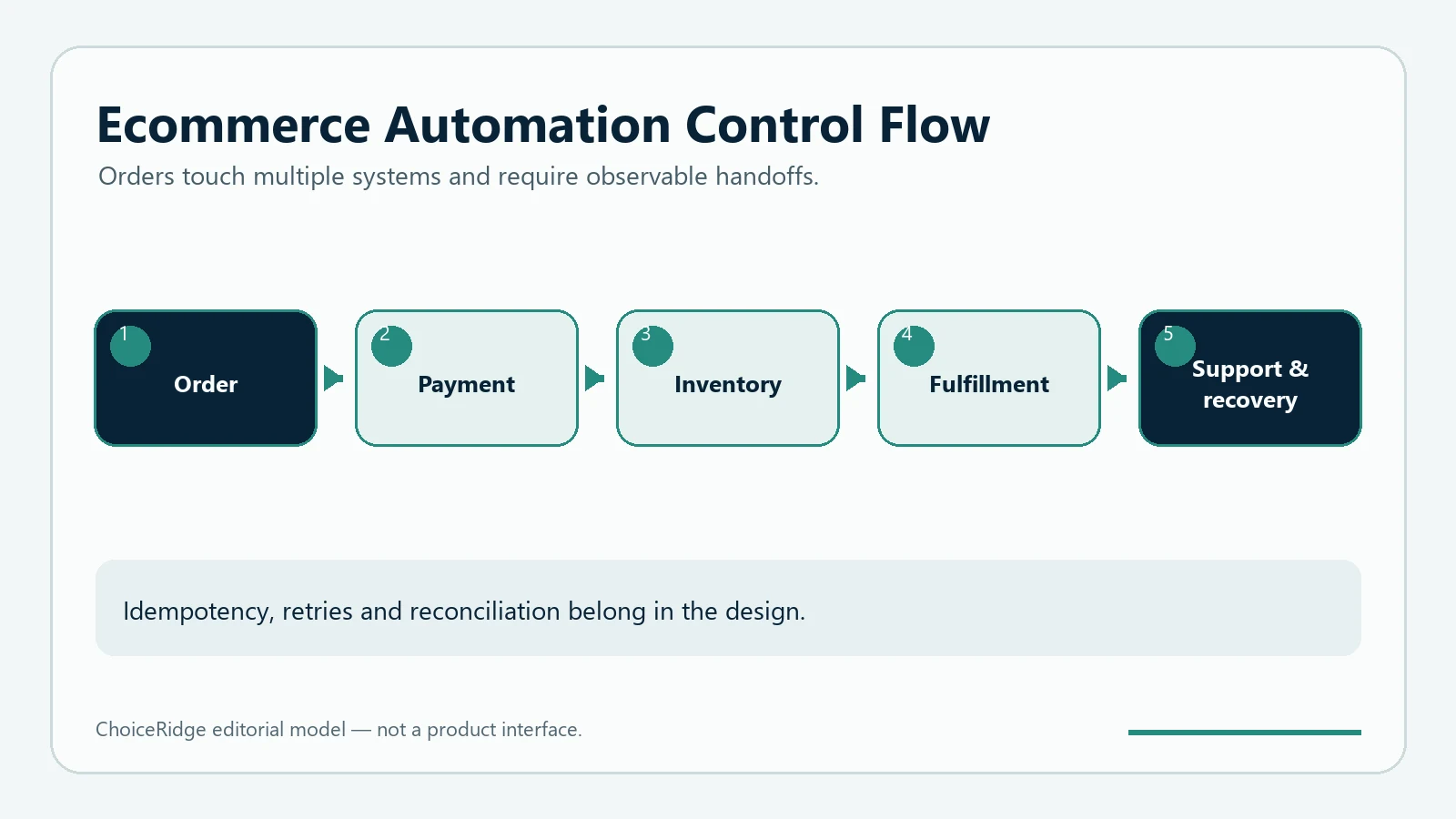
Treat orders, refunds, inventory, addresses, payment-adjacent data, and marketing consent as high-risk. Use idempotency, deduplication, retries, alerting, least-privilege credentials, audit logs, and a manual recovery path.
Final verdict
Make is the broadest ecommerce recommendation for teams comfortable with a visual builder. Zapier wins on rapid adoption, while n8n and Pipedream suit custom stacks and Power Automate suits Microsoft-centered operations.
Explore the complete automation library or use the Automation Tool Selector before building a shortlist.
Methodology and research limits
ChoiceRidge reviewed official pricing, product documentation, and feature descriptions available August 15, 2026. We considered billing architecture, workflow model, APIs and webhooks, code, self-hosting, desktop RPA, debugging, governance, maintenance, migration cost, and audience fit.
- No numerical scores or fabricated integration counts.
- No claim that self-hosting has zero total cost.
- No claim that provider features prove reliability or performance.
- Affiliate commission is not an inclusion or ranking criterion.
Read our Methodology, Editorial Policy, and How We Make Money.
Frequently asked questions
What ecommerce workflows should be automated first?
Internal notifications, CRM updates, support routing, reporting, and low-risk data synchronization are safer starting points than refunds or inventory writes.
Which is best for Shopify?
Zapier or Make often provide the fastest path, but verify the exact triggers and actions required.
Which is best for WooCommerce?
Make fits visual operations; n8n or Pipedream fit technical custom API workflows.