Activepieces and n8n both combine visual workflow building, code extensibility, AI-oriented automation, and self-hosting options. Their differences become clearer when a buyer compares commercial units, licensing, deployment responsibility, connector depth, and governance—not the number of logos on an integrations page.
Evidence disclosure: ChoiceRidge has not benchmarked both platforms under an identical production load for this draft. Findings are based on current first-party pricing, documentation, and license text checked August 31, 2026. Visuals are original editorial assets, not product screens.

Bottom line
Activepieces is compelling for teams that value a friendly builder, cloud or on-premises availability across plans, and MIT-covered core repository paths, subject to its enterprise-directory exceptions. n8n is compelling for teams that want a mature automation ecosystem, deep technical control, and a well-developed self-hosted operating model—but its Sustainable Use License is source-available/fair-code, not OSI open source.
Do not select either platform before running representative workflows. Connector counts change and may mix triggers, actions, community nodes, templates, or applications.
Side-by-side snapshot
| Question | Activepieces | n8n |
|---|---|---|
| Cloud and self-hosting | Advertised across plans | Cloud plus Community Edition; paid self-hosted tiers differ |
| Current billing concept | Credits; one full flow run is described as one credit | Workflow executions, with unlimited steps on current paid plans |
| Public entry plan | Free: 100 credits/day, one user | Community Edition for self-hosting; cloud Starter published separately |
| License signal | MIT for covered non-enterprise repository paths | Sustainable Use License; not OSI open source |
| Builder audience | Business-friendly automation with extensibility | Technical builders and operations teams needing deep workflow control |
| Governance | Plan-dependent users, SSO, roles, global connections, Git Sync | Plan-dependent projects, roles, environments, Git, SSO, log streaming |
Pricing models
Activepieces' page showed Free at $0 with 100 daily credits and one user; Plus at $16/month billed annually with 10,000 monthly credits, up to five users, and $0.007 per extra credit; Team at $166/month annually with 50,000 credits, 25 users, SSO, roles, and global connections; Ultimate is custom. Reconfirm limits and whether an operation can create more than one billed flow run through retries or architecture.
n8n's page showed Starter at €20/month billed annually with 2,500 executions and Pro at €50 with 10,000. Business was €667 with 40,000 executions and self-hosted enterprise features; Enterprise is custom. The page states paid plans include unlimited users, workflows, integrations, and steps, while pricing centers on executions. Verify concurrency, retention, projects, environments, support, AI builder credits, and overage behavior.
A fair model uses observed executions, not monthly task guesses. Include polling, retries, error branches, manual reruns, sub-workflows, test executions, queue backlogs, and seasonal peaks.
Self-hosting is an operating choice
Self-hosting can improve deployment control and data-location options, but it transfers responsibility. Activepieces recommends Docker Compose with PostgreSQL and Redis for production-style deployment, or Kubernetes when a team already operates a cluster. n8n similarly requires buyers to design persistence, encryption keys, worker/concurrency strategy, backups, upgrades, monitoring, and incident recovery.
Ask who owns:
- database backup and point-in-time recovery;
- secrets rotation and least-privilege credentials;
- queue monitoring and dead-letter handling;
- version upgrades and rollback;
- webhook availability and certificate renewal;
- node/package review;
- log retention and sensitive-data redaction.
If no team can own these controls, managed cloud may be the lower-risk option even when the license cost is higher.
Licensing matters
Activepieces' root license grants MIT terms for covered files but excludes enterprise-directory material. Confirm the exact edition and repository paths used in a deployment. n8n explicitly calls its license a Sustainable Use License and says it is not an OSI-approved open-source license. Internal business and noncommercial use are allowed, while white-labeling or hosting n8n as a paid service can require a commercial agreement.
This is not legal advice. Product builders, managed service providers, embedded-platform vendors, and resellers should have counsel review their intended distribution and monetization.
Integrations: test the operation, not the badge
For each critical system, record the exact trigger/action, authentication method, pagination, rate-limit behavior, webhook support, API version, custom-field handling, and error payload. A connector that can “create contact” may not support the idempotency, bulk operation, attachment, or region needed in production.
Also test the escape hatch: generic HTTP requests, code steps, custom pieces/nodes, and community packages. More extensibility means more security and maintenance work, so establish a review process.
Governance and AI workflows
Automation platforms increasingly execute AI-generated or AI-assisted decisions. Treat model output as untrusted input. Validate schema, constrain allowed actions, redact secrets and personal data, set monetary limits, and route high-impact actions to humans.
Compare both platforms on SSO, roles, project isolation, shared credentials, environment promotion, audit history, Git synchronization, secrets management, log streaming, and workflow ownership. The exact feature and deployment tier matters more than a generic “enterprise-ready” label.
Proof-of-concept scorecard
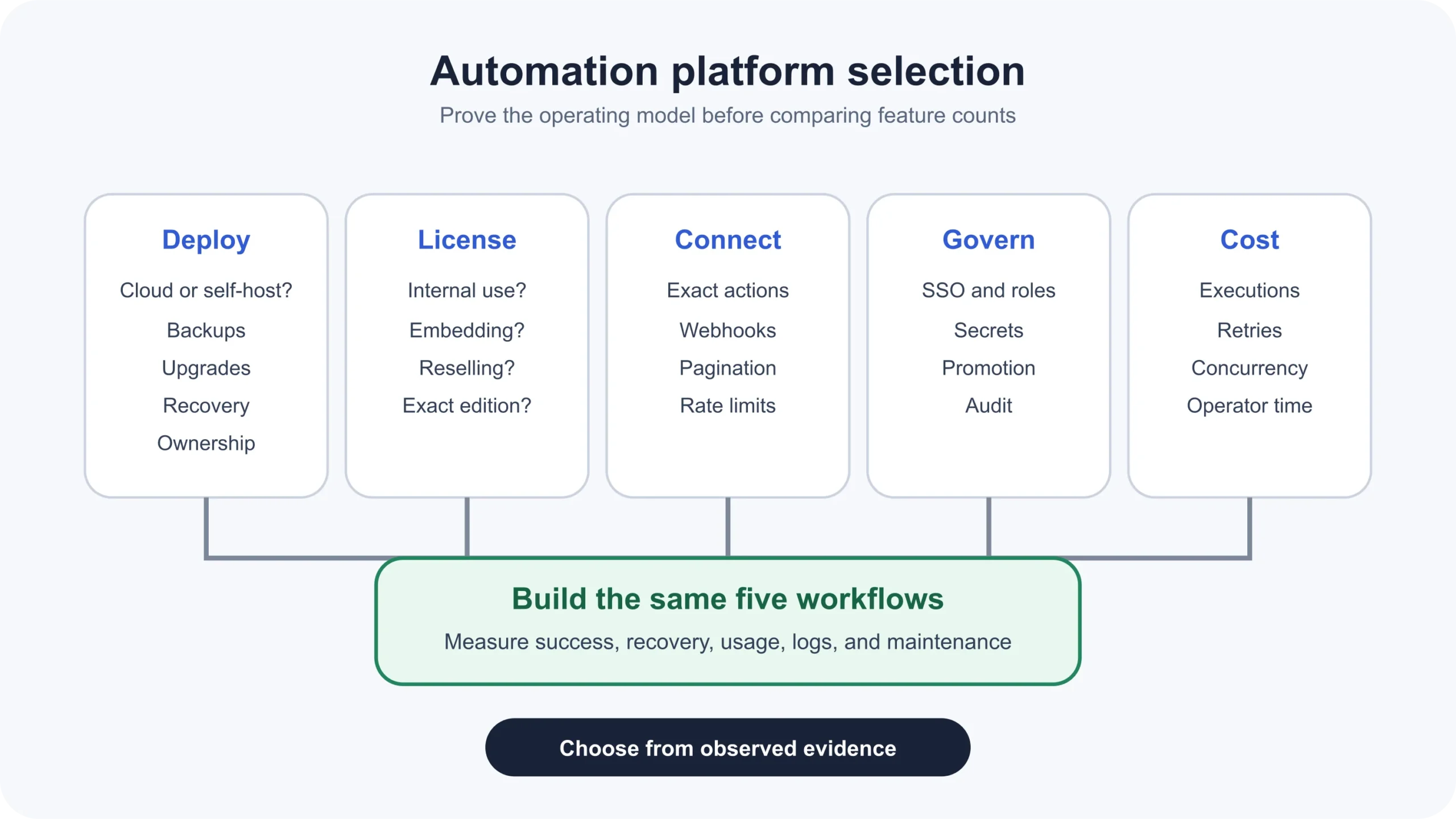
Build the same five workflows in both products:
- A webhook-to-CRM flow with validation and idempotency.
- A scheduled bulk sync with pagination and rate-limit recovery.
- An approval workflow that blocks a high-value action.
- An AI classification flow with structured output and a safe fallback.
- A failed-dependency scenario with retries, alerting, and replay.
Measure build time, successful-run rate, recovery time, execution consumption, log clarity, secrets exposure, version promotion, and operator effort. Then restore from backup and export the workflow as part of the test.
Verdict
Activepieces deserves a shortlist when approachable automation, flexible deployment, and the covered core license are priorities. n8n deserves a shortlist when technical workflow depth, ecosystem maturity, and scalable execution operations outweigh the license constraints and operational burden. The winner is the platform that safely runs the organization's real workload at a predictable total cost.
Read the complete Activepieces review and the Workflow Automation Governance Guide.