Order management, warehouse management, and inventory management overlap, but they optimize different decisions. An OMS coordinates the customer order across channels and fulfillment sources. A WMS executes work inside a warehouse. Inventory services track quantities, reservations, movements, and availability. The right architecture depends on where complexity actually exists.
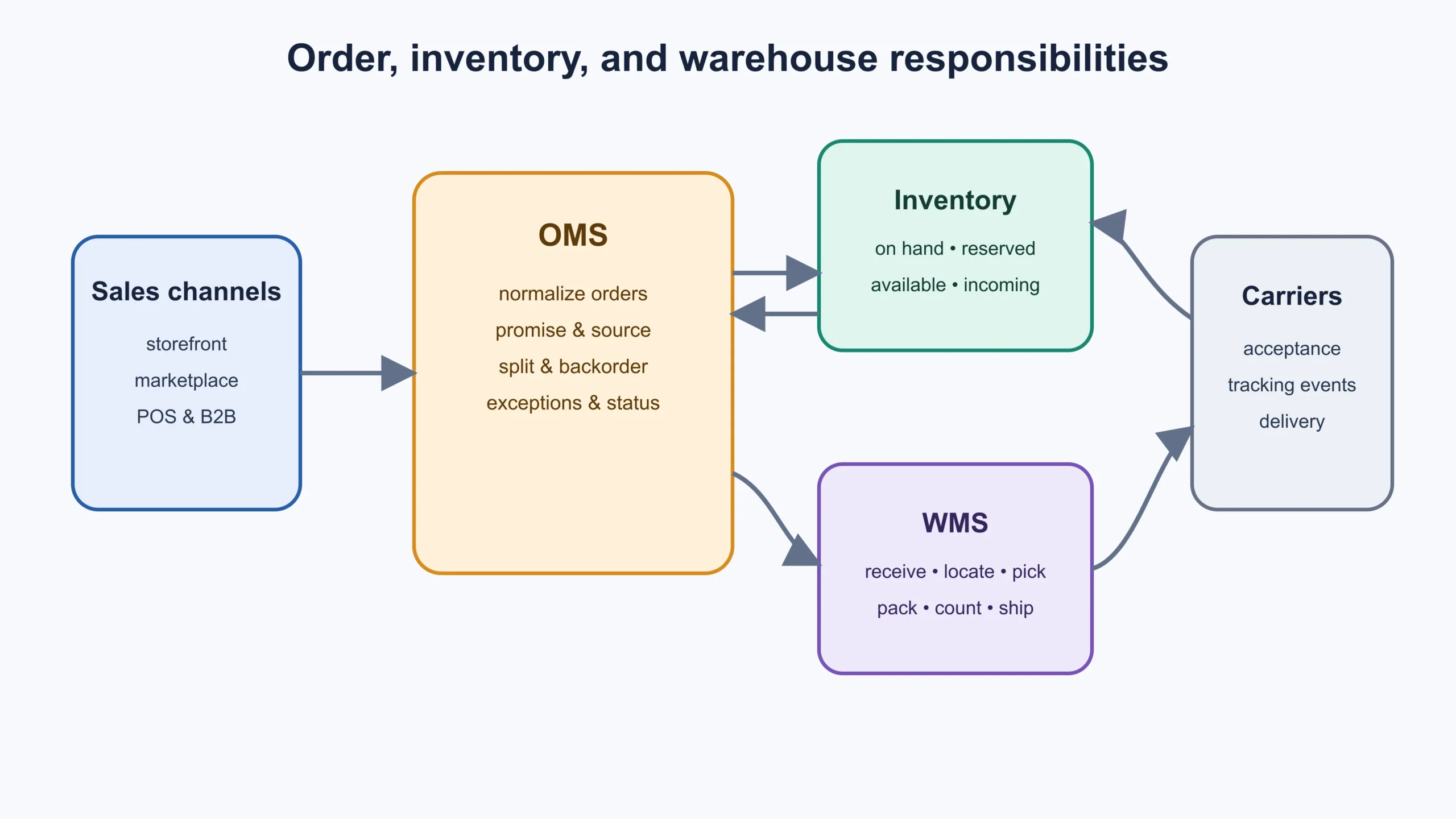
Image disclosure: The hero is an AI-generated editorial illustration, not a real warehouse or software test. The architecture diagram is an original ChoiceRidge schematic.

Short answer
Use an OMS when orders need cross-channel orchestration, sourcing, split fulfillment, exceptions, or a consistent order view. Use a WMS when warehouse receiving, locations, putaway, picking, packing, labor, and inventory movements require dedicated control. Use inventory management to maintain reliable on-hand, reserved, available, and incoming quantities. One suite may contain all three, but ownership and event flow must still be explicit.
What each system decides
| Capability | OMS | Inventory service | WMS |
|---|---|---|---|
| Capture and normalize orders | Primary | No | Receives work |
| Promise and source fulfillment | Primary | Supplies availability | Supplies capacity/status |
| Global stock view and reservation | Uses | Primary | Reports warehouse stock |
| Bin, lot, serial, putaway and pick | No | May summarize | Primary |
| Split, backorder and substitution | Orchestrates | Validates quantity | Executes assigned lines |
| Pack, label and ship confirmation | Tracks | Updates | Primary |
| Customer order status | Consolidates | Supplies stock events | Supplies execution events |
Microsoft's Intelligent Order Management documentation describes order orchestration across platforms, inventory visibility, fulfillment optimization, provider integrations, and a consolidated order view. It provides a useful example of OMS scope, not a universal product definition.
Inventory is a set of states
“Stock” can mean physical on hand, sellable, reserved, allocated, damaged, quarantined, incoming, safety stock, or available to promise. Define formulas and ownership. A global availability service may aggregate locations, while each WMS remains authoritative for movements inside its warehouse.
Latency matters. If a channel accepts orders using an availability value that updates slowly, overselling can occur even when every system is individually correct. Record event time, processing time, source, quantity delta, and idempotency key. Reconcile periodically against authoritative counts.
OMS: orchestration and customer promise
An OMS becomes valuable when orders arrive from multiple stores, marketplaces, B2B channels, point of sale, or service teams and can be fulfilled by warehouses, stores, suppliers, or 3PLs. It selects or coordinates a source, tracks splits, substitutions, holds, cancellations, returns, and exceptions, and publishes a coherent order state.
Test promised dates, source priorities, cutoff times, cost, capacity, inventory protection, geographic restrictions, and partial shipment. The ChoiceRidge Fulfillment SLA Calculator helps model promise assumptions, but production decisions need current inventory and operational capacity.
WMS: execution inside the facility
A WMS controls receiving, location and bin, putaway, replenishment, wave or task creation, picking, packing, cycle count, lot or serial traceability, and shipment confirmation. Requirements vary sharply by facility. A small operation with simple shelving may not need enterprise slotting or labor management; regulated or high-volume warehouses may require far deeper control.
Observe operators with scanners, printers, packaging, scales, and exception queues. Network coverage, label failure, damaged inventory, short picks, substitutions, and offline behavior often matter more than a polished dashboard.
Prevent circular ownership
Choose one authority for each state transition. For example, OMS creates a fulfillment request, inventory reserves quantity, WMS acknowledges and executes, carrier accepts the shipment, and OMS communicates consolidated status. Do not allow both OMS and WMS to independently finalize the same cancellation or quantity without reconciliation.
Use explicit events and states rather than overwriting one generic status. A shipment can be packed but not carrier-accepted; an order can be partially fulfilled while another line is backordered. Preserve line, fulfillment, package, and return identifiers.
Architecture test scenarios
- two channels compete for the last sellable unit;
- an order splits between warehouse and store;
- a short pick invalidates the original promise;
- customer cancels after release but before carrier acceptance;
- warehouse confirms a duplicate event;
- inventory update arrives late or out of order;
- one location goes offline during routing;
- return receipt changes disposition but not sellable stock immediately;
- substitution or backorder needs customer approval;
- OMS, WMS, or carrier is temporarily unavailable.
Measure allocation success, oversell, cancellation after promise, split rate, order-cycle time, pick accuracy, dock-to-stock, inventory adjustment, exception age, on-time shipment, and complete delivery. Averages should be segmented by channel, node, method, and exception type.
Selection checklist
- Order, fulfillment, inventory, warehouse, package, and return states defined
- System of record named for each field and transition
- Availability formula, reservation, safety stock, and latency documented
- Routing rules use real capacity, cutoff, cost, and restrictions
- Warehouse workflows tested on actual devices and exceptions
- Events are idempotent, timestamped, observable, and reconcilable
- Partial, duplicate, late, canceled, and offline scenarios pass
- Customer promise derives from measurable operational inputs
- Export, historical trace, and migration path verified
Use the Commerce Operations Software hub for adjacent returns, fraud, shipping, and SLA topics. Ecommerce platform reviews explain native order features, but they do not replace an architecture assessment for a multi-system operation.
Method and limitations
This product-neutral guide uses current Microsoft documentation as an implementation example. Vendor modules blur category boundaries. Validate the actual data model, APIs, workflows, plan limits, and operational fit in a representative proof of concept.