Activepieces combines visual workflow automation with AI agents, tables, integrations, cloud hosting, and self-hosting. It is especially relevant to buyers who want an open-source core or deployment control without giving up a no-code/low-code builder. The trade-off is operational responsibility: self-hosting moves availability, upgrades, backups, secrets, and observability onto the buyer.
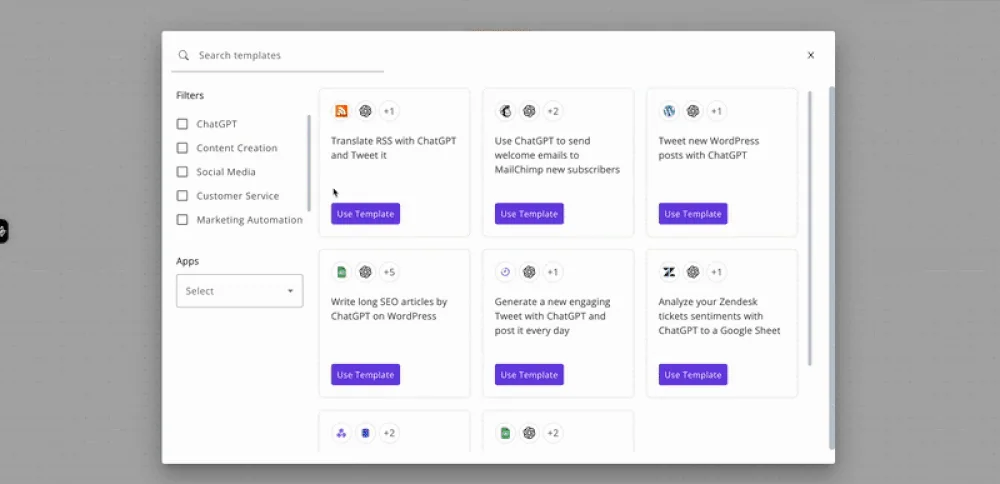
Testing and image disclosure: ChoiceRidge has not completed a hands-on Activepieces trial for this draft. Findings use current first-party pricing, documentation, and the official GitHub repository checked August 31, 2026. The hero and workflow diagram are original editorial visuals. The included product screenshots come from the official repository's MIT-covered documentation resources and are not ChoiceRidge test evidence; the license is preserved in
sources/ACTIVEPIECES-LICENSE.txt.

Bottom line
Activepieces deserves a shortlist for teams comparing cloud automation with an open-source or on-premises path. Its current pricing is accessible for individual and small-team builders, while enterprise governance features sit higher in the plan structure. Do not choose it solely because it is open source: compare connector coverage, debugging, change control, execution reliability, community health, and the real cost of operating it.
Pricing and deployment
The public pricing page currently lists:
- Free: $0, one user, 100 credits per day, unlimited flows, API access, agents, flows, tables, and all apps.
- Plus: $16 per month billed yearly, up to five users, 10,000 credits per month, bring-your-own AI keys, and $0.007 per extra credit.
- Team: $166 per month billed yearly, 25 users, 50,000 credits per month, unlimited projects, SSO and standard roles, global connections, and email support.
- Ultimate: custom pricing, with features including SCIM, custom roles, secret-manager support, audit logs, SIEM event streaming, private pieces, releases, and Git Sync.
The page says every plan can run cloud or on-premises. Activepieces recommends Docker Compose with PostgreSQL and Redis for self-hosting; Kubernetes is intended for teams already operating a cluster. The Community edition is available for hobbyist self-hosting, while enterprise governance requires commercial evaluation.
Builder and integration model
Activepieces' public site currently advertises more than 700 integrations. Treat that count as dynamic and verify the exact triggers/actions needed. A connector may exist but lack a critical field, webhook, pagination behavior, or authentication mode. The open repository also makes it possible to inspect and contribute “pieces,” but custom maintenance is still maintenance.
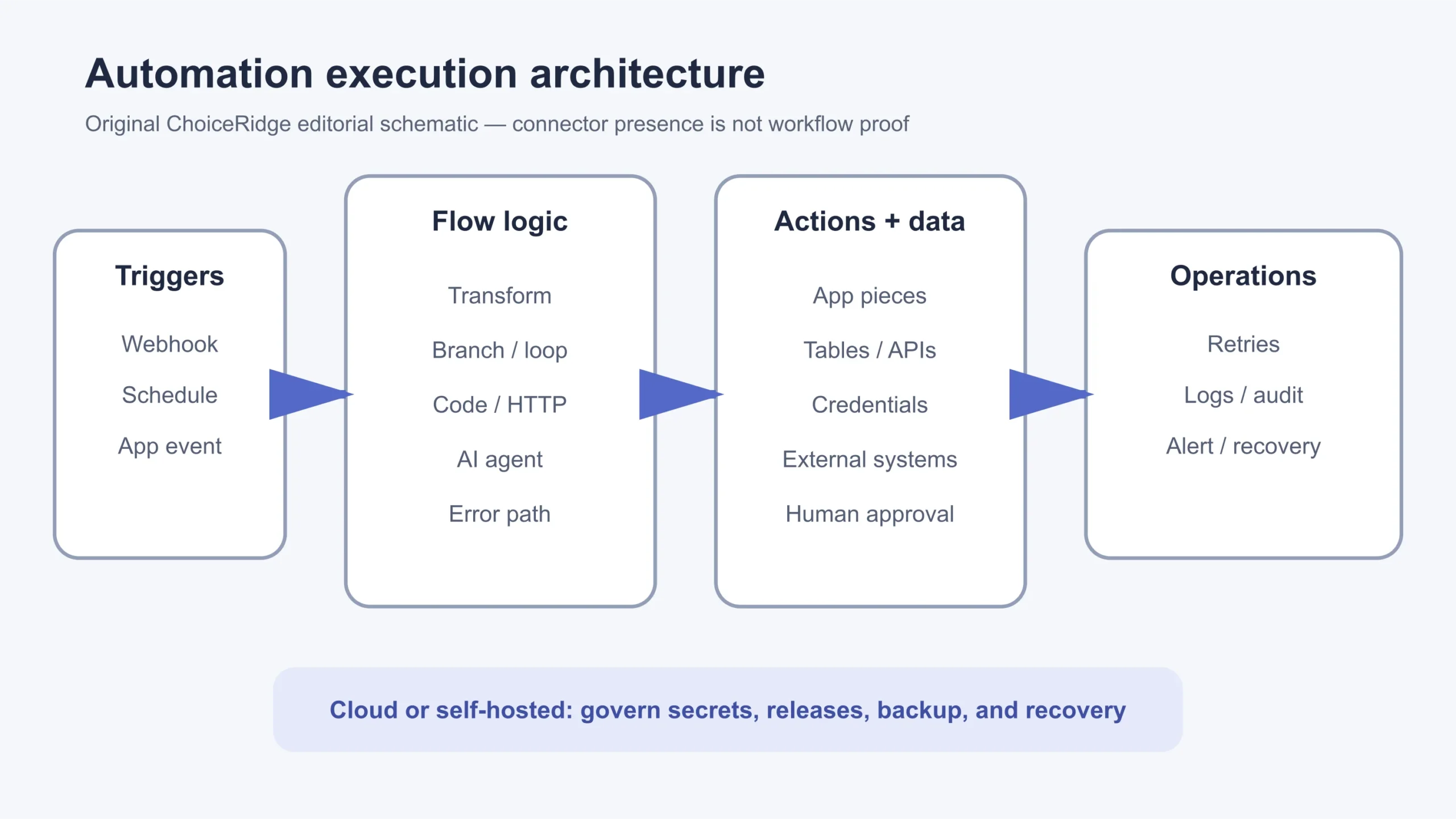
The core automation pattern is trigger, steps, branching or looping, actions, and execution history. AI features add agents and conversational automation. Useful capability is only half the evaluation; buyers must test retry behavior, idempotency, concurrency, payload size, long-running workflows, time zones, rate limits, secrets, and recovery after partial failure.
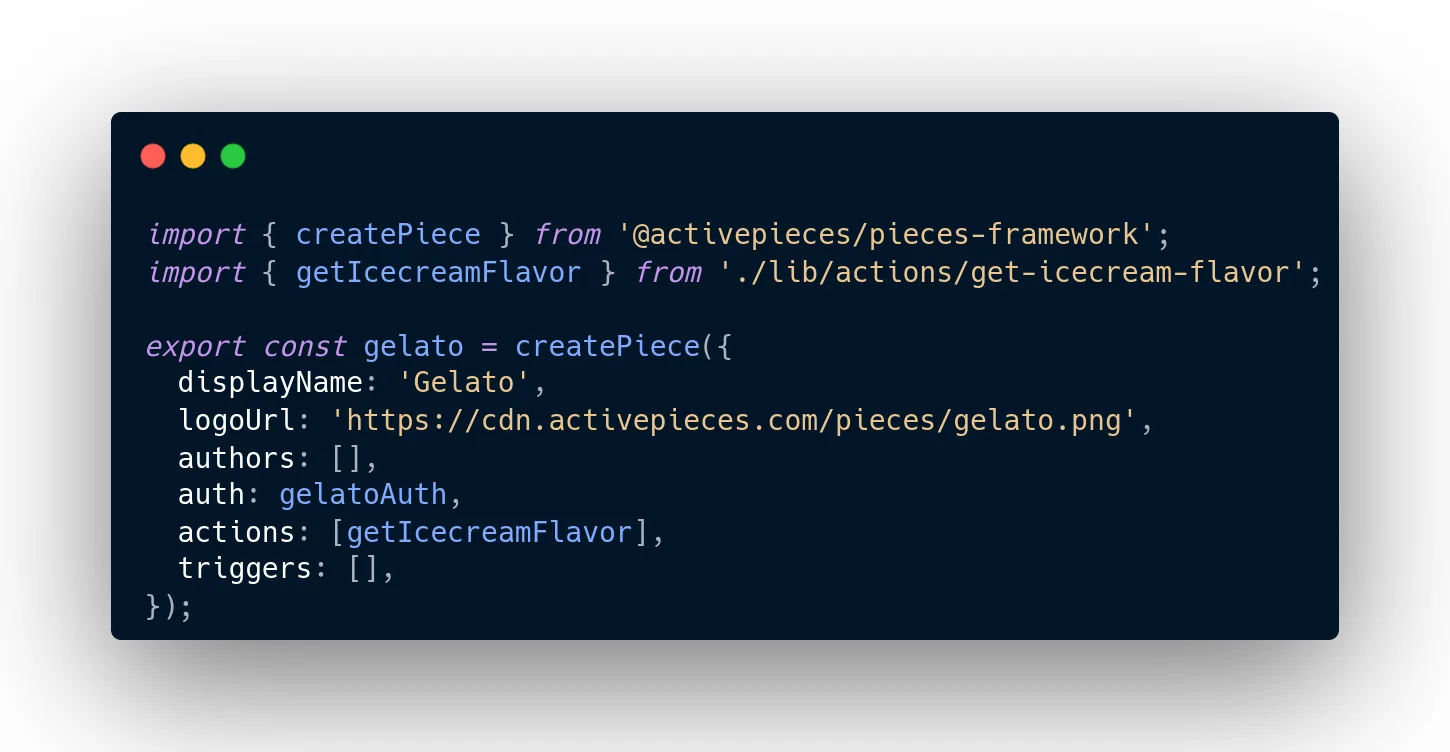
The repository also documents how developers can extend the catalog with custom pieces. The example below is source-code documentation rather than a product-interface capture; it illustrates that extensibility requires software ownership, testing, and maintenance.
Cloud versus self-hosting
Cloud reduces operational work and gives the vendor responsibility for the service layer. Self-hosting improves deployment control and may support data-location or network requirements, but the buyer must own:
- database and Redis durability;
- encryption and secret storage;
- backups and restore drills;
- upgrades, migrations, and rollback;
- public webhook reachability and TLS;
- worker scaling and queue health;
- logs, metrics, alerting, and incident response;
- license and enterprise-feature boundaries.
The documentation says cloud data is currently hosted in Germany; self-hosted regions depend on the buyer's infrastructure. Confirm current data-processing terms and subprocessors before approval.
Governance
Activepieces documents RBAC, SSO, audit logs, password controls, and enterprise governance capabilities, but plan availability matters. A small team can begin quickly; an organization that needs custom roles, SCIM, external vaults, audit streaming, private connectors, and controlled releases may require Ultimate.
Open source improves inspectability and exit options but does not automatically provide secure configuration. Pin versions, review dependencies, limit egress, separate environments, rotate credentials, and test restoration.
Where it fits best
- Technical operations teams wanting visual automation plus an inspectable open-source core.
- Organizations comparing vendor cloud with controlled self-hosting.
- Builders needing workflows, agents, tables, APIs, and a broad connector catalog.
- Teams prepared to govern credentials, failures, releases, and custom pieces.
Where to be cautious
- Connector quantity does not guarantee workflow completeness.
- Self-hosting can cost more than cloud after operations labor and reliability controls.
- Advanced governance and release controls may require a custom enterprise plan.
- AI steps introduce model cost, nondeterminism, privacy, and evaluation requirements.
- Public product and integration counts change quickly; validate them at purchase time.
Proof-of-concept checklist
- Build three representative flows: simple SaaS sync, webhook with branching, and a failure-prone multi-step process.
- Verify every required field, trigger, action, pagination path, and authentication mode.
- Test duplicate events, retries, rate limits, timeouts, partial failure, and idempotency.
- Compare cloud and self-host restore, upgrade, rollback, logging, and webhook behavior.
- Validate secret access, roles, project isolation, SSO, and audit evidence required by policy.
- Evaluate AI steps with a fixed test set, cost ceiling, human escalation, and data rules.
- Export flows and document migration or exit options.
- Model credits plus infrastructure, engineering, monitoring, support, and incident labor.
Pros and drawbacks
| Strengths | Drawbacks or unknowns |
|---|---|
| Open-source core and cloud/on-prem path | Self-hosting shifts operations to the buyer |
| Accessible entry pricing and unlimited flows | Credits and AI/infrastructure costs need modeling |
| Broad and extensible connector ecosystem | Each critical connector still needs field-level testing |
| Enterprise governance path | Advanced controls may require custom pricing |
Verdict
Activepieces is one of the more interesting automation options for buyers who value deployment choice and source availability. It should advance when representative workflows prove connector depth, failure recovery, governance, and total cost. The open-source label is a useful architectural property—not a substitute for reliability engineering or vendor due diligence.
Use the ChoiceRidge Workflow Automation Governance Guide to define requirements and the Automation Tool Selector to structure the shortlist.