Short answer: inventory automation needs one defined authority per quantity, explicit reservation logic and regular reconciliation. Copying numbers quickly between systems does not solve overselling when the systems disagree about what “available” means.
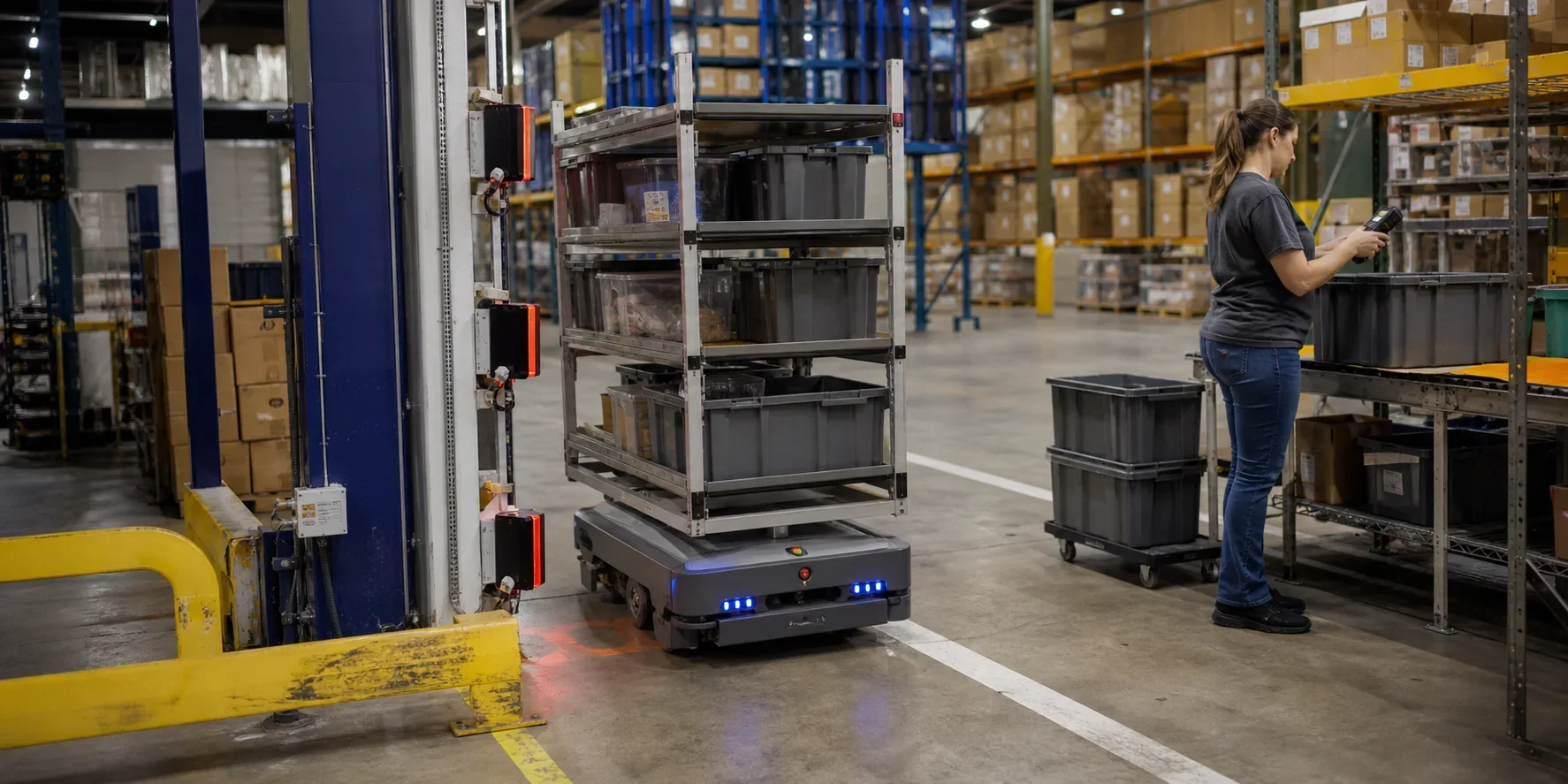
Image disclosure: this AI-generated editorial illustration visualizes warehouse automation; it is not a documented vendor installation.
Define every quantity
Physical on-hand, sellable, reserved, committed, inbound, damaged, quarantined and safety stock are different measures. Write the formula for the quantity each channel may sell. Then document which system owns each component and which event changes it.
A common design is to let the inventory or order-management system own reservations while commerce channels receive derived availability. Another business may use the commerce platform as the authority for simple single-location stock. The correct choice depends on fulfillment topology, not software prestige.
Choose events that match the business transition
An item-created event is not the same as a quantity-changed event. A paid order is not necessarily a shipped order. An inbound purchase order is not available stock. Shopify’s Flow documentation, for example, distinguishes inventory-item creation from quantity-change workflows and supports scheduled inventory queries. The useful lesson is to select events by meaning, not by convenient name.
For each event, record the source timestamp, source sequence or version where available, SKU, location and reason. Reject or quarantine events that cannot be mapped safely.
Protect against ordering and concurrency errors
Two orders may reserve the final unit at nearly the same time. A late adjustment may arrive after a newer count. A retry may apply the same decrement twice. Use atomic reservation in the authoritative system, compare-and-set/version checks where supported, and event identifiers for deduplication.
When strict ordering is impossible, calculate current state from the authority rather than trusting every delta. Periodic snapshots and reconciliation are essential because a real integration eventually misses, delays or duplicates something.
Automate replenishment with constraints
A low-stock alert is the simplest pattern. Automatic purchase suggestions add lead time, demand variability, pack size, minimum order quantity, supplier reliability, open purchase orders and safety stock. Automatic purchasing adds financial authority and should use thresholds or approval gates.
| Automation level | Output | Recommended control |
|---|---|---|
| Observe | Low-stock alert | Owner and response target |
| Recommend | Proposed reorder quantity | Explain inputs and allow edit |
| Prepare | Draft purchase order | Approval before supplier commitment |
| Execute | Send order automatically | Narrow scope, spend limit and reconciliation |
Do not let an anomalous demand spike or corrupted count create an unlimited order. Cap quantities and monetary exposure, then route outliers to review.
Reconcile physical and digital stock
Track negative inventory, stale SKUs, unacknowledged channel updates, location mismatches, reservation age and count variance. Cycle counts should feed corrections with a reason code; they should not silently overwrite discrepancies that might indicate process failure.
Test duplicate sales events, returns before receipt, transfers in transit, partial receipts, damaged items, SKU remaps, late events, API rate limits and a channel outage. Confirm recovery without resetting good quantities.
Use the Software Stack Planner to map inventory dependencies and the automation governance guide to assign ownership.
Decision rule
Automate inventory movement only when the quantity definition, authority, conflict behavior and reconciliation path are explicit. If two systems can both change the same number without coordination, fix ownership before adding another connector.
References
- Shopify Help: Managing inventory, accessed August 30, 2026.
- Shopify Help: Get inventory item data in Flow, accessed August 30, 2026.
- Microsoft Azure: Queue-Based Load Leveling pattern, accessed August 30, 2026.