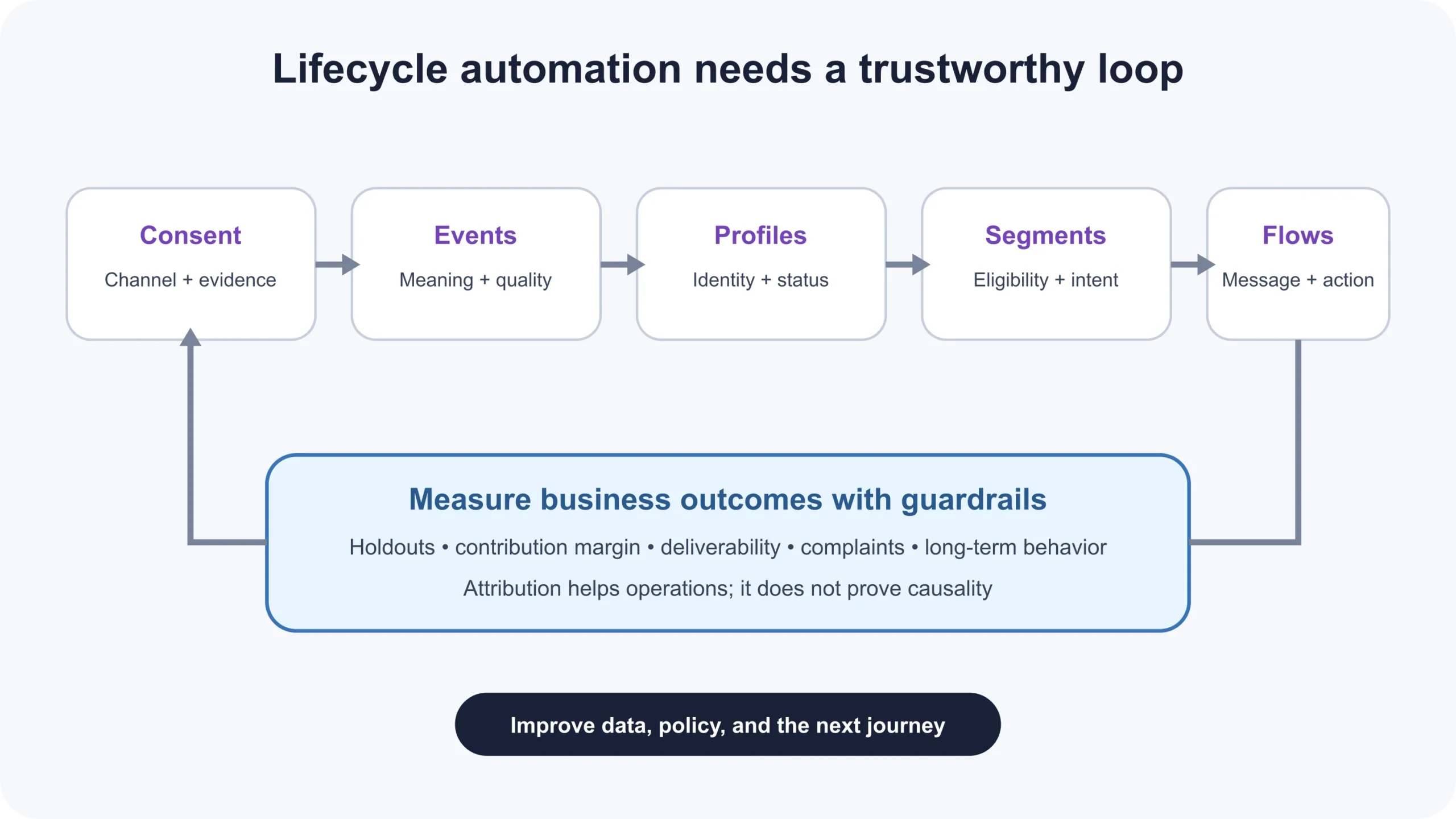
Klaviyo has expanded beyond email into a broader B2C CRM proposition spanning marketing, service, analytics, and data. Its familiar center remains customer profiles, events, segments, campaigns, and triggered flows across channels. The platform is powerful when commerce and behavioral data are reliable; it becomes expensive and risky when profile hygiene, consent, attribution, or event definitions are weak.
Testing and image disclosure: ChoiceRidge has not completed a controlled Klaviyo implementation for this draft. Findings use first-party pricing, help, and developer documentation checked August 31, 2026. Visuals are original editorial assets, not Klaviyo product screens. No official screenshot or logo is included because a sufficiently clear general editorial-use permission was not established during research.

Bottom line
Klaviyo is a strong shortlist candidate for a consumer brand that needs ecommerce-aware segmentation and lifecycle automation and can operate the underlying data, consent, deliverability, and experimentation program. It is a poor purchase if the plan is merely to import a large contact list and send more messages.
The core business case should be incremental profit from relevant journeys—not platform-attributed revenue alone.
What Klaviyo does
Klaviyo combines customer profiles and event data with segmentation, campaigns, automated flows, forms, analytics, and integrations. Current positioning includes email, SMS and other mobile or messaging channels depending on region and product availability, plus service and analytics capabilities. The marketplace advertises hundreds of integrations, but buyers should test the specific objects and event latency they need.
Flows can start from a list, segment, event/metric, date, price drop, or other supported trigger. Flow filters are rechecked before a message is sent, which is useful for excluding customers whose status changed after entering the journey. Typical programs include welcome, browse abandonment, cart abandonment, post-purchase education, replenishment, win-back, and back-in-stock messaging.
Pricing and active profiles
Klaviyo's pricing is dynamic: paid costs vary with active profiles, send volume, channel, and selected products. At the review date, the Free tier supported up to 250 active profiles and 500 monthly emails, included a $5 monthly mobile-message allowance, 10,000 Composer credits, built-in reporting, and email support for the first 60 days. Use the live calculator for the intended profile and channel mix rather than quoting a universal paid price.
Klaviyo says email billing uses active profiles—profiles eligible for at least one marketing type—and email plan send limits can be ten times the maximum active-profile count. Suppressing inactive profiles can control cost and improve engagement quality, but suppression is a policy decision: it can take time to process, must respect retention and reactivation needs, and a plan does not automatically downgrade after the audience shrinks.
Model:
- active and total profiles over 12 months;
- email and mobile-message volume;
- seasonal list growth;
- service, analytics, or data-platform subscriptions;
- implementation, creative production, deliverability, and data engineering;
- opt-out, suppression, and reactivation rates.
Data architecture determines value
The best flow cannot repair ambiguous events. Define a canonical event dictionary with owner, trigger, required properties, timestamp, currency, identifiers, deduplication rule, consent basis, and retention. Verify identities across guest checkout, logged-in sessions, devices, returns, cancellations, and subscription changes.
Klaviyo's Events API can create or retrieve event data associated with profiles and metrics, and events can trigger flows. Instrument the full lifecycle: viewed product, started checkout, placed order, fulfilled order, refunded order, subscription state, support outcome, and product availability. Avoid sending secrets or unnecessary personal information as event properties.
Consent is channel-specific
Email permission does not automatically authorize SMS or another messaging channel. Klaviyo's documentation emphasizes channel-specific consent and explicit SMS consent. Requirements vary by jurisdiction, so configure forms, disclosures, quiet hours, double opt-in where appropriate, proof records, suppression, and keyword handling with qualified legal guidance.
Test that consent changes propagate before a scheduled send and that imports preserve source and timestamp. A “subscribed” field without evidence is not a complete consent record.
Attribution is useful, not causal proof
Klaviyo attribution uses configurable lookback windows and, for new accounts, documents a last-touch approach by default. Attributed revenue can guide operations, but it does not prove the message caused the purchase. Existing demand, discounts, other channels, seasonality, and selection effects may receive credit.
For meaningful measurement, combine attribution with holdout groups, randomized tests where feasible, margin and discount data, unsubscribe/spam rates, deliverability, and long-term customer behavior. Optimize incremental contribution margin, not open rates or gross attributed revenue in isolation.
Strengths
- Ecommerce-oriented profiles, events, segments, and lifecycle flows.
- Broad integration marketplace and APIs for custom event pipelines.
- Multi-channel expansion within one customer model.
- Trigger and filter controls that support timely automation.
- Useful operational reporting when definitions and windows are understood.
Risks and limitations
Profile-cost growth
An undisciplined audience can raise cost even when many profiles are unengaged. Establish lifecycle definitions for active, inactive, suppressed, consented, and service-only contacts.
Deliverability
More volume can reduce inbox placement. Configure authentication, warm sending carefully, monitor bounces and complaints, segment by engagement, and maintain list hygiene. Evaluate deliverability independently from dashboard engagement.
Integration quality
Marketplace presence does not guarantee every event, property, historic backfill, or consent state synchronizes correctly. Reconcile source-system totals and test updates, deletes, refunds, and duplicate identities.
Organizational complexity
Lifecycle programs need marketing, engineering, analytics, design, legal/privacy, and support collaboration. Without owners and change control, overlapping flows can over-message customers or create conflicting offers.
Proof-of-concept checklist
- Import only a consented, documented test audience.
- Validate identity resolution across anonymous browse, signup, and purchase.
- Reconcile placed-order, cancellation, refund, and revenue totals with the commerce source.
- Build one welcome, abandonment, post-purchase, and win-back flow.
- Test exclusions at entry and immediately before send.
- Confirm email and SMS consent remain separate through import, form, API, unsubscribe, and resubscribe.
- Run a holdout or incrementality experiment with a predeclared success metric.
- Measure event latency, duplicate rate, send cost, contribution margin, complaints, and unsubscribes.
- Export profiles, consent evidence, events, segments, templates, and reporting data.
- Forecast cost at 12-month active-profile growth.
Verdict
Klaviyo can be a high-leverage lifecycle platform for commerce businesses that invest in trustworthy events, channel-specific consent, deliverability, and experimentation. Its broadening B2C CRM scope is useful only when the organization has a clear system boundary and operating ownership. Shortlist it for sophisticated lifecycle marketing; reject a business case based solely on attributed revenue or headline integration counts.
Use the ChoiceRidge Workflow Automation Governance Guide to govern consequential automations and record observed evidence in the Software Comparison Scorecard.