ShipStation is a multi-channel shipping platform for importing orders, comparing or assigning services, producing labels, coordinating fulfillment work, and returning shipment updates to selling channels. Its value depends on operational fit: carrier accounts, shipment volume, warehouse layout, order complexity, automation rules, hardware, and the quality of each channel integration.
Testing and image disclosure: ChoiceRidge has not completed a hands-on ShipStation trial for this draft. Findings are based on current first-party pricing and help documentation checked August 31, 2026. The images are original editorial visuals, not ShipStation screens. No vendor logo or site image is copied because ShipStation's terms restrict commercial reproduction and trademark use without permission.

Bottom line
ShipStation belongs on a shortlist when a merchant needs a dedicated shipping workspace across several stores or marketplaces and wants repeatable rules for carrier, service, packaging, fulfillment, and warehouse decisions. It should not be mistaken for a universal OMS, WMS, or ERP replacement. Buyers need to define which system owns orders, inventory, allocation, picking, labels, tracking, returns, and financial reconciliation.
Plans and pricing
ShipStation's public US pricing currently scales by plan and monthly shipment allowance. Starter begins at $14.99 per month for 50 shipments; Standard begins at $29.99; Premium begins at $349.99. The page lists unlimited store connections across the plans shown. Standard adds capabilities such as unlimited automations, combining and auto-splitting orders, existing carrier accounts, returns/exchanges, basic warehouse management, Shipping API, and phone support. Premium adds advanced inventory and warehouse features, custom analytics, auto-routing, ODBC, and dedicated implementation.
The headline subscription is only part of cost. Model label/postage charges, carrier terms, insurance, premium integrations, users, scanners/printers/scales, implementation, support, warehouse labor, API development, and peak-volume tiers.
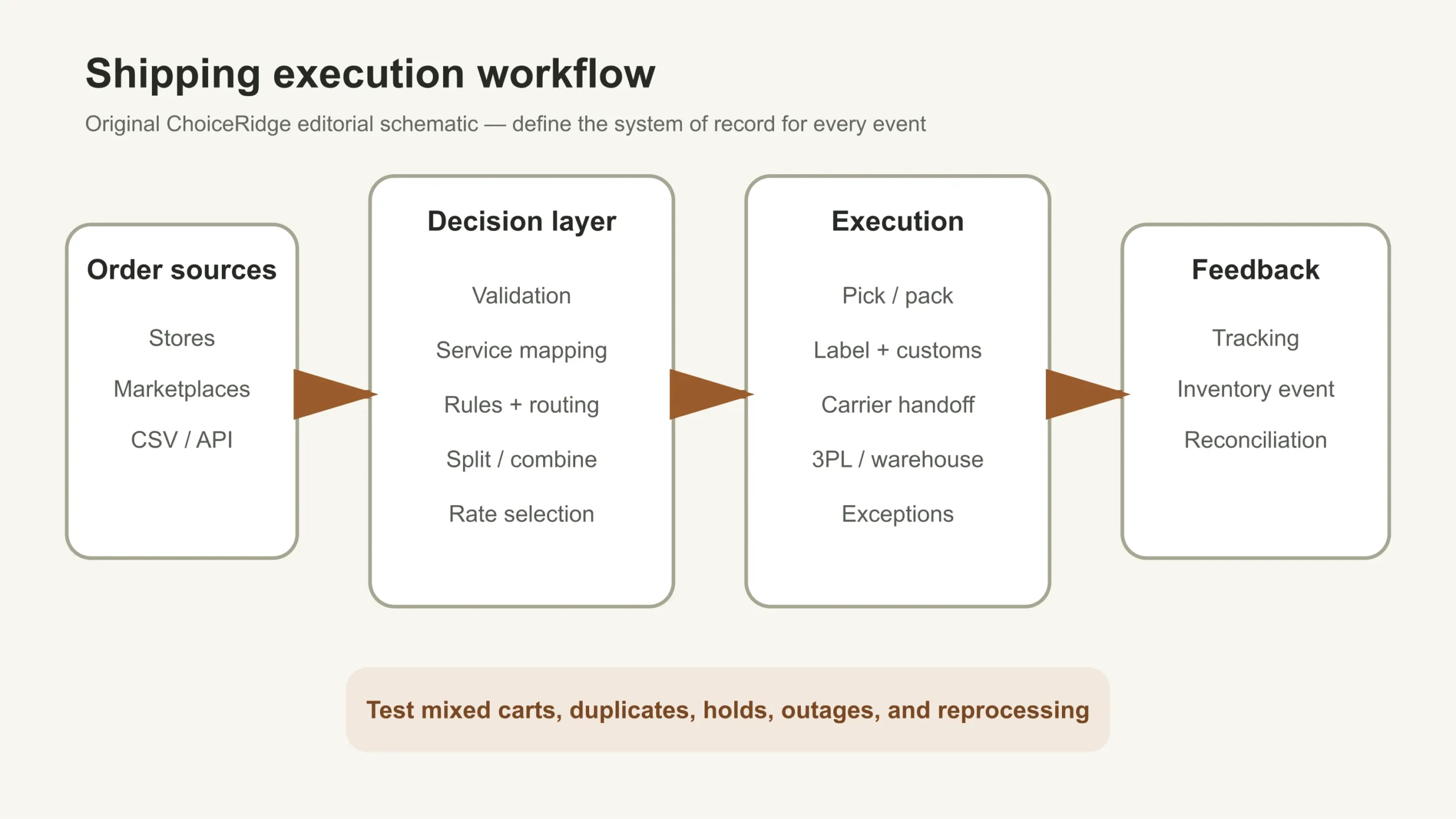
Automation depth
ShipStation documents several automation layers: auto-routing, auto-split, product defaults, service mapping, and IF/THEN automation rules. Rules can inspect fields such as store, destination, order value, SKU, tags, requested service, and warehouse location, then set carrier/service/package, add tags or notes, assign users, send email, or send an order to a fulfillment provider.
Order matters. Some rules rely on earlier rules, and reprocessing does not replay every behavior. The documentation also notes limitations for item-name, SKU, and warehouse-location criteria on multi-line-item orders. A proof of concept must include mixed carts, split shipments, holds, edits, and duplicate imports—not only clean one-item orders.
ShipStation explicitly warns buyers to test before using the “Don't Import the Order” action because it can make orders unavailable in the platform. That principle should extend to any rule that routes, suppresses, splits, or submits an order.
Inventory and API
ShipStation offers internal inventory functions and integrations that display stock counts. Its V2 API includes shipping and inventory endpoints for rates, labels, tracking, stock levels, SKU counts, warehouse assignment, and inventory adjustments. API availability does not resolve ownership: establish whether ecommerce, ERP, WMS, 3PL, or ShipStation is authoritative for each inventory event.
Latency and conflict handling are critical. Test oversells, partial fulfillment, returns, manual adjustments, bundles, multiple warehouses, and simultaneous updates. Confirm what happens when a store, carrier, or API is temporarily unavailable.
Where it fits best
- Merchants shipping from several stores or marketplaces.
- Teams that want configurable rules to reduce repetitive carrier and service selection.
- Operations with enough label volume to justify a specialized shipping console.
- Businesses whose carrier, warehouse, and integration requirements appear on the tested plan.
Where to be cautious
- Advanced warehouse and inventory functions sit on a substantially higher starting tier.
- Rules can create silent operational errors if their order and edge cases are not documented.
- Some item-specific criteria do not behave as expected for multi-product orders.
- API and integration capabilities vary; “connected” does not mean real-time, bidirectional, or complete.
- International shipping requires carrier, tax, customs, commodity, and documentation validation outside the subscription checklist.
Proof-of-concept checklist
- Import orders from every target channel, including edits, cancellations, holds, and duplicates.
- Compare rates using actual package dimensions, negotiated accounts, surcharges, and delivery promises.
- Print batches on production printers and measure corrections, reprints, and scan flow.
- Test multi-item, split, partially fulfilled, international, hazmat, and high-value orders as relevant.
- Build rules in a safe mode using tags or notes before allowing routing or submission actions.
- Verify tracking and shipment-status updates in each selling channel.
- Reconcile inventory events and document the system of record.
- Test API rate limits, authentication, retries, idempotency, and outage recovery.
- Model normal, peak, and growth-tier cost with labor and hardware.
Pros and drawbacks
| Strengths | Drawbacks or unknowns |
|---|---|
| Multi-channel order import and carrier workflow | Complex rule interactions require disciplined testing |
| Configurable service mapping and automation | Some criteria have multi-item limitations |
| Shipping and inventory APIs | Integration completeness varies by system |
| Warehouse and inventory expansion path | Advanced plan starts far above entry tiers |
Verdict
ShipStation can reduce repetitive shipping decisions and consolidate label work for a multi-channel merchant. It is most convincing when a proof of concept measures correct labels, operator time, exception handling, tracking reliability, and total landed workflow cost. Avoid selecting it from carrier-count or discount claims alone; verify actual rates, surcharges, rules, and inventory ownership in the intended architecture.
Use the ChoiceRidge OMS vs WMS vs Inventory Management guide to define system boundaries, then test cost assumptions with the Software ROI Calculator.