An ecommerce helpdesk is not merely a shared inbox. It connects customer messages with order, payment, shipment, return, and account context so agents can resolve issues without switching across disconnected systems. The right platform depends less on the longest feature list than on channel complexity, ticket volume, permissions, service commitments, and the actions agents must safely complete.
Image disclosure: The hero is an AI-generated editorial illustration, not a real vendor interface, customer, or ChoiceRidge test. The architecture diagram is an original ChoiceRidge editorial schematic.

Short answer
Choose a helpdesk after documenting channels, ticket types, service levels, routing, commerce context, permissions, escalation, reporting, and data-retention requirements. Test complete customer journeys with representative tickets. A small team may need only a structured shared inbox; omnichannel routing becomes valuable when identity and workload must be coordinated across email, messaging, chat, voice, and social channels.
Shared inbox, helpdesk, or contact center?
| Architecture | What it adds | Typical fit |
|---|---|---|
| Shared inbox | Assignment, internal notes, collision avoidance | Low volume, few channels, simple ownership |
| Helpdesk | Ticket states, routing, SLAs, automation, knowledge, reporting | Growing service team with repeatable workflows |
| Omnichannel helpdesk | Coordinated identity, workload and context across channels | Customers move between channels and teams |
| Contact center | Voice queues, recordings, quality management and workforce operations | Voice is operationally central |
Do not buy an omnichannel label without testing the handoff. Zendesk's documentation describes omnichannel routing as directing email, messaging, and calls according to availability and capacity, with plan-dependent support for SLA, priority, and skills. That illustrates the underlying requirement, not a recommendation for one vendor.
Map service before software
Export a representative sample of contacts and classify them: “where is my order,” cancellation, address change, failed delivery, return, refund status, damaged item, subscription change, product question, payment issue, suspected fraud, and complaint. Record volume, handling time, required systems, escalation, business impact, and the correct resolution.
This exercise reveals whether the helpdesk needs read-only order context, permissioned actions, warehouse collaboration, marketplace messaging, multilingual routing, or regulated-data controls. It also prevents a vendor demo from defining the problem for you.
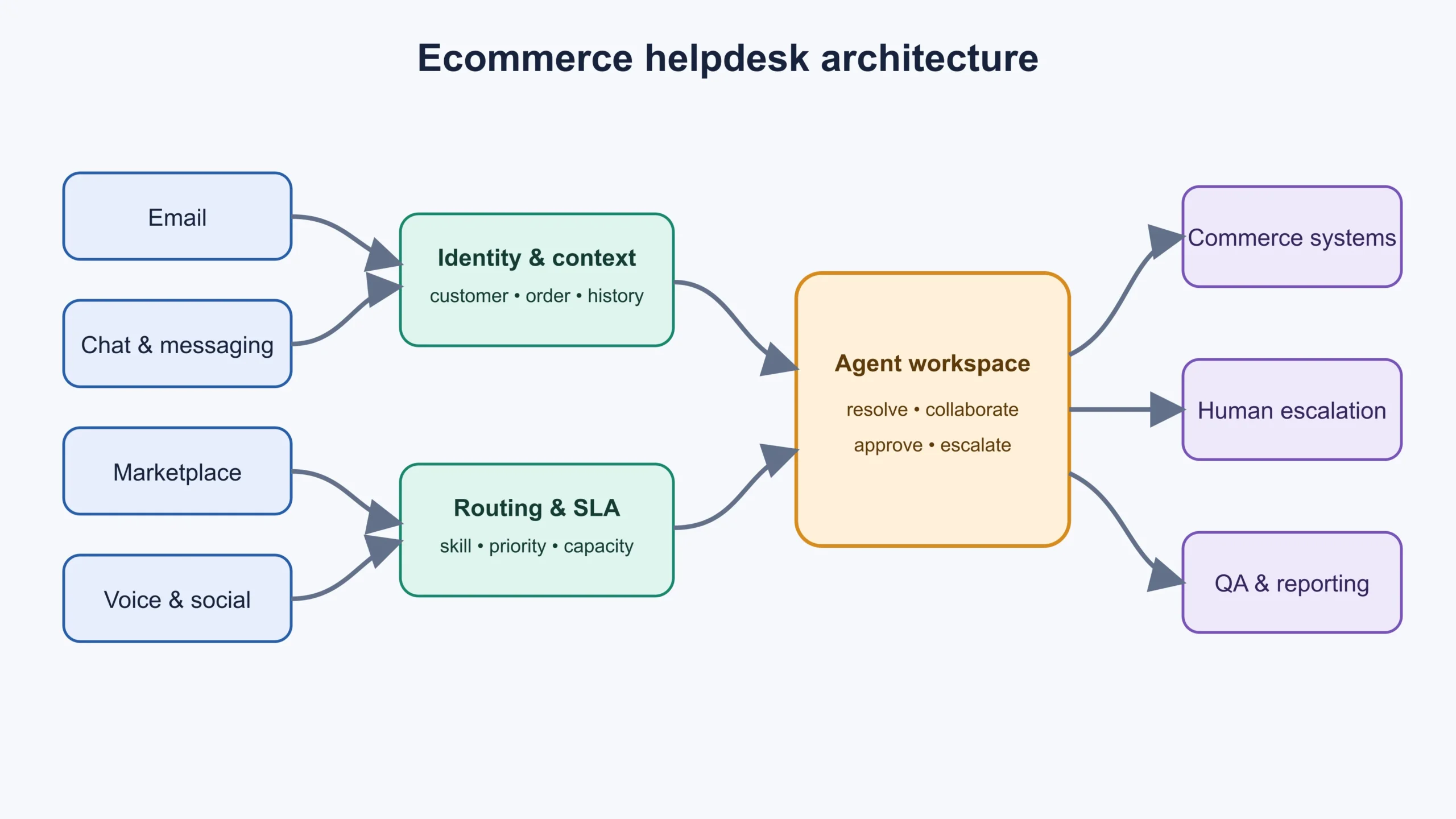
Core requirements
Identity and channel continuity
The system should merge conversations only when identity evidence supports it. Test duplicate profiles, guest checkout, marketplace aliases, forwarded email, shared household addresses, and customers who change channels. Agents need the relevant history without exposing another person's order.
Routing and workload
Define queues by language, market, product, customer tier, issue type, urgency, and required skill. Test availability, capacity, business hours, holidays, overflow, reassignment, and what happens when no qualified agent is online. “Round robin” alone may not protect a refund deadline or safety-related case.
Service levels
Separate first response, next response, and resolution targets. Decide which events pause a timer and whether marketplace or contractual deadlines differ. Confirm that reporting uses the same calendar and status logic as operations. The ChoiceRidge Helpdesk Selector can turn these requirements into an architecture profile before a vendor shortlist.
Commerce context and actions
An agent may need order line items, fulfillment events, tracking, payment state, discounts, customer history, and return eligibility. For every action—cancel, refund, resend, issue credit, change address—define permission, monetary limit, approval, audit record, and reversal path. Never grant broad commerce-admin access merely because an integration supports it.
Knowledge and automation
Measure whether suggested articles or replies are current and useful. Rules should be observable, versioned, and easy to disable. AI assistance requires grounded sources, evaluation, privacy controls, and escalation; the AI for Business & Commerce hub provides the adjacent governance framework.
Proof-of-concept scenarios
Use anonymized or synthetic records in a safe environment and test:
- one customer writing through two channels;
- a VIP request that should not bypass a fraud control;
- a return needing warehouse inspection before refund;
- an order split across two fulfillments;
- a missed SLA during a holiday calendar;
- a marketplace message with restricted reply rules;
- a sensitive complaint requiring human escalation;
- an integration outage with a safe read-only fallback;
- export of tickets, attachments, users, fields, and audit history.
Observe agents completing the work. Count clicks, system switches, rework, permission errors, routing mistakes, and incomplete handoffs. A polished agent workspace can still fail if the integration shows stale order data or actions lack an audit trail.
Metrics that resist gaming
Track response and resolution distributions, backlog age, reopen and repeat-contact rate, transfer rate, escalation quality, customer effort, correction, and verified resolution. Pair customer satisfaction with response rate and case mix. Avoid treating ticket deflection, short handling time, or AI containment as success if customers return with the same unresolved issue.
Selection checklist
- Channels and ticket taxonomy documented from real volume
- Identity merge and privacy behavior tested
- Routing covers skills, capacity, priority, calendars, and overflow
- SLA definitions match reports and customer commitments
- Commerce data is current and permissioned actions are auditable
- Human escalation and outage fallback are practical
- Knowledge, rules, and AI can be evaluated and disabled
- Security, retention, residency, export, and deletion verified
- Pricing modeled at expected seats, contacts, AI usage, and channels
- Migration and exit plan covers history and attachments
For adjacent customer-experience systems, return to the Customer Experience Software hub. Use the Software Comparison Scorecard to record evidence consistently.
Method and limitations
This product-neutral guide uses current public helpdesk documentation to illustrate requirements. Features and plan limits change; verify them in dated vendor documentation and a representative proof of concept. This is not legal, privacy, labor, or security advice.