Short answer: returns software should convert a published policy into consistent eligibility decisions, reverse-logistics steps, inspection outcomes, exchanges, refunds and inventory updates. Evaluate the complete return lifecycle—including exceptions and reconciliation—not just the appearance of a self-service portal.
Editorial image disclosure: the header is an AI-generated editorial illustration. It is not a product screenshot or evidence of hands-on testing.

A return is simultaneously a customer-service case, a shipment, a financial adjustment and an inventory event. When these parts are managed in separate tools, the customer may receive one status while the warehouse, payment system and storefront each show another.
This guide provides a requirements framework and proof-of-concept plan. It does not rank vendors, claim a new benchmark or offer legal advice.
Returns workflow at a glance
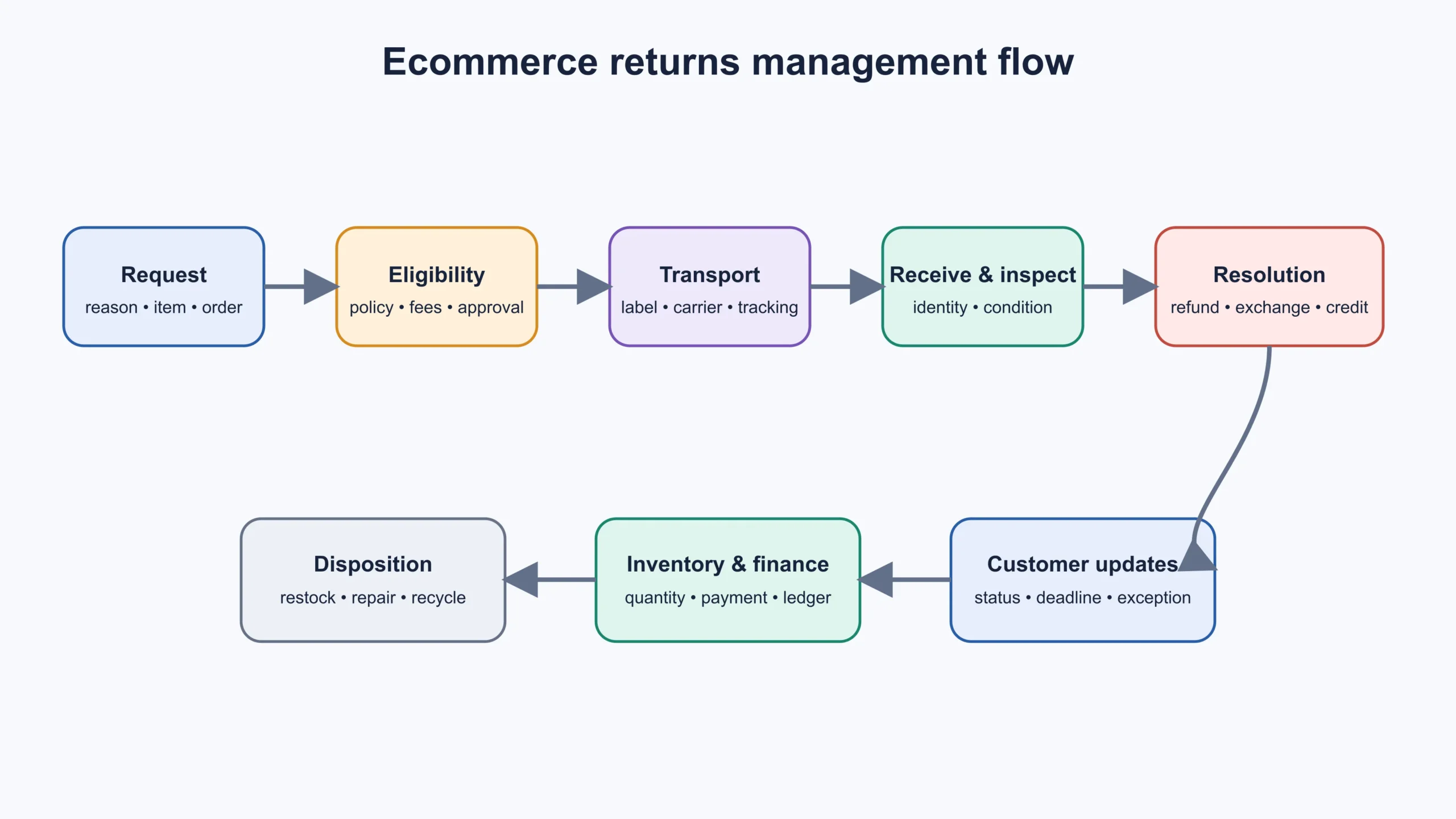
The workflow must keep customer eligibility, physical movement, inspection, resolution and inventory reconciliation connected without treating any single event as proof that every downstream step completed.
First decide whether you need another platform
Many commerce platforms already support basic return creation, labels, refunds and restocking. Shopify, for example, documents return and exchange workflows in its admin, including return reasons, fees, partial processing, exchange items and refund or payment collection. It also supports configurable return and cancellation rules and customer self-service requests.
An additional returns-management product becomes easier to justify when the existing workflow cannot reliably support one or more of these conditions:
- multiple storefronts, markets, warehouses or third-party logistics providers;
- different eligibility rules by product, market or customer agreement;
- branded self-service across several commerce platforms;
- exchange inventory reservation and replacement fulfillment;
- carrier selection, label generation or consolidated returns;
- inspection, grading, refurbishment, quarantine or resale decisions;
- high volumes of “where is my refund?” contacts;
- fraud controls or repeated-return patterns that require review;
- reconciliation across payment, inventory, ERP and customer-service systems.
Do not add software merely to make the portal look better. Tie the purchase to a measurable failure such as return cycle time, manual touches, incorrect refunds, lost exchange revenue or unresolved inventory.
Map the return lifecycle
Document the state, owner and source of truth at every stage:
- Request: the customer identifies the order and items.
- Eligibility: policy, delivery date, item, market and exception rules are evaluated.
- Authorization: the request is approved, declined or routed for review.
- Method: label, drop-off, pickup or returnless resolution is selected.
- Transit: the parcel receives tracking and exception monitoring.
- Receipt: the facility confirms what physically arrived.
- Inspection: condition, completeness and disposition are recorded.
- Resolution: refund, store credit, repair, replacement or exchange is authorized.
- Inventory: sellable, damaged, quarantine or refurbishment stock is updated.
- Reconciliation: logistics, financial and inventory records are compared.
For each transition, record who can change it, which evidence is required, how the customer is notified and what happens if an integration fails.
Policy and legal requirements
The system must implement the policy that actually applied when the customer ordered. Shopify notes that changes to configured return rules affect future orders rather than previous ones. That is a useful control pattern: policy version and effective date should be attached to the order or return decision.
Requirements may include:
- return window and the event that starts it;
- final-sale or non-returnable items;
- market-specific conditions;
- original and return shipping treatment;
- restocking fees;
- warranty or defective-goods path;
- refund method and timing;
- exchange price difference;
- evidence required for damaged or incorrect items;
- exception approval authority.
Legal rights can differ from a voluntary merchant policy. Official EU guidance states that many distance purchases include a 14-day right of withdrawal, with exceptions and additional rules about information, costs and reimbursement. Obtain jurisdiction-specific advice before translating a legal requirement into automation.
Eligibility needs explainability
A customer and an agent should be able to understand why an item is eligible, ineligible or awaiting review. Test edge cases such as:
- a split order whose items arrived on different dates;
- a product exchanged once already;
- a bundle with one component missing;
- a promotional item or gift;
- an international order with duties;
- an item marked final sale after the original purchase;
- a late carrier scan;
- a warranty claim submitted through the returns flow.
Avoid rules that silently collapse uncertainty into denial. When delivery state, product mapping or policy version is unavailable, the safer behavior is usually to pause and route for review.
Separate return, refund and exchange
These terms are operationally connected but not identical:
- a return tracks goods moving back and their disposition;
- a refund sends money or value to the customer;
- an exchange adds replacement merchandise and may create an amount owed by either party.
Shopify’s documentation distinguishes these concepts and describes cases in which processing a partial return can change the financial result. Your system should show the expected goods, actual goods, fees, exchange items, balance and payment or refund state without requiring manual arithmetic.
Inspection and disposition
Create a controlled inspection vocabulary. Free-text notes alone make analysis and training difficult.
| Inspection result | Possible disposition | Evidence and control |
|---|---|---|
| Unopened and resellable | Return to sellable inventory | Item and package confirmation |
| Opened but complete | Open-box inventory | Grading standard and approver |
| Cosmetic damage | Refurbish, outlet or write-off | Photo and severity code |
| Functional defect | Repair, warranty or supplier claim | Test result and serial/lot data |
| Wrong item received | Investigation or exception stock | Expected-versus-received record |
| Missing components | Partial refund or customer follow-up | Component checklist |
| Unsafe or contaminated | Quarantine or disposal | Restricted handling procedure |
Ask whether the system can prevent an inspected item from returning to sellable stock before the required checks finish.
Integration and financial controls
Every external action needs an owner, idempotency behavior and audit record. Verify:
- order and line identifiers survive exchanges and edits;
- label creation cannot silently duplicate charges;
- duplicate warehouse scans do not create duplicate refunds;
- refund limits are enforced outside free-form agent instructions;
- store credit and original-payment refunds remain distinguishable;
- exchange inventory is reserved at a defined point;
- tax, discounts, duties and currency rounding reconcile;
- failed events can be replayed without repeating completed actions;
- manual overrides are visible in reporting.
Use the ChoiceRidge StackMap to document system ownership and the Software Migration Cost Calculator to include integration and historical-data work in the business case.
Metrics that reveal the real outcome
Track distributions and cohorts, not only an overall return rate:
- request-to-authorization time;
- authorization-to-first-carrier-scan time;
- first-scan-to-receipt time;
- receipt-to-inspection and inspection-to-resolution time;
- refund aging by method and cause;
- exchange completion and exchange stockout rate;
- manual-review and override rate;
- inspection disagreement rate;
- return reasons by product, variant, supplier and acquisition cohort;
- disposition recovery value;
- repeat contact related to a return;
- integration failures and unreconciled balances.
A lower return rate is not automatically better. It can reflect improved product information—or a difficult and unfair process. Pair rate changes with customer contacts, denial reasons, complaint volume and product-quality evidence.
Proof-of-concept scenarios
Give each shortlisted vendor the same anonymized cases:
- ordinary return inside the policy window;
- split shipment with different delivery dates;
- exchange for a higher-priced variant;
- partial return with a promotional discount;
- item received in a different condition than declared;
- wrong item inside the parcel;
- return label API timeout followed by retry;
- duplicate warehouse receipt event;
- refund failure after inspection approval;
- market-specific legal or policy exception.
Observe customer communication, operator steps, state history, permissions and reconciliation—not just speed.
Selection scorecard
| Dimension | Suggested weight | Evidence |
|---|---|---|
| Policy and eligibility engine | 20% | Versioned rules and edge-case decisions |
| Reverse logistics | 15% | Carrier, label, tracking and exception workflows |
| Inspection and disposition | 15% | Configured grading and inventory controls |
| Exchange and financial accuracy | 15% | Partial, unequal and failed-payment cases |
| Integration and reconciliation | 15% | Retry, idempotency and exception reports |
| Customer and operator experience | 10% | Scripted task observation |
| Reporting and data export | 5% | Definitions and raw data access |
| Total cost and implementation risk | 5% | Three-year scenario and dependency plan |
Record evidence in the Software Comparison Scorecard. Use the Software ROI Calculator to model labor, recovered inventory, retained exchange revenue and error reduction separately.
Decision rule
Choose a returns platform only when it closes a documented lifecycle gap and passes exception scenarios with consistent state, permissions and reconciliation. A polished portal cannot compensate for an uncertain refund, duplicated label or incorrect inventory disposition.
Research method and limitations
This guide uses public platform documentation and official consumer-information sources. ChoiceRidge did not run a new returns benchmark or inspect a live merchant implementation for this article. Product behavior and legal requirements can change. Verify current documentation, contract terms and jurisdiction-specific obligations.
References
- Shopify Help Center: Returns and exchanges, accessed August 30, 2026.
- Shopify Help Center: Creating and processing returns and exchanges, accessed August 30, 2026.
- Shopify Help Center: Setting up return and cancellation rules, accessed August 30, 2026.
- Shopify developer documentation: Apps in orders and fulfillment, accessed August 30, 2026.
- Shopify developer documentation: Build for return management, accessed August 30, 2026.
- Your Europe: Returns and the right of withdrawal, checked April 28, 2026.
- Your Europe for business: B2C ecommerce and distance selling, accessed August 30, 2026.