Shippo offers two related routes into multi-carrier shipping: a web application for merchants and an API for platforms or custom operations. It can compare rates, create labels, track packages, process returns, and validate addresses. The important buying question is whether its carrier coverage, rule logic, billing adjustments, and exception handling match your actual parcel network.
Testing and image disclosure: ChoiceRidge has not completed a production Shippo implementation for this draft. Findings are based on first-party pricing, product, API, and help documentation checked August 31, 2026. The visuals are original editorial assets, not product screens. Any future official Shippo asset should come from its newsroom press kit and retain its source record.

Bottom line
Shippo is a strong shortlist candidate for a small or midsize merchant that wants multi-carrier label purchasing without building carrier integrations, and for a software platform that wants one shipping API. It is not a substitute for warehouse execution, inventory planning, or a full order-management system.
The decisive test is a shipment matrix covering real origins, destinations, weights, dimensions, service levels, own carrier contracts, international paperwork, surcharges, refunds, and returns.
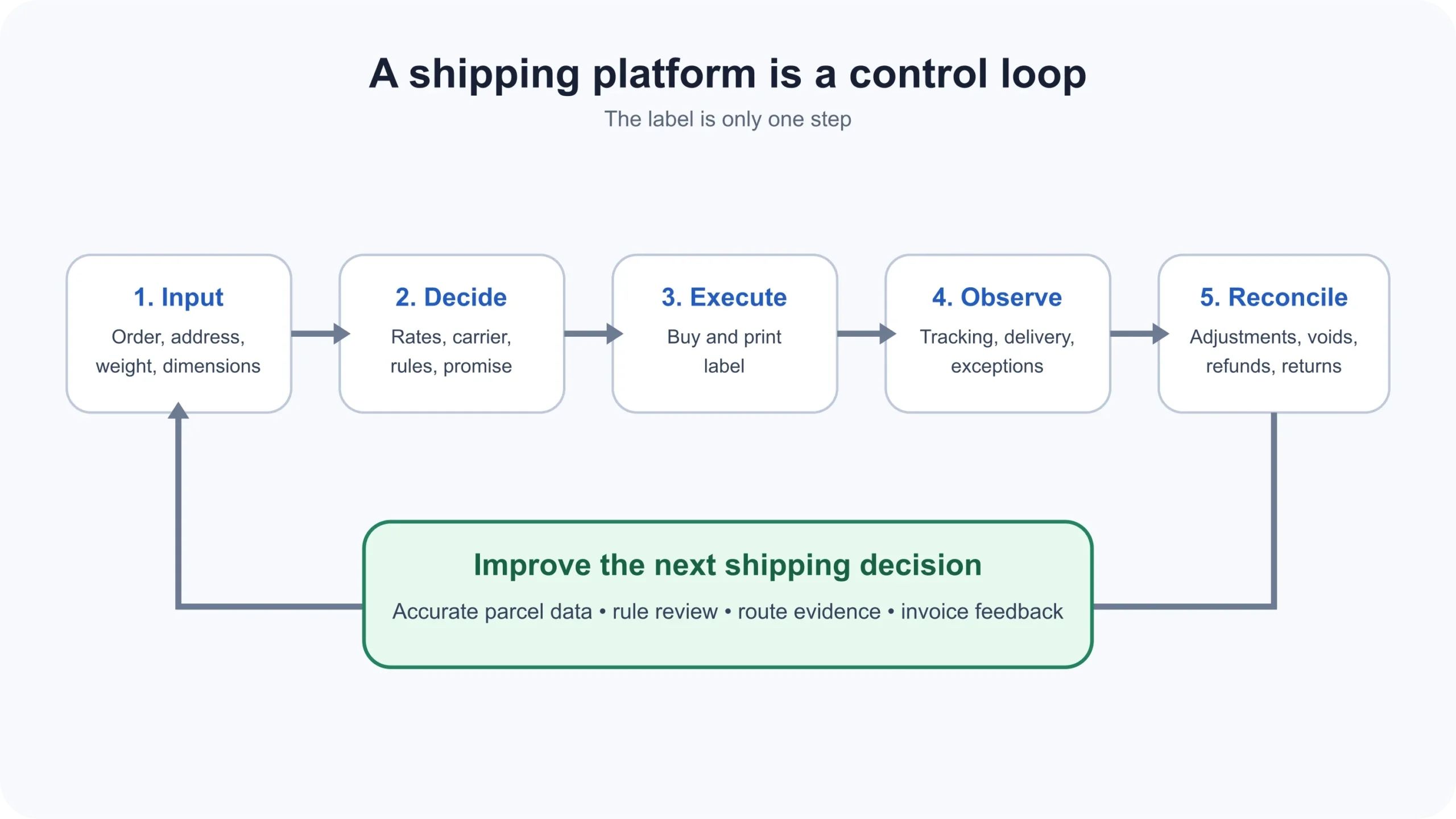
What Shippo includes
The web app connects stores, imports orders, compares available carrier services, purchases labels, generates return labels, tracks shipments, and supports branded customer communications on paid plans. Automation rules can inspect item name, SKU, quantity, weight, destination, state, or ZIP and then select a package, service, sender address, or tags.
Shippo says rules run from top to bottom. When multiple rules try to set the same action, the first applicable rule wins, and rules apply to newly imported orders rather than retroactively. That makes ordering, naming, change review, and regression tests operational requirements.
The API standardizes rating, labels, tracking, address validation, and returns through one integration. Shippo currently documents connections to more than 40 carriers through the API. Buyers still need to verify each carrier, account type, service, country, hazardous-goods requirement, and contractual rate.
Pricing explained
At the review date, Shippo's public app pricing listed:
- Starter: free, up to 30 labels per month, one user, unlimited connected stores, automation, international shipping, return labels, tracking, reports, and email support. Using your own carrier account was listed at $0.05 per label.
- Pro: from $17 per month when billed annually for 1–200 labels, scaling with volume. It adds at least five users, free own-carrier connections, estimated delivery dates, branding, and chat/phone support.
- Premier: custom pricing, at least 15 users, unlimited shipments, and a dedicated account manager.
The page also listed $0.08 per label above 10,000 monthly Pro labels and separate non-US address-validation fees by tier. API-call pricing is distinct from the app subscription, and postage, insurance, carrier adjustments, duties, taxes, and some services remain separate. Reconfirm all numbers on publication day.
Where Shippo fits best
- A merchant graduating from single-carrier portals or manual label buying.
- A multichannel store that needs orders consolidated for parcel shipping.
- A platform adding carrier rating, labels, tracking, or returns through an API.
- A small operations team that needs shipping rules but not warehouse orchestration.
- A business willing to reconcile quoted rates with final carrier invoices.
Limitations and buying risks
Rate quotes are not always final cost
Incorrect dimensions, weight, packaging, residential status, or special handling can produce carrier adjustments. Test dimensional weight and typical surcharge conditions, then reconcile the original quote, purchased label, tracking event, and final charge.
Carrier breadth is not route fitness
A carrier logo does not prove that your origin, destination, account, pickup method, return service, manifest, or customs workflow is supported. Build a route-level requirement table.
Rules can silently encode policy
A top-to-bottom rule list can produce an unexpected service when conditions overlap. Assign an owner, document precedence, test conflict cases, and review changes before peak season.
International shipping remains data-intensive
Customs descriptions, harmonized codes, values, origin country, duties, taxes, and restricted items must be correct. Software can facilitate forms but cannot fix weak product data or replace compliance expertise.
Operational scope
Shippo can be a shipping layer, but complex wave planning, bin locations, pick paths, labor management, inventory allocation, or vendor purchasing may require an OMS, WMS, or other system.
API and reliability questions
The API uses token authentication and requires secure transport. Before production, test idempotency, asynchronous responses, webhook signature/verification, retry behavior, duplicate callbacks, pagination, rate limits, sandbox-to-live differences, and data retention. Instrument every shipment with internal order and correlation identifiers.
Define degraded modes. Can the warehouse continue printing for already-rated orders during an API incident? Who retries a failed label? How are voids and refunds reconciled? What prevents two workers from buying duplicate labels?
Proof-of-concept checklist
- Connect a sandbox or limited store with synthetic customer data.
- Rate at least 30 representative parcels across real routes.
- Compare platform rates with your own carrier contracts.
- Trigger overlapping automation rules and verify precedence.
- Create, void, and refund labels; confirm financial records.
- Complete one international shipment dataset and customs-document review.
- Generate a return label and test customer communication.
- Reconcile carrier adjustments for measured versus declared parcels.
- Simulate timeouts, duplicate webhook delivery, and a carrier outage.
- Calculate total cost per shipped order at normal and peak volume.
Verdict
Shippo can remove substantial integration and operational friction when a merchant needs accessible multi-carrier shipping or a product team needs a unified shipping API. Its value depends on route-level carrier support, accurate parcel data, disciplined automation rules, and charge reconciliation. Shortlist it for parcel execution; do not mistake it for a complete inventory or warehouse platform.
Use the ChoiceRidge OMS vs WMS vs Inventory Management guide to confirm the system boundary, and compare the existing ShipStation review.