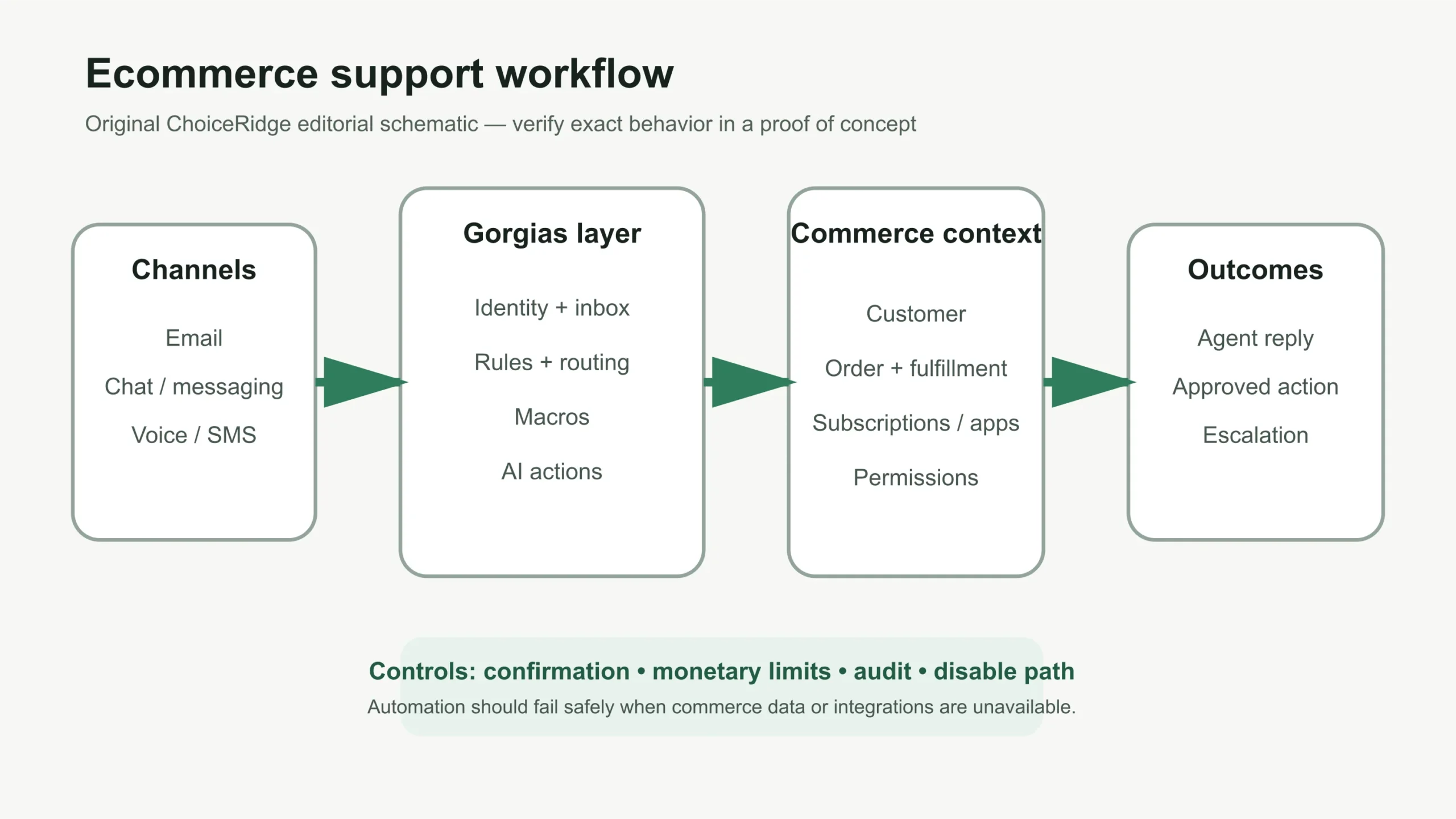
Gorgias is a customer-support platform built around ecommerce conversations and store actions. Its strongest case is not simply “one inbox.” It is the proximity between a ticket and commerce context: agents can view order information and, with the right integration and permissions, complete actions such as cancellation, refund, or address updates without moving through several systems.
Testing and image disclosure: ChoiceRidge has not completed a hands-on Gorgias trial for this draft. Findings are based on current first-party product, pricing, and help documentation checked August 31, 2026. The hero and workflow diagram are original editorial visuals, not product screens. The Gorgias logo comes from its official brand kit and is used under the published brand rules.

Bottom line
Gorgias belongs on the shortlist for a Shopify-centered merchant that wants customer-service automation tied closely to order context. It is less straightforward for a business expecting identical automation across every ecommerce platform: Gorgias documents full support for its AI Agent, Flows, and Order Management on Shopify, while feature compatibility is more limited on BigCommerce, Magento, WooCommerce, and PrestaShop.
The buying question is therefore architectural: does your support team need ecommerce-native actions more than it needs a broad, platform-neutral service stack?
What Gorgias does
Gorgias centralizes support conversations and connects them with store and app data. Its current positioning combines a helpdesk with an AI Agent. The official pricing page says helpdesk capacity scales by monthly ticket volume rather than agent seat count, while AI Agent is available on every plan and charged when it resolves a conversation. Voice and SMS are optional add-ons whose prices vary with usage.
For Shopify, Gorgias documents enriched customer and order context beside the ticket, plus supported actions including refunds, cancellations, order duplication, and shipping-address edits. Rules can tag, assign, prioritize, close, or respond to tickets based on conditions. Macros can combine a reply with ticket or commerce actions. AI Agent actions can also span connected apps, use conditions, and request customer confirmation before consequential actions.
Where it fits best
- A direct-to-consumer merchant whose support workload is dominated by order status, cancellations, returns, subscriptions, delivery problems, and product questions.
- A Shopify operation that wants agents to resolve common order issues from the support workspace.
- A team whose cost model benefits from ticket-volume pricing rather than per-agent pricing.
- An operation willing to define safeguards for automated commerce actions and continuously test them.
Where to be cautious
Platform parity
Do not assume that the Shopify experience applies to every storefront. Gorgias' compatibility table says Shopify supports AI Agent, Flows, and Order Management; BigCommerce and Magento support Flows but not the other two in that table; WooCommerce and PrestaShop do not support those automation features. Verify the current matrix for your exact store, region, and integrations.
Ticket and resolution economics
Ticket-based helpdesk capacity and per-resolution AI pricing can be attractive, but they require clean forecasting. Model seasonal peaks, spam, merged contacts, multiple storefronts, AI-resolution definitions, reopens, voice/SMS, onboarding, and integration costs. Ask what counts as a billable ticket and a resolved conversation in the proposed contract.
Automation risk
An automated reply is reversible; canceling an order or changing an address may not be. Gorgias allows conditions and customer-confirmation checkpoints, and turns confirmation on automatically for some irreversible actions. Buyers should still add monetary limits, audit review, test orders, escalation paths, and a rapid disable procedure.
Broader service operations
If the organization needs sophisticated workforce management, enterprise contact-center controls, complex non-commerce case management, or consistent behavior across many business units, compare Gorgias with a broader service platform. Ecommerce specialization is a benefit only when it matches the actual operating model.
Pricing interpretation
The public page did not expose a stable plan-price table in the accessible text used for this review, so this draft intentionally avoids quoting a number that could be incomplete. It does state that helpdesk plans scale from 50 to 5,000 tickets per month and are not priced per agent, with AI Agent billed by resolved conversation. Obtain a written quote for expected ticket and AI volume and re-check the public page on publication day.
Security and governance questions
Before connecting a live store, request the current security documentation and data-processing terms. Verify data locations, subprocessors, retention, deletion, incident notice, SSO availability, role granularity, audit logs, API-token scope, and how customer/order data is used by AI features. Map who can create rules, macros, integrations, and AI actions. Gorgias documents role-based controls, but a proof of concept should verify the exact plan and configuration.
Proof-of-concept checklist
Run the test with synthetic or anonymized orders:
- Merge one shopper contacting through two channels without exposing another customer's order.
- Cancel an eligible unfulfilled order and block an ineligible fulfilled one.
- Change an address only after the required confirmation.
- Route a high-value refund to human approval.
- Confirm that a rule and macro leave usable audit evidence.
- Measure the accuracy of Shopify order data and the delay after a store update.
- Simulate an integration outage and document the read-only fallback.
- Export tickets, users, tags, fields, attachments, and history.
- Recalculate cost at normal, peak, and AI-heavy volume.
Pros and drawbacks
| Strengths | Drawbacks or unknowns |
|---|---|
| Deep Shopify context and actions | Automation parity differs across ecommerce platforms |
| Ticket-volume rather than per-seat helpdesk model | AI-resolution economics require careful forecasting |
| Rules, macros, and multi-step AI actions | Consequential actions increase governance burden |
| Ecommerce-focused integrations | Broader enterprise service needs may favor another architecture |
Verdict
Gorgias is a credible ecommerce helpdesk candidate, especially for Shopify brands whose agents repeatedly switch between support and order administration. Its value should be proven through complete order-resolution scenarios, not inbox aesthetics or a headline automation rate. Shortlist it when commerce context is central; compare alternatives when cross-platform parity, complex enterprise routing, or non-commerce service work dominates.
Use the ChoiceRidge Ecommerce Helpdesk Software Requirements guide to define the requirement first, then record evidence in the live Software Comparison Scorecard.