Lifecycle marketing automation coordinates messages around a customer's changing relationship with a store: discovery, signup, consideration, purchase, delivery, repeat purchase, subscription, inactivity, and return. The goal is not to automate every touchpoint. It is to make a small number of valuable journeys timely, accurate, measurable, and respectful.
Scope disclosure: This is an editorial operating guide, not legal advice and not a claim that ChoiceRidge has implemented the named platforms. Product references use first-party documentation checked August 31, 2026. The visuals are original ChoiceRidge diagrams and editorial imagery.

Start with the lifecycle, not the tool
Map the customer's state before selecting software. A simple model can include:
- Anonymous visitor
- Known, consented prospect
- First-time buyer
- Active customer
- Repeat or high-value customer
- Subscriber
- At-risk customer
- Inactive or lapsed customer
- Suppressed or service-only profile
Each state needs a measurable entry, a permissible channel, a relevant objective, and a clear exit. Avoid labels such as “VIP” unless the definition is reproducible.
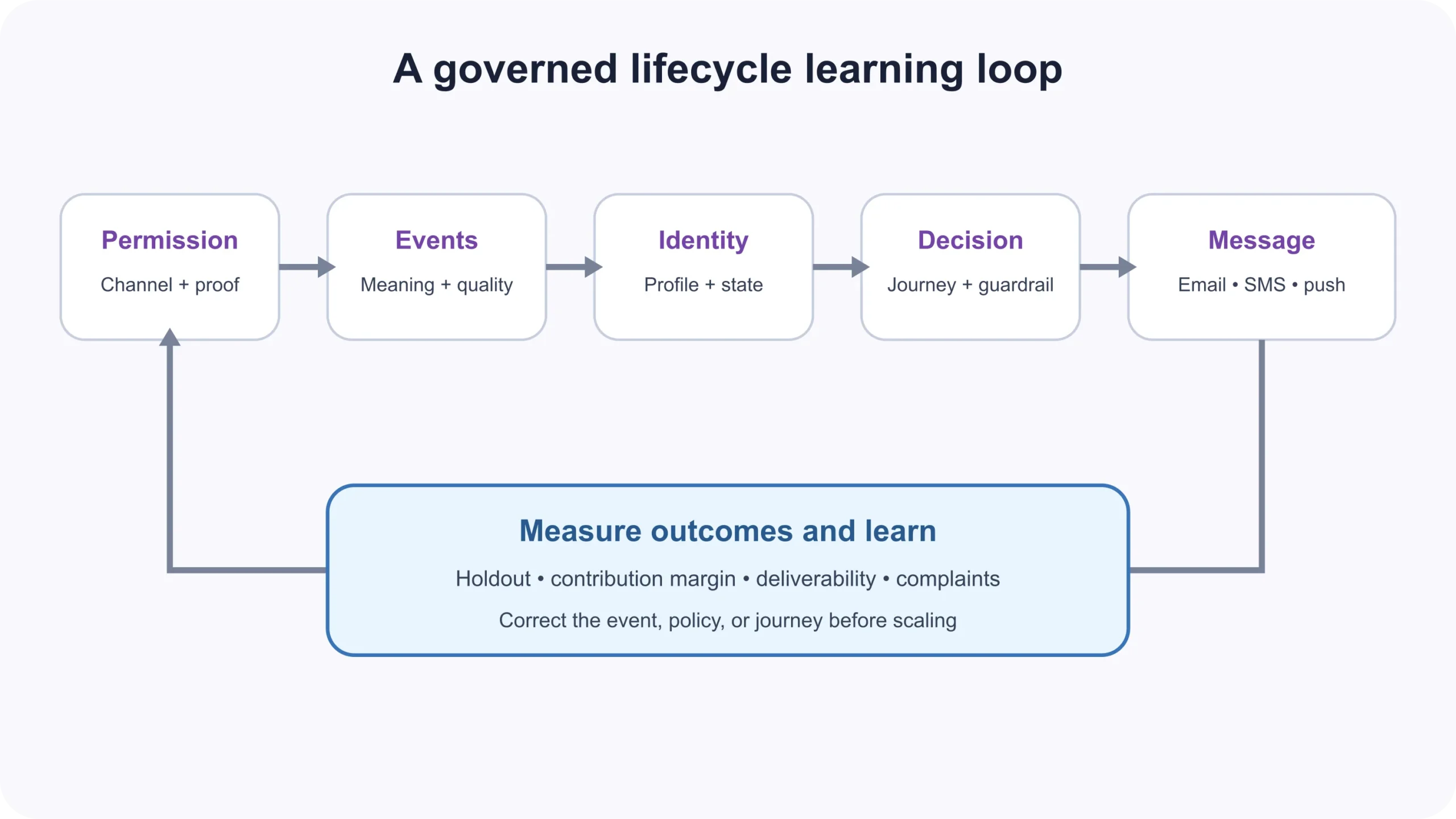
Build an event contract
For each event, document:
- name and business meaning;
- source system and owner;
- timestamp and time zone;
- profile and order identifiers;
- required properties;
- duplicate and late-arrival behavior;
- cancellation/refund corrections;
- retention and personal-data rules;
- tests and monitoring.
“Placed order” should not be confused with paid, fulfilled, delivered, or retained. A cancellation or full refund should change downstream eligibility. Treat the event dictionary as a product with version control.
Consent is a gate, not a profile decoration
Channel eligibility should combine subscription state, consent evidence, jurisdiction, customer status, quiet hours, and suppression. Email permission does not imply SMS permission. Record source, timestamp, form/disclosure version, and withdrawal.
Omnisend's documentation illustrates the distinction: subscribed status and GDPR/TCPA consent records are separate, and marketers are instructed to create segments and workflow exit conditions. Klaviyo likewise documents channel-specific consent. Configure conservative defaults and have qualified counsel review the implementation.
Prioritize five journeys
1. Welcome
Confirm expectations, introduce value, collect useful preferences, and avoid an aggressive sequence that trains customers to wait for discounts.
2. Consideration and abandonment
Use reliable browse or cart signals and suppress after purchase. Avoid revealing sensitive browsing on shared devices. Test delay, frequency, and incremental lift.
3. Post-purchase
Coordinate transactional and marketing messages. Provide education, delivery context, support, and review requests at appropriate times. Never let a promotional journey contradict a delayed or canceled order.
4. Replenishment or subscription
Base timing on expected consumption and actual purchase state. Provide skip, pause, frequency, and support paths. Stock and fulfillment readiness must be part of the decision.
5. Win-back
Define inactivity with category purchase cycles, not an arbitrary 30-day rule. Use a holdout and include margin, discount, unsubscribe, and complaint costs.
Frequency and collision control
A customer can enter several journeys simultaneously. Create global rules for message priority, maximum frequency, transactional exceptions, recent purchase, active support case, return/refund state, and channel fallback. Define who can override the rules and how changes are reviewed.
Measurement beyond attributed revenue
Platform attribution answers which interaction receives credit under a configured rule. It does not prove causal lift. Use:
- randomized holdouts where feasible;
- incremental revenue and contribution margin;
- discount and message cost;
- return/refund behavior;
- unsubscribe and complaint rates;
- repeat-purchase timing;
- long-term customer value with documented assumptions.
Predeclare the metric and test duration. Do not stop an experiment only when the dashboard looks favorable.
Platform requirements
Score candidates on real workflows:
| Requirement | Evidence to collect |
|---|---|
| Ecommerce events | Objects, properties, latency, backfill, refunds, deletes |
| Identity | Guest-to-known merge, duplicates, multi-store behavior |
| Consent | Channel evidence, suppression, exports, API behavior |
| Automation | Triggers, filters, rechecks, splits, approvals, testing |
| Deliverability | Authentication, monitoring, suppression, support |
| Measurement | Attribution settings, raw export, holdouts, warehouse feeds |
| Cost | Profiles/contacts, sends, SMS destination, services, growth |
| Exit | Data, templates, workflow logic, consent and history export |
Omnisend may fit a focused ecommerce team; Klaviyo may fit a broader data and B2C CRM roadmap. Neither replaces clean source data or operating governance.
30-day implementation sequence
Week 1: define states, events, owners, consent, and baseline metrics.
Week 2: connect a limited data set, reconcile counts, and configure authentication/suppression.
Week 3: build welcome and post-purchase journeys with review and rollback.
Week 4: launch a controlled cohort, monitor collisions and deliverability, and run the first holdout.
Only then add abandonment, replenishment, recommendation, and win-back complexity.
Common failure modes
- Buying a platform before defining event meaning.
- Treating every imported profile as marketable.
- Allowing several teams to message without collision rules.
- Optimizing opens instead of incremental margin.
- Ignoring refunds and returns in eligibility.
- Assuming AI-generated segments or copy are automatically accurate or compliant.
- Failing to export consent and automation logic before switching platforms.
A quarterly lifecycle audit
Every quarter, select a sample from each live journey and reconstruct why the customer entered, what permission applied, which data was used, what was sent, and what happened afterward. Reconcile event totals with the store, review suppression and complaint trends, inspect journeys with weak incremental margin, and expire outdated offers or content. Also verify that former employees and agencies no longer retain access.
The audit should produce an owner and due date for every defect. A journey that cannot be explained from its data and rules should not continue operating merely because its attributed-revenue tile is positive.
Next decision
Use this guide to build the requirement, then compare the Omnisend review, Klaviyo review, and Klaviyo vs Omnisend. Record observations in the live Software Comparison Scorecard.