Omnisend is an ecommerce-focused marketing platform for email, SMS, push notifications, forms, segmentation, automation, reporting, and product reviews. Its appeal is consolidation: a smaller commerce team can connect store behavior to campaigns and lifecycle workflows without assembling a general-purpose CRM stack.
Evidence and image disclosure: ChoiceRidge has not operated a production Omnisend account for this draft. Product and pricing findings use first-party pages checked August 31, 2026. The hero is an original editorial image. Product screenshots and the optional logo come from Omnisend's official newsroom press kit; they are provider-supplied interface evidence, not ChoiceRidge captures or proof of testing.

Bottom line
Omnisend is a credible shortlist option for a small or midsize ecommerce team that wants approachable email automation with commerce triggers and a path to SMS. Its strongest fit is a team that prefers an ecommerce-specific operating model over the broader customer-data and B2C CRM scope now promoted by Klaviyo.
The main purchasing risks are billable-contact growth, plan-dependent SMS access, unexamined attribution, consent operations, integration detail, and assuming “all features” means unlimited use.
What Omnisend does
The platform combines campaigns, prebuilt and custom automations, behavior-based segmentation, forms/popups, reporting, web push, and product blocks. Workflows can react to customer or commerce behavior; segment entry and exit can also act as a trigger. Omnisend warns that segment triggers do not carry order variables, so order-specific journeys should use an appropriate order trigger.
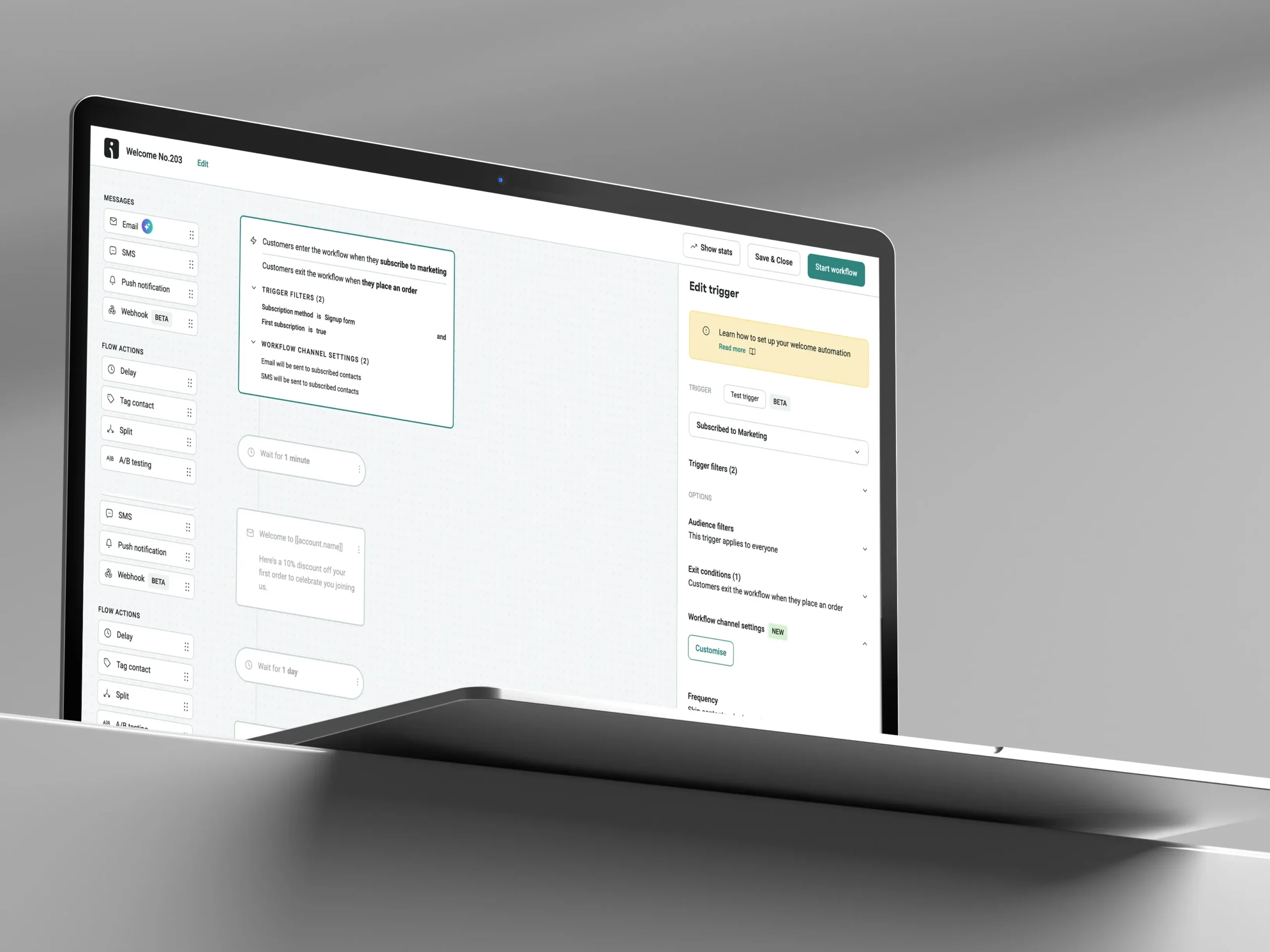
Official Omnisend app visual, downloaded from the provider's newsroom press kit on August 31, 2026. Interface details may change.
The automation builder can combine email, SMS, push, delays, splits, tags, and webhooks. Availability and billing still vary by plan, channel, recipient country, and subscription date.
Pricing snapshot
Omnisend's 2026 help documentation listed:
- Free: $0, up to 500 monthly emails sent to no more than 250 unique contacts. The account can hold more contacts, but campaign recipients are constrained.
- Standard: from $16/month, with monthly email credits equal to 12 times the billable-contact count, push notifications, live chat, and most features.
- Pro: from $59/month, unlimited email and push sends, advanced AI features, and SMS as a separately purchased volume-based service for customers subscribing on or after May 4, 2026.
For newer subscriptions, official documentation says SMS is unavailable on Free and Standard and starts at $0.007 per message for US/Canada recipients on Pro, with country and volume differences. Legacy accounts can have different rules. Pricing adjusts with billable contacts, which include subscribers and non-subscribers according to the pricing guide. Recheck the calculator and account cohort before publication.
Where it fits best
- Ecommerce brands needing welcome, abandonment, post-purchase, cross-sell, review-request, and win-back journeys.
- Lean teams that want email, push, forms, and segmentation in one product.
- Buyers that value a useful free evaluation tier.
- Shopify or other supported-commerce users whose required events pass a proof test.
- Teams prepared to maintain contact hygiene and channel-specific consent.
Important limitations
Billable contacts can grow quietly
Organic signups, checkout records, and integrations can increase the billable audience. Define which profiles need marketing eligibility, how inactive contacts are suppressed or removed, and how service-only contacts are treated.
SMS access changed in 2026
Current and legacy customers can have different entitlements. Model SMS by destination, message segments, volume, expiry/rollover rules, and the operational cost of obtaining and preserving lawful consent.
Consent status is not the whole legal record
Omnisend distinguishes subscription status from GDPR or TCPA consent records and says the platform does not automatically prevent every send merely because a consent record is absent. Buyers must create filters, exit conditions, proof retention, and jurisdiction-specific policies with qualified counsel.
Attribution is not incrementality
Revenue attributed by a platform depends on windows and rules. It can over-credit messaging that followed existing purchase intent. Pair platform reporting with holdouts, margin, discount cost, unsubscribes, complaints, and long-term customer behavior.
Integration logos do not prove data quality
Test event timing, refunds, cancellations, product/catalog changes, identity merging, historic backfill, consent fields, and delete requests for the exact ecommerce integration.
Proof-of-concept checklist
- Import a small, documented, consented audience.
- Reconcile contacts, orders, refunds, and revenue with the source store.
- Build welcome, cart abandonment, post-purchase, and win-back journeys.
- Test trigger timing, order variables, exit conditions, and duplicate events.
- Verify email and SMS consent independently.
- Measure delivery, clicks, complaints, unsubscribes, incremental margin, and contact growth.
- Validate the real SMS price in the top five recipient countries.
- Export contacts, consent evidence, templates, workflows, and performance data.
- Forecast 12-month cost at normal, peak, and list-growth scenarios.
Questions buyers often ask
Is Omnisend only for Shopify?
No. Omnisend publishes integrations for Shopify, WooCommerce, BigCommerce, Wix, and other commerce platforms. The important question is not whether a logo appears in the marketplace, but whether the exact order, refund, catalog, consent, and customer events required by your journeys synchronize correctly.
Does “unlimited email” mean unlimited marketing cost?
No. Pro removes a monthly email-send ceiling according to the current plan guide, but price still changes with billable contacts. SMS, list growth, deliverability work, creative production, integrations, and administration remain cost drivers.
Can Omnisend replace a CRM?
It can centralize useful ecommerce audience and lifecycle data, but a business needing sales pipeline management, complex service cases, enterprise customer-data governance, or cross-business-unit records should define those requirements separately.
Verdict
Omnisend is best viewed as an ecommerce lifecycle workspace rather than a generic bulk-email tool. It can suit a lean commerce team well, provided contact economics, SMS rules, consent, data quality, and measurement are actively managed. Shortlist it when simplicity and commerce-native workflows matter; compare Klaviyo when the organization needs a broader customer-data, analytics, and cross-functional B2C CRM roadmap.
Continue with Klaviyo vs Omnisend and the Ecommerce Lifecycle Marketing Automation Guide.