Easyship combines multi-carrier shipping, checkout-rate tools, rules, cross-border data, tracking, and an API. Its clearest differentiation is the effort to connect the checkout promise with international fulfillment: carrier options, delivery estimates, duties/taxes treatment, customs data, and label execution.
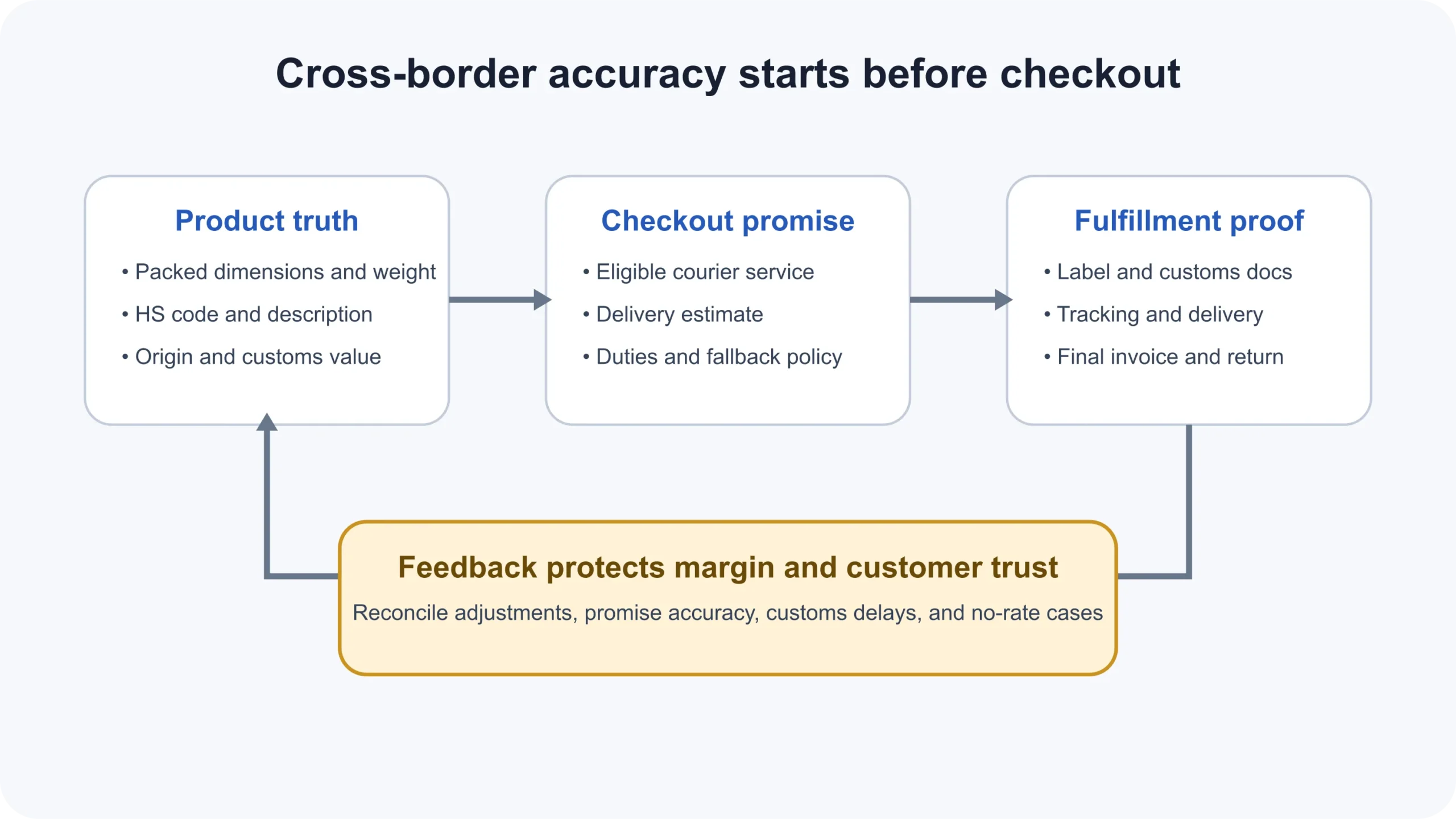
Testing and image disclosure: ChoiceRidge has not completed a production Easyship deployment for this draft. Findings use first-party pricing, developer, and help documentation checked August 31, 2026. The hero and diagram are original. Easyship's press center explicitly offers downloadable dashboard screenshots for use on sites or in marketing; any screenshot added during publication should be downloaded there, dated, credited, and checked against the live interface.

Bottom line
Easyship deserves consideration when cross-border shipping, checkout-rate choice, and multi-carrier access are central requirements. It needs especially careful proof testing because the displayed checkout rate depends on clean product dimensions, weight, category, harmonized codes, addresses, packaging, duty configuration, and route availability.
It will not make incomplete customs data accurate, and its broad courier catalog does not guarantee a specific service from every ship-from country.
What Easyship does
Easyship can connect ecommerce stores, compare courier services, create shipments and labels, configure shipping rules, show rates at checkout, handle tracking, and expose shipping functions through an API. The checkout feature is documented for Shopify, BigCommerce, WooCommerce, Magento 2, Wix, and Shopline, subject to plan and platform requirements.
Rules can use destination, SKU, item count, tag, order value, or weight. Actions can choose ship-from address, package, cheapest/fastest/best-value courier, preferred or excluded services, tracking quality, delivery time, duty payer, insurance, or return label. Rule precedence is top to bottom, so conflicts must be deliberately tested.
Pricing snapshot
Easyship's current public structure includes Free, Plus, Premier, and Scale/Enterprise options. Official material published in late 2025 listed Plus from $29/month, Premier from $69, and Scale levels at $99, $149, and $199. It also described API-rate allowances and overage prices that vary by tier. A 2026 Easyship article continued to describe Rates at Checkout on Plus from $29 and international checkout with taxes/duties on Premier from $69.
The help center says the free plan can serve merchants below 50 shipments per month. Because price, region, carrier, API, and promotion details can change, use these as dated orientation rather than a quote. Confirm monthly/annual billing, shipment limits, users, stores, checkout features, API calls, overages, support, insurance, and carrier-account fees.
Cross-border strengths
The platform can help surface courier choices and organize customs-related shipment information. For applicable configurations, checkout tools can present delivery options and tax/duty treatment before purchase. This can reduce the gap between a customer's promise and warehouse execution—but only when source data is reliable.
Easyship documents pre-negotiated shipping services from selected countries, including major markets in North America, Europe, Asia-Pacific, and Oceania, while merchants in other origins may need to connect their own courier accounts. Verify each origin and lane; do not infer global origin coverage from a large courier count.
The data-quality problem
Easyship says checkout calculations use the destination address plus product dimensions, weight, category or harmonized code, and saved boxes. It also warns that some dimensions and category data do not automatically synchronize from the store. Missing or inaccurate data can cause wrong prices, carrier adjustments, customs delays, or margin loss.
Create a product-data gate before enabling live rates:
- measured packed dimensions and weight;
- accurate customs description and HS code;
- country of origin and defensible customs value;
- restricted-goods and battery handling;
- packaging assignment;
- duty payer and tax-registration logic;
- fallback rate when no eligible service returns.
Where to be cautious
Catalog counts vary
Easyship pages have published different courier totals. Counts can reflect carriers, services, regions, or partnerships and change over time. Evaluate the exact services that pass the shipment matrix.
Duties and compliance
IOSS, DDP/DDU-style choices, customs value, and tax obligations require business and legal context. The platform assists execution; the merchant remains responsible for correct declarations and registrations.
Multi-warehouse complexity
Multi-origin routing can affect inventory ownership, checkout estimates, split shipments, duties, and returns. Easyship documents multi-warehouse support for certain operations and API/webhook workflows. Validate country and plan availability as well as failure behavior.
Surcharges and final cost
Remote areas, oversize parcels, incorrect declarations, fuel, residential delivery, address correction, and special handling can change the final charge. Reconcile invoices rather than judging only the quoted checkout rate.
API and integration evaluation
The developer platform covers rates, shipments, labels, and tracking with sandbox support. Test authentication, idempotency, webhooks, duplicates, timeout recovery, rate limits, pagination, customs validation, and the transition from sandbox carriers to live accounts. Keep an internal shipment ledger for quote, label, tracking, adjustment, refund, and claim identifiers.
Proof-of-concept checklist
- Select 25 domestic and international parcels from real historical distributions.
- Verify every product's packed weight, dimensions, HS code, origin, and customs value.
- Compare displayed checkout rates with purchased labels and final invoices.
- Test DDP and recipient-paid scenarios with tax specialists.
- Trigger overlapping rules and no-rate fallbacks.
- Test split orders and multiple ship-from locations if relevant.
- Simulate an unavailable courier and API timeout.
- Complete an international return.
- Measure checkout latency, service availability, adjustment rate, delivery promise accuracy, and support workload.
- Calculate total cost per order by destination zone and plan.
Verdict
Easyship is most persuasive for merchants treating international delivery as a product experience rather than a back-office label task. Its success depends on disciplined catalog data, route-by-route validation, customs ownership, and invoice reconciliation. Shortlist it when checkout choice and cross-border breadth matter; prove the exact lanes before committing.
Use the ChoiceRidge OMS vs WMS vs Inventory Management guide to position the tool correctly, then compare Shippo and ShipStation.