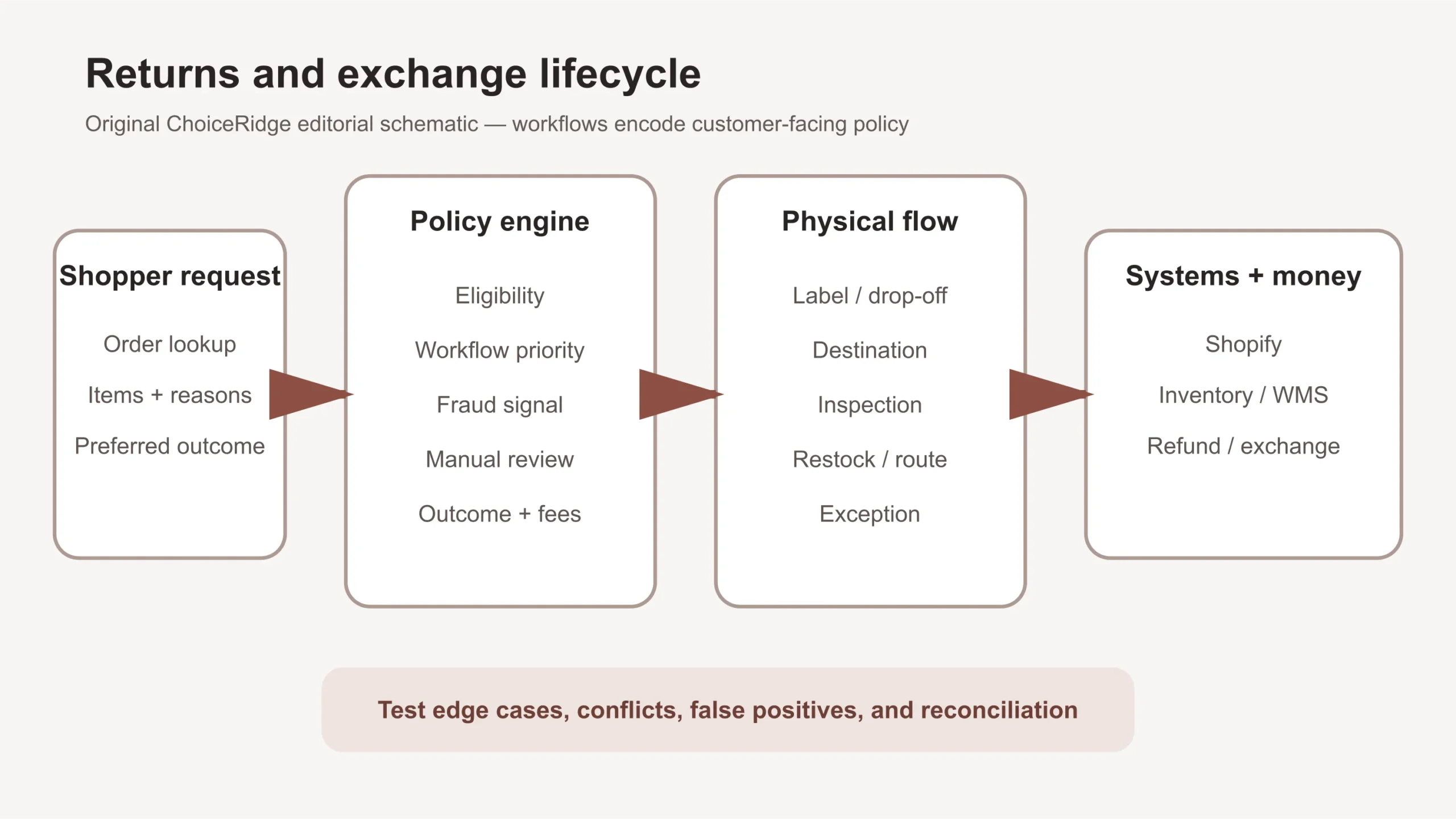
Loop Returns manages ecommerce return and exchange journeys: shopper self-service, eligibility, outcomes, labels or drop-off methods, routing, processing, fraud signals, and integrations with commerce and warehouse systems. It can improve consistency, but it also encodes policy. A flawed workflow can reject a legitimate shopper, route inventory incorrectly, or trigger a refund before inspection.
Testing and image disclosure: ChoiceRidge has not completed a hands-on Loop trial for this draft. Findings use current first-party pricing, legal, product, and help documentation checked August 31, 2026. Both images are original editorial visuals, not Loop interfaces. No Loop logo or marketing screenshot is included because the public terms do not provide an external editorial-media license.

Bottom line
Loop is a strong shortlist candidate for a Shopify merchant that has outgrown manual return handling and wants policy workflows, exchanges, routing, and fraud controls in a dedicated platform. Its value rises with return volume and exception complexity. A low-volume business with a simple refund-only policy may not recover the subscription, integration, and process costs.
Pricing and plan interpretation
Loop's public page currently lists Checkout+ as free software plus return shipping, Essential starting at $155 per month, and Advanced starting at $340 per month. Essential includes unlimited destinations, automated return policies, carrier rate shopping, and Workflows. Advanced adds features highlighted as Shop Now, Instant Exchange, Bonus Credit, and fraud prevention. The comparison also lists capabilities such as printerless and box-free returns, POS, cross-border returns, bundles, and advanced exchanges, with availability varying by plan.
“Starting at” pricing is not a full quote. Confirm annual terms, return volume, label/carrier costs, transaction or outcome fees, integrations, onboarding, support, POS locations, cross-border services, and contract increases. Loop's March 2026 service terms state that an annual increase of 6% occurs at the completion of each term unless the order form says otherwise; buyers should verify the language in their proposed contract.
Workflows and policy control
Loop Workflows sit above the regular return policy. They can use customer, order, product, and return conditions, ask questions or request photos, and apply actions. Examples include extending holiday windows, limiting outcomes, waiving fees, routing high-value returns to manual review, or sending particular products to a different destination.
Priority matters when multiple workflows qualify. Some actions stack while others do not, and the documentation warns that complex combinations can conflict. Loop recommends publishing and immediately testing representative return scenarios. A safer implementation adds draft review, named owners, test orders, change logs, and rollback instructions before production policy changes.
Exchanges, routing, and integration
Loop supports variant and advanced exchange scenarios, store credit, and plan-dependent incentives intended to retain revenue. Buyers should measure incremental retained margin, not merely exchange rate. Account for reshipment, discount, fraud, restocking, inventory reservation, and customer-support costs.
Multiple destinations can rate-shop or route returns to warehouses, donation centers, stores, outlets, resale partners, or manufacturers. Workflows can select a destination based on richer conditions. Loop also documents APIs and webhooks for sending return events to third-party systems and processing approved outcomes in Shopify.
The Shopify Returns API improves visibility of Loop returns in Shopify, but Loop notes that Shopify does not support every advanced outcome such as exchanges or store credit. Do not assume the two systems are interchangeable.
Fraud controls
Loop documents an ML-based fraud model that flags returns using device, geography, order, and customer-history signals. Workflows can route higher-risk cases to manual review or exclude certain methods. Treat a score as decision support, not proof. Measure false positives, disparate impact, appeal paths, evidence retention, and human override. Never deny a shopper solely because “AI said so” without a documented policy and review process.
Where it fits best
- Shopify merchants with meaningful return volume and multiple outcomes.
- Teams seeking consistent eligibility, fees, exchange, routing, and inspection rules.
- Operations that need data exchange among storefront, return portal, warehouse, CX, and finance.
- Brands able to measure retained margin, processing time, fraud loss, and customer effort.
Proof-of-concept checklist
- Test in-window, out-of-window, final-sale, exchange-only, gift, discounted, bundled, and international orders.
- Cover refunds, variant exchanges, store credit, advanced exchanges, and rejected outcomes.
- Test overlapping workflows and document precedence.
- Route different SKUs to warehouse, store, donation, or manual review as required.
- Verify inventory reservation and exchange-order behavior during stock changes.
- Reconcile Loop, Shopify, warehouse, payment, and finance records.
- Review fraud false positives and human override.
- Simulate carrier, webhook, and warehouse outages.
- Model subscription, return shipping, processing, reshipment, and support cost per outcome.
Pros and drawbacks
| Strengths | Drawbacks or unknowns |
|---|---|
| Dedicated returns and exchanges journey | Workflow conflicts can affect shopper eligibility |
| Flexible policy and destination rules | “Starting at” prices require a detailed quote |
| Fraud signals and manual-review options | Automated risk flags require fairness and appeal controls |
| APIs, webhooks, and Shopify visibility | Shopify does not represent every advanced Loop outcome |
Verdict
Loop Returns can turn an improvised reverse-logistics process into an auditable policy engine and shopper journey. Its fit is strongest when exchanges, multiple destinations, exception rules, and fraud review justify dedicated software. Approve it only after testing the full financial and physical lifecycle—from eligibility to warehouse inspection, inventory, payment, and reconciliation.
Use the ChoiceRidge Ecommerce Returns Management Software guide to map requirements, then quantify the change with the Software ROI Calculator.