Recharge is a subscription-commerce platform centered on recurring purchases, customer self-service, payment recovery, churn prevention, bundles, upsells, workflows, loyalty, and analytics. It is closely associated with Shopify, while its developer platform also documents hosted and API-led approaches for supported configurations.
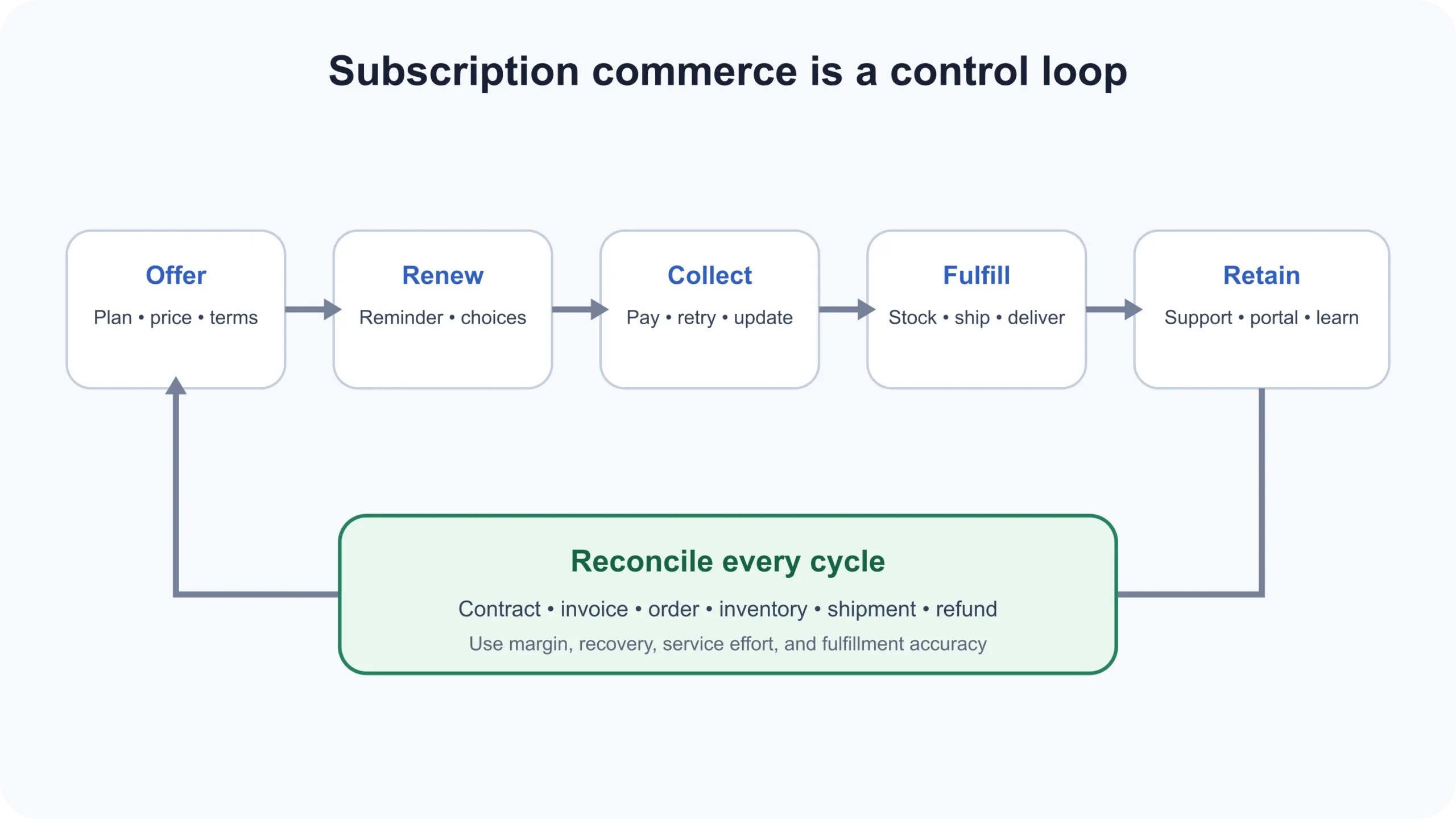
Evidence and image disclosure: ChoiceRidge has not launched or benchmarked a Recharge store for this draft. Findings use first-party pricing, documentation, and API references checked August 31, 2026. The hero and diagram are original editorial visuals. Recharge's official press room and brand guidelines were reviewed, but no product interface is included because the downloaded resource did not provide an equally clear general screenshot-use grant.

Bottom line
Recharge is a serious candidate for a growing Shopify subscription brand that wants more than recurring billing: customer portal control, cancellation prevention, dunning, bundles, product journeys, retention communications, analytics, and extensibility. It is harder to justify for a new or low-volume subscription concept that has not proved demand or economics.
The buying model must include both the monthly subscription and transaction fees. Operational value should be measured through retained contribution margin, lower support work, successful recovery, and reliable fulfillment—not platform-reported LTV claims alone.
Pricing snapshot
Recharge's public page listed these rates on the review date:
- Starter: $99/month plus 1.49% + $0.19 per processed transaction.
- Plus: $499/month plus 1.34% + $0.19 per transaction, with scalable rates; it adds implementation/migration support, bundles, Concierge SMS, loyalty, and Storefront/API tooling.
- Custom: volume-based pricing with custom implementation and priority support.
The page advertised a 60-day Starter trial. Plus and Custom use 12-month terms according to the FAQ. Concierge SMS was listed at $0.03 per US/Canada message segment and $0.06 internationally on applicable tiers. Ecommerce-platform, processor, messaging, implementation, and other application costs are additional. Recheck rates and contract terms before publication.
What Recharge covers
Starter includes a subscription widget, customer portal, cancellation prevention, failed-payment recovery, win-backs, workflows, gifting, analytics, upsell/cross-sell, and permissions. Plus adds features such as customizable bundles, loyalty, implementation support, and storefront-development options.
The API can expose subscriptions, customers, charges, orders, addresses, and related operations. A custom portal can let customers change dates and frequency, skip or unskip shipments, swap products, add a one-time item, cancel, and manage payment/address information. Recharge recommends middleware because API keys must remain server-side and its API does not support direct browser CORS for this pattern.
Where it fits best
- Shopify brands with meaningful recurring revenue and retention operations.
- Consumables, replenishment, curated boxes, memberships, or product journeys.
- Teams that need customer self-service to reduce support workload.
- Businesses prepared to coordinate subscription, storefront, payment, inventory, fulfillment, and messaging data.
- Developer-led brands needing portal, bundle, or headless customization on the appropriate tier.
Material risks
Transaction fees compound
A percentage fee scales with processed volume. Model gross transaction value, refunds, failed payments, one-time add-ons, discounts, tax, processor fees, and the definition of a billable processed transaction in the contract.
Subscription state crosses systems
Editing an ecommerce order may not change the underlying subscription contract. Shopify explicitly distinguishes an order from future contract behavior. Define the system of record and reconcile contract, billing attempt, order, inventory reservation, fulfillment, refund, and customer communication.
Dunning is not guaranteed revenue
Recharge markets smart retries and payment-update messages, but recovery performance depends on decline reason, payment method, timing, customer intent, and region. Measure net recovered margin and complaints; do not treat a provider headline as your expected result.
Cancellation prevention can become dark UX
Offers and branching should help customers find a suitable pause, skip, frequency change, or cancellation path. Review for clarity, accessibility, legal requirements, and support escalation. A difficult cancellation path can damage trust.
Inventory and fulfillment complexity
Prepaid and pay-per-delivery subscriptions create different order and fulfillment timelines. Test stockouts, substitutions, split locations, skipped dates, address changes, cutoff times, and refunds.
Proof-of-concept checklist
- Create pay-per-delivery and prepaid plans with synthetic customers.
- Test subscription purchase, tax, shipping, discount, and first order.
- Skip, pause, resume, swap, change frequency, update payment, and cancel in the portal.
- Trigger a failed payment and verify retry, notification, recovery, and terminal states.
- Create a stockout before renewal and trace every system.
- Compare current and future order edits with the subscription contract.
- Test API scopes, webhooks, duplicates, idempotency, and replay.
- Export subscriptions, charges, orders, customers, cancellations, and history.
- Calculate cost at current, growth, and peak scenarios.
Questions buyers often ask
Is Recharge a payment processor?
Recharge coordinates subscription commerce, while the selected commerce and payment configuration handles payment processing. Its fees are additional to ecommerce-platform, processor, messaging, and other application costs.
Is the Starter plan enough?
Starter includes substantial subscription, portal, recovery, retention, and analytics functionality. Plus becomes relevant when bundles, loyalty, implementation/migration support, Concierge SMS, and storefront-development features matter. Validate the current comparison table because packaging changes.
Can a merchant build a custom portal?
Yes, on configurations with the required API or SDK access. Recharge documents a middleware architecture so secrets remain server-side. A custom portal should be justified by customer need because it creates security, accessibility, testing, and maintenance work.
Verdict
Recharge offers a broad retention and subscription operating layer for Shopify-centric brands, with meaningful self-service and extensibility. Its value increases with recurring volume and operational sophistication; so do its fees and integration responsibilities. Shortlist it after proving product-market fit, and judge it through complete renewal-to-fulfillment scenarios rather than only subscription-widget setup.
Continue with the Subscription Ecommerce Operations Guide, Failed Payment Recovery Guide, and existing Loop Returns review.