Gorgias and Zendesk can both centralize customer conversations, but they start from different operating assumptions. Gorgias is designed around ecommerce context and store actions. Zendesk is a broader service platform with omnichannel routing, telephony, knowledge, workflow tools, and enterprise controls.
Evidence disclosure: ChoiceRidge has not completed a controlled head-to-head implementation for this draft. The comparison is based on first-party pricing, product, and help documentation checked August 31, 2026. The visuals are original editorial illustrations and do not reproduce either interface.

Short answer
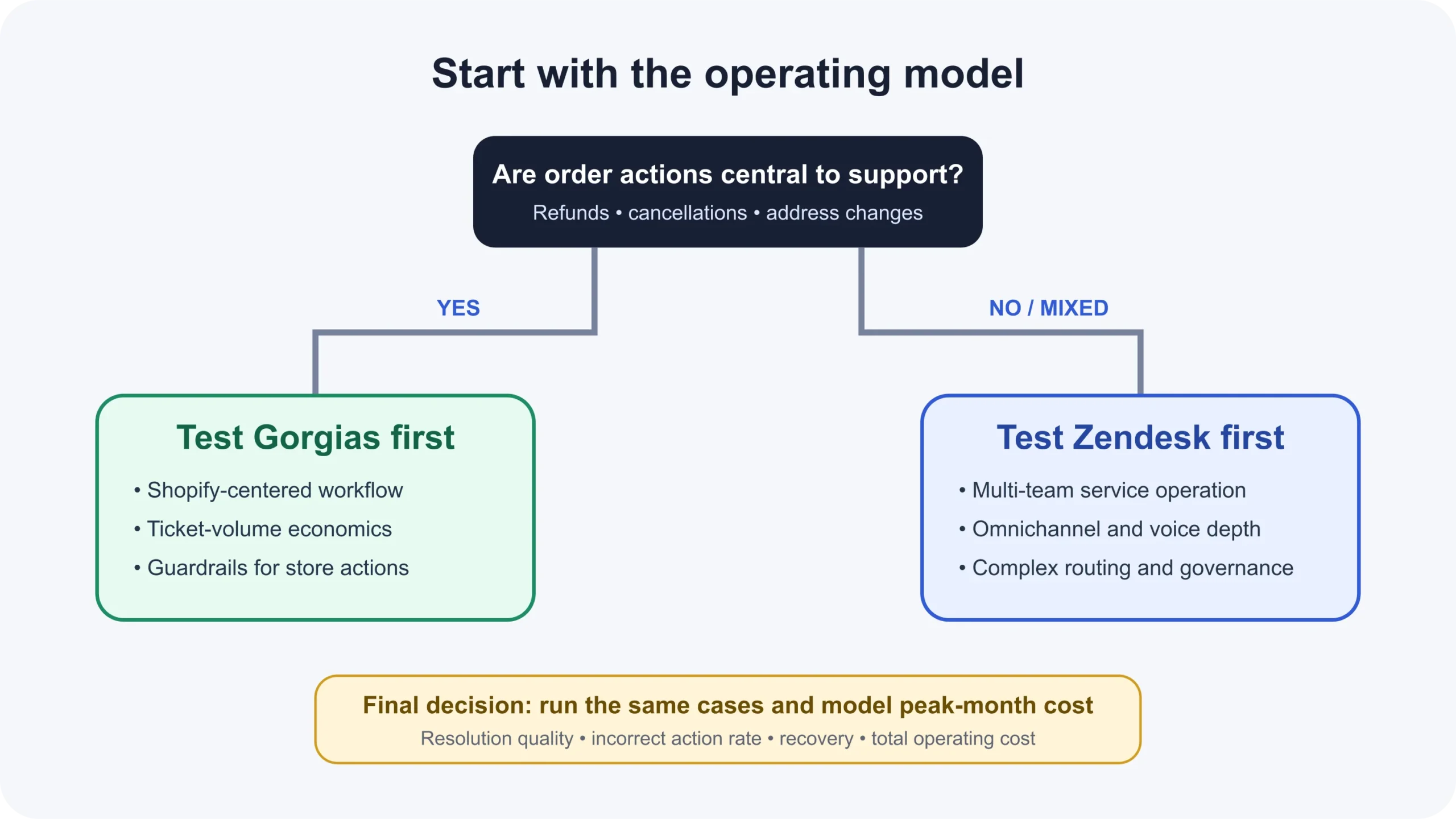
Choose Gorgias when Shopify order questions dominate the queue, agents frequently need to refund, cancel, duplicate, or edit orders, and ticket-volume pricing fits the staffing model. Choose Zendesk when support spans products, departments, regions, voice operations, complex routing, or non-commerce cases and the organization can justify per-agent pricing.
Neither is automatically cheaper. Gorgias prices the helpdesk around ticket volume and separately charges for AI-resolved conversations; Zendesk publishes annual per-agent prices and sells additional capabilities at higher tiers or as add-ons. Model the workload, not just the headcount.
Core differences
| Requirement | Gorgias | Zendesk |
|---|---|---|
| Primary design center | Ecommerce customer support | Broad customer and employee service |
| Commercial unit | Helpdesk ticket volume; AI resolution usage | Per agent, with plan and add-on differences |
| Shopify order work | Native order context and supported store actions | Usually requires app and workflow design |
| Omnichannel breadth | Ecommerce-focused channels and add-ons | Mature messaging, email, voice, routing, and knowledge stack |
| Cross-platform consistency | Automation support varies by commerce platform | Broader platform-neutral case model |
| Enterprise operations | Validate exact roles, audit, and scale needs | Stronger fit for complex routing and multi-team governance |
Ecommerce workflow depth
Gorgias documents Shopify order history beside the ticket and actions such as refunds, cancellations, duplication, and shipping-address edits. Rules, macros, and AI Agent actions can combine routing, responses, and actions in connected applications. This can reduce context switching for repetitive “where is my order?” and order-change work.
That advantage is not uniform across storefronts. Gorgias' compatibility table says Shopify supports AI Agent, Flows, and Order Management, while the listed support for BigCommerce, Magento, WooCommerce, and PrestaShop is more limited. A multi-platform merchant should test each storefront independently.
Zendesk is less commerce-specific out of the box, but its Suite packages combine ticketing, messaging, help center, voice options, routing, and workflow building. This is useful when an ecommerce queue is only one part of a larger service operation. The trade-off is implementation: order actions may require marketplace apps, custom objects, API work, or an external automation layer.
Routing, channels, and knowledge
Zendesk's omnichannel routing can assign email, messaging, and calls according to agent availability and capacity, with skills, priority, and SLA-related controls depending on plan. That matters for contact centers balancing several queues or service levels.
Gorgias is usually easier to explain to an ecommerce team: order context, customer conversation, macros, and commerce actions live close together. Buyers should still test social channel limitations, voice/SMS costs, business-hours behavior, duplicate contacts, multilingual knowledge, and what happens when a connected store is unavailable.
AI and automation: count the resolved work
The meaningful unit is not the number of AI features. Measure safe resolution of complete intents.
For Gorgias, test whether AI can identify the right order, respect fulfillment state, request confirmation, make an allowed change, and record evidence. For Zendesk, test intent recognition, knowledge grounding, routing, handoff, Action Builder workflows, and whether agents can understand why a decision was made.
Use a risk ladder:
- Draft a reply for agent review.
- Answer from approved knowledge.
- Retrieve order status.
- Change reversible preferences.
- Route refunds or cancellations for approval.
- Permit tightly bounded autonomous actions only after measured success.
Pricing interpretation
Zendesk's public pricing page showed Support Team at $19 per agent/month billed annually, Suite Team at $55, and Suite Professional at $115 when checked. Enterprise and Copilot configurations require broader evaluation. Reconfirm currency, billing term, minimums, add-ons, telephony, implementation, sandbox, storage, and AI usage before publication.
Gorgias' accessible pricing copy described helpdesk capacity from 50 to 5,000 monthly tickets, no per-agent charge, AI Agent billed per resolved conversation, and usage-based voice/SMS add-ons. The stable price table was not available in the retrieved text, so this draft does not quote incomplete numbers.
Build three cost scenarios: normal month, peak month, and automation-heavy month. Include agents, tickets, AI resolutions, messaging/voice, implementation, apps, data migration, training, and ongoing administration.
Security and governance questions
- Which roles can change routing, macros, AI behavior, store connections, and irreversible actions?
- Are audit events detailed enough to reconstruct a refund, cancellation, or disclosure?
- What SSO, provisioning, data residency, retention, deletion, and export controls exist on the proposed tier?
- How are knowledge sources approved and expired?
- What happens to service during a Shopify, carrier, integration, or model outage?
- Can the organization restrict AI by intent, value, customer, country, and channel?
A practical proof of concept
Use anonymized or synthetic orders and score both tools on the same 25–40 cases:
- Resolve a normal order-status request.
- Block an address edit after fulfillment.
- Escalate a refund above a monetary threshold.
- Merge duplicate identities without exposing another customer's data.
- Route a priority customer while preserving fairness and SLA rules.
- Handle a failed commerce integration with a safe fallback.
- Measure first-contact resolution, handle time, reopen rate, incorrect action rate, and agent correction time.
- Export tickets, users, fields, tags, attachments, knowledge, and audit history.
- Recalculate the total cost from observed volume.
Verdict
Gorgias is the more direct fit for a Shopify-led merchant whose service team spends much of its day acting on orders. Zendesk is the stronger architectural candidate for a diversified service operation that needs broad omnichannel management and enterprise workflow depth. The correct choice depends on the proportion of commerce-native work, cross-platform requirements, governance burden, and the cost model under peak demand.
Read the full Gorgias review, Zendesk review, and Ecommerce Helpdesk Software Requirements before scoring the shortlist.