Klaviyo and Omnisend both turn commerce and customer behavior into segments, campaigns, and automated journeys. The meaningful difference is scope. Omnisend presents a focused ecommerce marketing workspace. Klaviyo increasingly positions itself as a broader B2C CRM spanning marketing, service, analytics, and customer data.
Evidence disclosure: ChoiceRidge has not completed a controlled migration or production benchmark for this draft. Pricing and feature statements use first-party sources checked August 31, 2026. The hero and decision map are original. The Omnisend screenshot is a provider-supplied press-kit asset; no Klaviyo interface is reproduced because equally clear reuse permission was not established.

Short answer
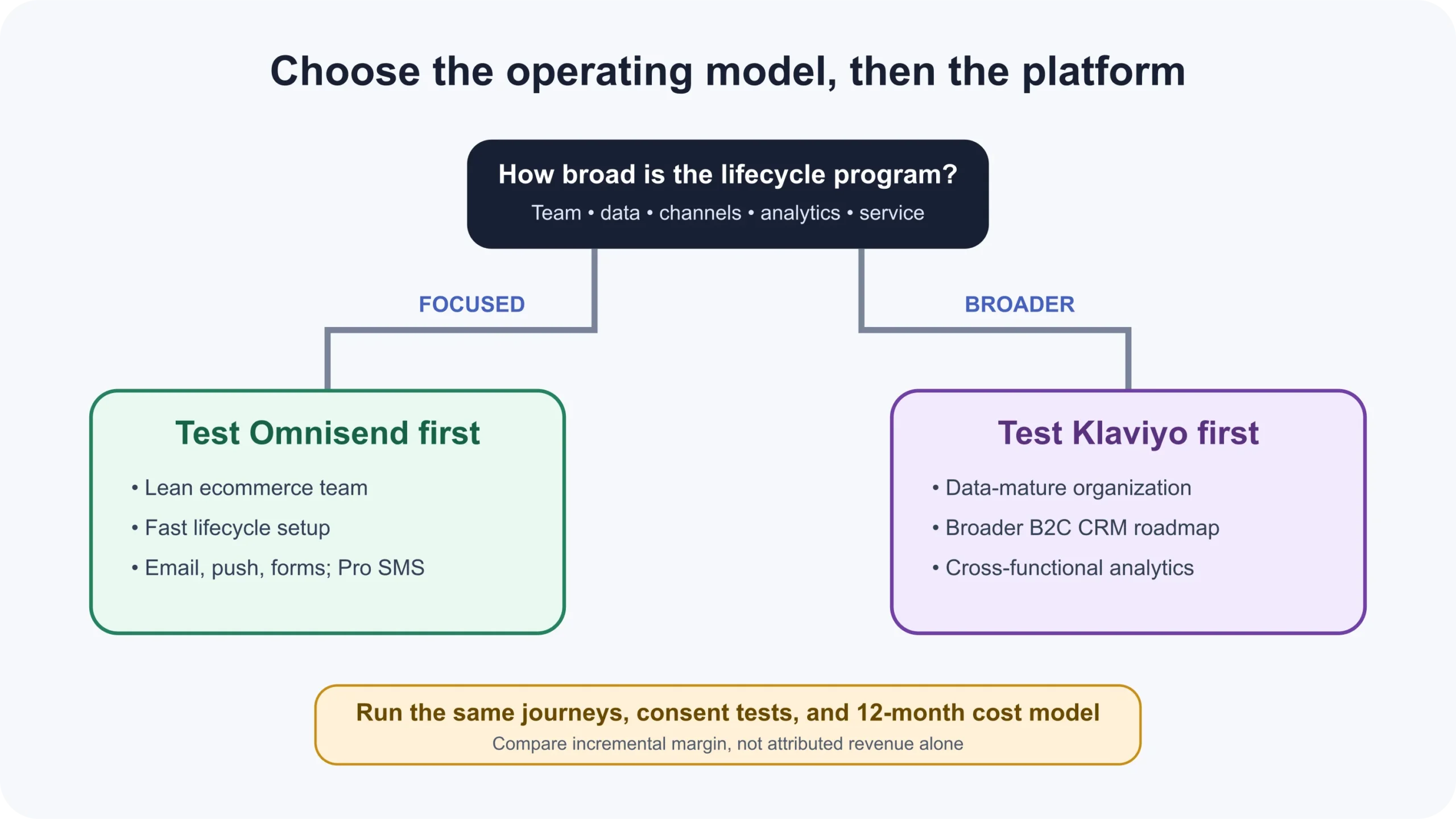
Choose Omnisend first when a lean ecommerce team values fast lifecycle setup, an accessible free tier, and consolidated email/push/form automation with a Pro path to SMS. Choose Klaviyo first when a business needs deeper event and profile architecture, a larger B2C CRM roadmap, extensive segmentation, analytics, and cross-functional use—and has the operations to govern it.
The smaller invoice is not necessarily the lower total cost. Include active or billable profiles, sends, SMS destination and segments, data engineering, migration, creative production, deliverability, support, and ongoing administration.
Core differences
| Decision area | Omnisend | Klaviyo |
|---|---|---|
| Design center | Ecommerce marketing automation | Broader B2C CRM and customer-data ecosystem |
| Public free tier | 250 recipients, 500 emails/month | 250 active profiles, 500 emails/month |
| Audience cost concept | Billable contacts; price adjusts with count | Active profiles for email, plus channel/product choices |
| SMS | Current new accounts require Pro and separate volume pricing | Mobile-message pricing varies by channel and destination |
| Best organizational fit | Lean commerce marketing team | More data-intensive, cross-functional lifecycle operation |
| Main risk | Contact growth and plan/channel constraints | Profile growth, complexity, attribution, and broader stack cost |
Automation and segmentation
Both platforms support behavioral automation and dynamic audience logic. Omnisend emphasizes prebuilt commerce journeys and one builder for email, SMS, and push. Klaviyo supports list, segment, metric/event, date, price-drop, and other flow triggers, with filters rechecked before send.
The deciding test is event fidelity. Send placed, canceled, refunded, fulfilled, product-view, stock, subscription, and consent changes through both candidates. Compare latency, duplicates, properties, identity merging, and whether a changed customer remains eligible at send time.
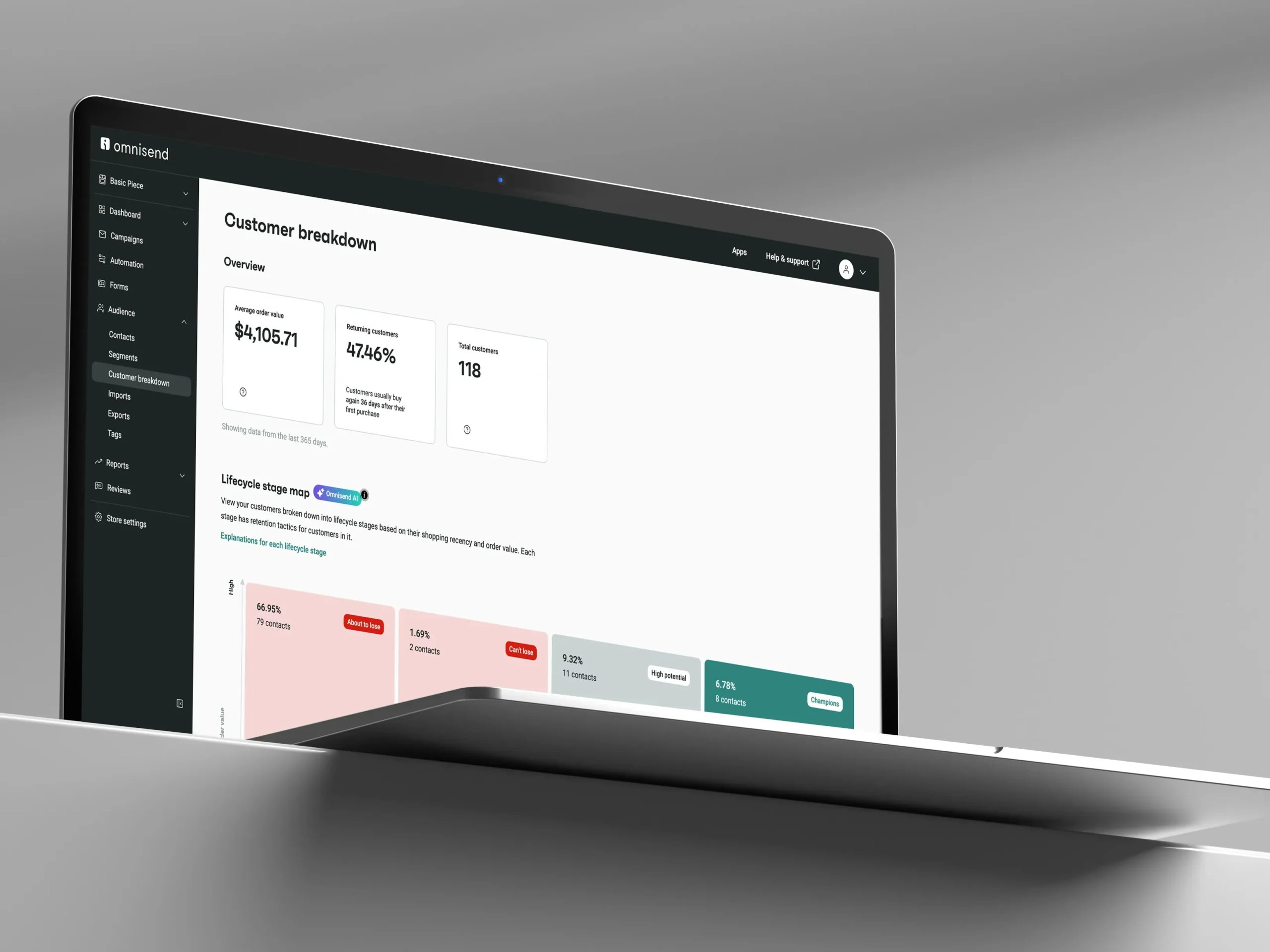
Official Omnisend app visual, downloaded August 31, 2026. It illustrates provider-presented lifecycle analysis and is not a ChoiceRidge test result.
Pricing interpretation
Omnisend lists Standard from $16 and Pro from $59, while its free tier permits 500 emails to up to 250 unique contacts. Standard email allowance is twelve times billable contacts; Pro offers unlimited email and push. For accounts started on or after May 4, 2026, SMS is a separately priced Pro capability.
Klaviyo's free tier supports up to 250 active profiles and 500 monthly emails, plus a small mobile-message allowance. Paid pricing is calculator-driven by active profiles, sends, channels, and selected products. Its help center says suppression can take up to 72 hours and plans do not automatically downgrade when the profile count falls.
Calculate cost using the same audience policy. A “contact” or “profile” can be counted differently, so export and classify real records as marketable, suppressed, service-only, unsubscribed, duplicate, dormant, or legally retained.
Consent, deliverability, and measurement
Neither platform removes the merchant's responsibility for permission. Email permission does not imply SMS permission. Verify source, timestamp, disclosure version, jurisdiction, proof, quiet hours, opt-out, and deletion behavior.
Compare domain authentication, warmup guidance, bounce and complaint visibility, suppression controls, and whether support can diagnose inbox problems. Run a seed test but judge success with provider-independent signals where possible.
Both products report attributed revenue. Attribution supports workflow management but does not establish causal lift. Require holdouts or controlled experiments, and calculate contribution margin after discounts, returns, message cost, and creative effort.
Migration test
Do not migrate only contacts and templates. Map:
- profile identifiers, properties, and suppression state;
- consent source, timestamp, and channel;
- events and historic backfill;
- flows, delays, branches, and exclusions;
- UTM rules and attribution windows;
- coupons, product recommendations, forms, and reviews;
- dashboards, exports, and data-warehouse feeds.
Run both tools in a limited, non-overlapping validation period so customers do not receive duplicate messages.
Proof-of-concept scorecard
- Build the same four lifecycle journeys.
- Reconcile customer and order totals with the store.
- Test channel-specific consent and suppression latency.
- Measure journey build time and reviewer clarity.
- Validate mobile pricing for actual countries and message segments.
- Run an incremental-lift test with a holdout.
- Export the data required for exit.
- Forecast cost after 12 months of audience growth.
Questions buyers often ask
Is Omnisend automatically cheaper than Klaviyo?
Not for every audience. Published entry prices favor simple comparison, but the final bill depends on each platform's profile/contact definition, email volume, mobile destinations, selected products, and list hygiene. Apply both calculators to the same classified export.
Which is easier to operate?
Omnisend's narrower ecommerce orientation may reduce setup choices for a lean team. Klaviyo's broader data and product scope may be valuable to a more mature organization. Ease should be measured through build, review, troubleshooting, and reporting tasks—not a demo walkthrough.
Can the two platforms run in parallel during migration?
Yes, but only with non-overlapping audiences or journeys and explicit suppression. Duplicate welcome, abandonment, or post-purchase messages can damage customer trust and invalidate measurement.
Verdict
Omnisend is the more focused candidate for a lean ecommerce team seeking an approachable automation stack. Klaviyo is the stronger candidate for a data-mature business that wants broader B2C CRM capabilities and can absorb additional operating complexity. Decide with clean audience definitions and real journey evidence, not vendor ROI claims or feature-count tables.
Read the full Klaviyo review, Omnisend review, and Lifecycle Marketing Automation Guide.